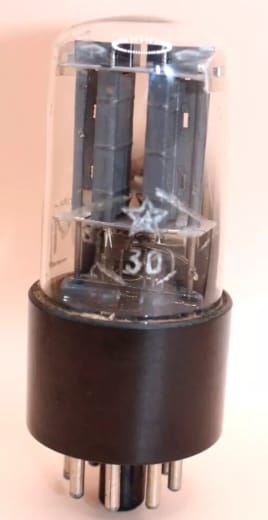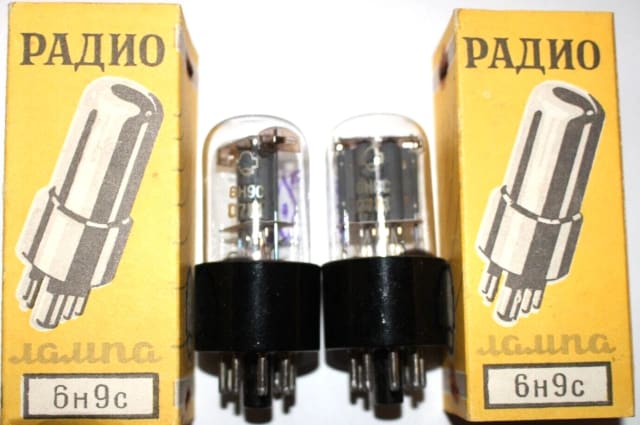

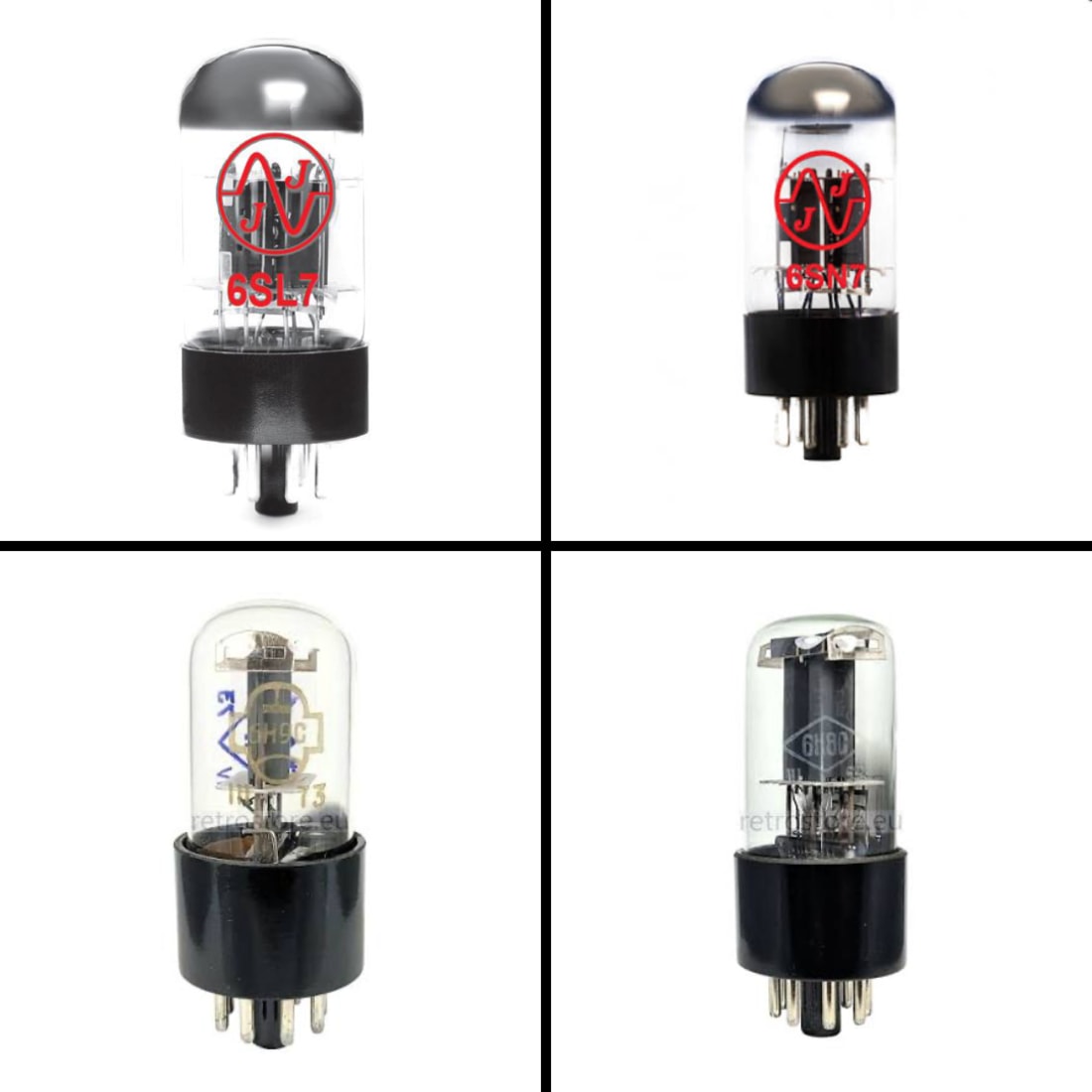
The 6N8S (6Н8С, often typed 6H8C) is a real 6SN7 equivalent: same octal base and pinout, same 6.3 V heater, and a typical operating point that matches the American sheet digit for digit. The 6N9S (6Н9С / 6H9C) does the same job for the 6SL7. Each has exactly one maximum rating that comes out lower than its American counterpart, and that is the whole of the fine print.
The swap that does cause trouble is between the two Soviet tubes. A 6N8S cannot replace a 6N9S, and a 6N9S cannot replace a 6N8S. They share the octal socket and look like siblings, but the 6N8S has a gain of 20 and the 6N9S a gain of 70. Nothing smokes when they get mixed up — the stage simply lands at the wrong gain and the wrong bias, and people spend a long time wondering why the amp sounds wrong.
Why the same tube has two names
Soviet type numbers are Cyrillic. In 6Н8С, the 6 is the heater voltage, Н marks a double triode, С a glass octal envelope. The Н transliterates to N and the С to S, but both letters look like Latin H and C, so the same tube gets listed as 6N8S and as 6H8C. Same glass, same tube. The 1578 and 1579 numbers in listing titles are special-quality MELZ versions of the same two types — they matter to collectors and to price, not to the electrical family.
6N8S vs 6SN7
The Sylvania 6SN7GT sheet (1955) and the Soviet 6N8S handbook both publish typical figures at 250 V plate and −8 V grid, so the columns line up directly:
| Parameter (per section) | 6SN7GT (Sylvania) | 6N8S (Soviet handbook) |
|---|---|---|
| Heater | 6.3 V / 600 mA | 6.3 V / 600±50 mA |
| Plate current at 250 V / −8 V | 9.0 mA | 9±3.5 mA |
| Transconductance | 2.6 mA/V | 2.6±0.53 mA/V |
| Amplification factor | 20 | 20.5±2.5 |
| Plate resistance | 7,700 Ω | 7,700 Ω |
| Max plate voltage | 300 V | 330 V |
| Max plate dissipation | 3.5 W per plate | 2.75 W per plate |
The Soviet column is the American column, down to the 7,700 ohms — the 6N8S was copied from the 6SN7, and the handbook numbers came across with it.
One figure genuinely differs: plate dissipation, 2.75 W against Sylvania’s 3.5 W. In a preamp or phase-inverter seat, where the tube idles at a watt or less, this never comes up. In OTL output stages and hard-working cathode followers it does, so bias to the 6N8S sheet rather than to American numbers. If the amp was designed around a later 6SN7GTA or GTB — 5 W per plate, 450 V — the gap is wider still, and that is exactly the case where the Soviet tube needs derating.
Schiit’s Freya manual lists the 6SN7 and the Russian 6N8S side by side as accepted types, which is about as plain as manufacturer confirmation gets.
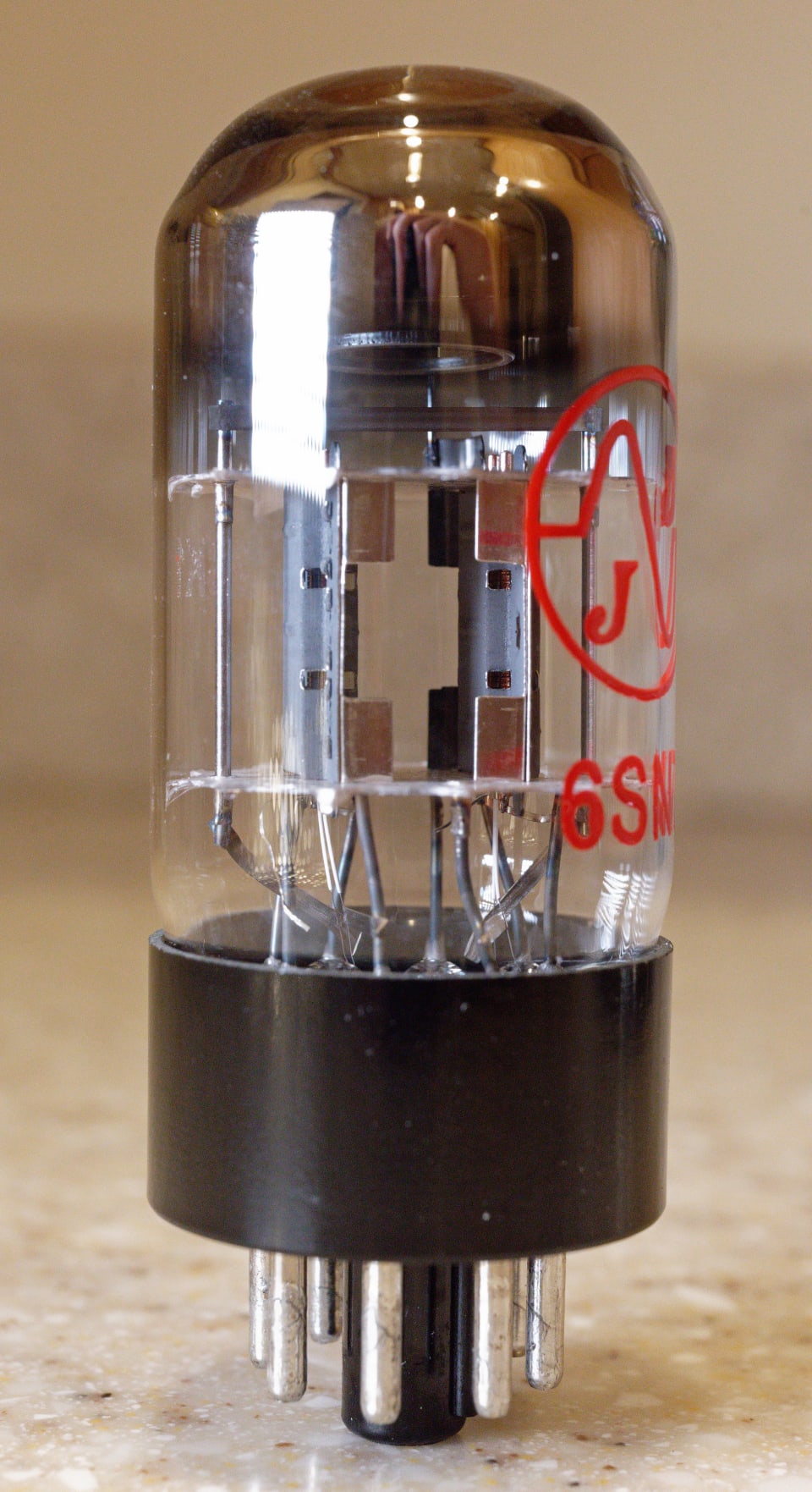
An American 6SN7. Photo: Jud McCranie, Wikimedia Commons, CC BY-SA 4.0.
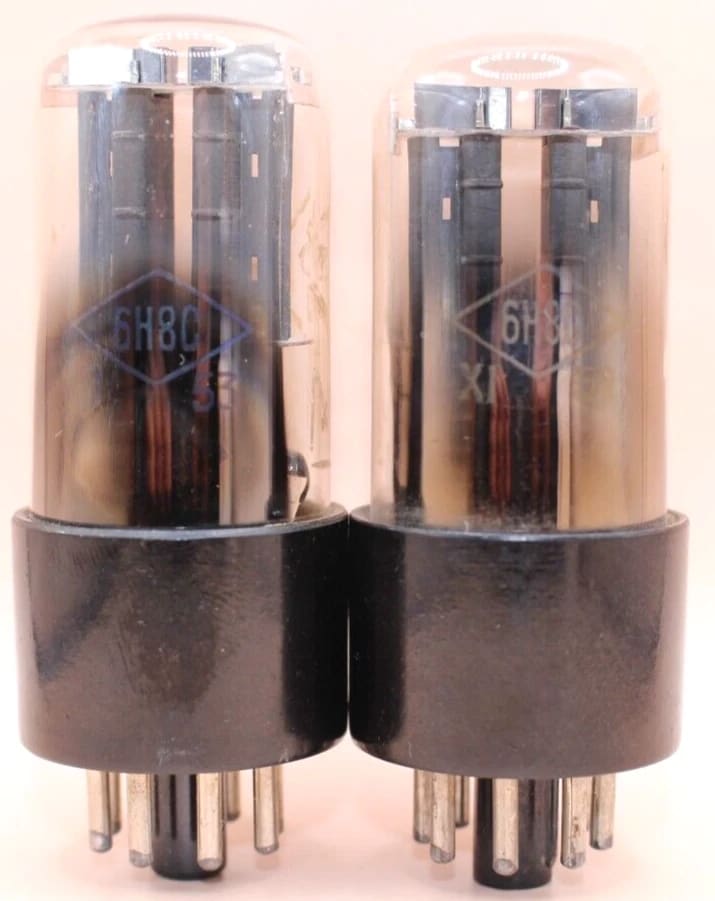
A 1950s Foton 6N8S with ribbed anodes — same electrical family, distinctly earlier construction.
6N9S vs 6SL7
Same exercise with the RCA 6SL7-GT sheet (1954) and the 6N9S handbook, at their shared typical point of 250 V / −2 V:
| Parameter (per section) | 6SL7-GT (RCA) | 6N9S (Soviet handbook) |
|---|---|---|
| Heater | 6.3 V / 300 mA | 6.3 V / 300±25 mA |
| Plate current at 250 V / −2 V | 2.3 mA | 2.3±0.9 mA |
| Transconductance | 1.6 mA/V | 1.6±0.4 mA/V |
| Amplification factor | 70 | 70±15 |
| Plate resistance | 44,000 Ω | 44,000 Ω |
| Max plate voltage | 300 V | 275 V |
| Max plate dissipation | 1.0 W | 1.1 W |
Another verbatim match at the operating point, and again a single number to check: maximum plate voltage, 275 V against RCA’s 300 V. Most 6SL7 stages sit well below either figure, but gear that runs the plate supply close to 300 V exists, so read the schematic before ordering.
Heater-cathode limits also differ in the small print — the 6N8S allows 100 V where Sylvania allows 200 V with the heater negative, and the 6N9S allows 100 V against RCA’s 90 V. Only elevated-heater and stacked-stage topologies get anywhere near those numbers, but those are the designs where it is worth checking.
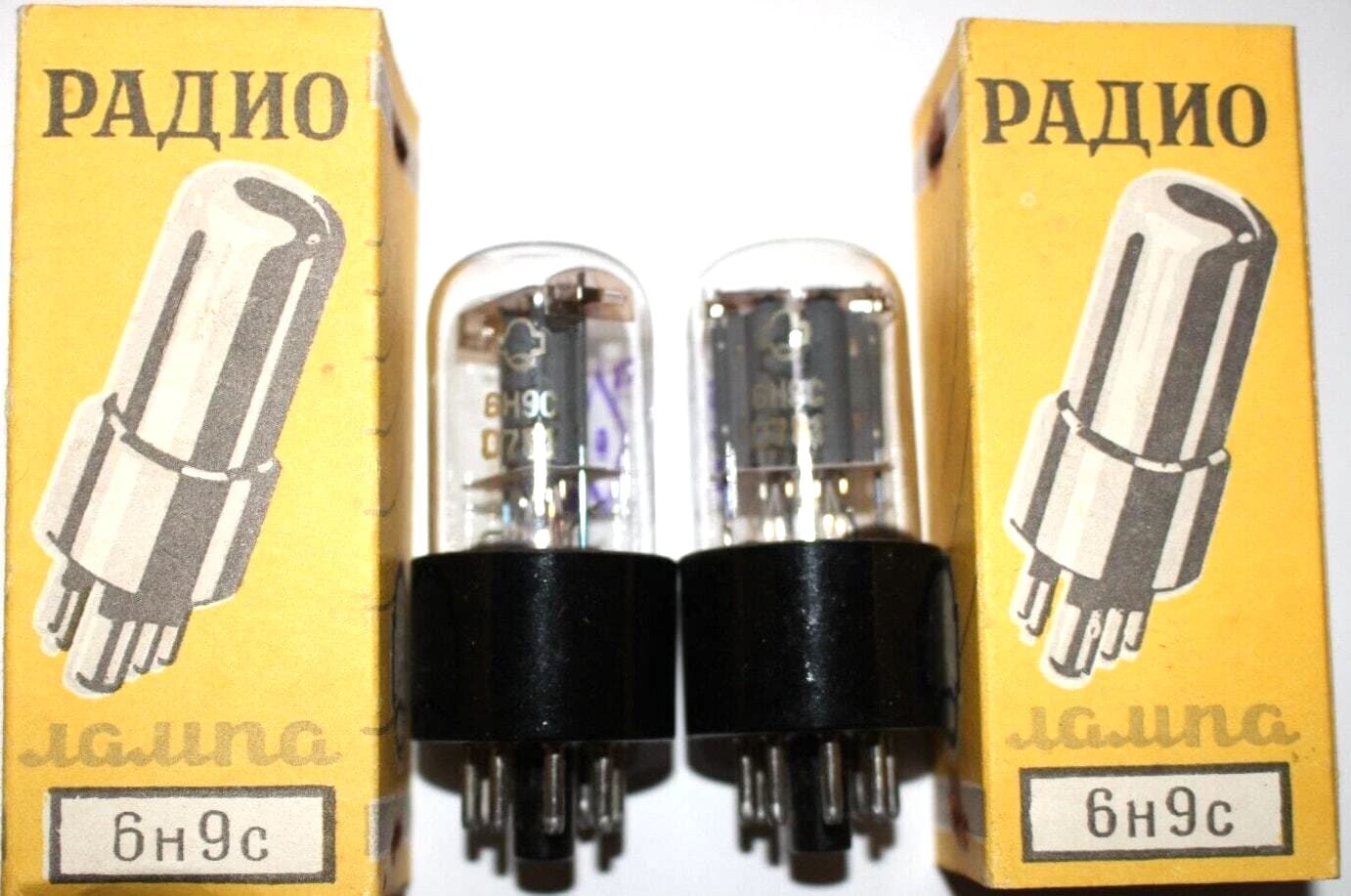
A same-date 6N9S set with OTK stamps and original boxes.
Can a 6N8S replace a 6N9S?
No. They are not substitutes for each other in either direction, and the shared octal socket makes that mistake effortless. Two electrical opposites in the same bottle:
- 6N8S / 6SN7 — gain 20, 2.6 mA/V, plate resistance 7.7 kΩ, heater 600 mA. A medium-mu driver that likes current.
- 6N9S / 6SL7 — gain 70, 1.6 mA/V, plate resistance 44 kΩ, heater 300 mA. A high-mu voltage amplifier running at a couple of milliamps.
A 6N9S in a 6SN7 seat gives triple the gain at a bias point calculated for something else; the reverse loses most of the stage’s gain. The heater draw differs too — 300 mA against 600 mA — so a swap in either direction also changes the load on the heater supply. Some amps genuinely accept both, by design or with a switch, and their manuals say so; if the manual does not say so, treat the two as different tubes.
ECC32, 5692 and CV181 in listing titles
Those are search aliases, not equivalents — including in our own titles, because that is what buyers type. The British ECC32 is a different tube with its own heater draw and gain, and premium American variants such as the red-base 5692 carry deliberately reduced maximum ratings despite the family name. Same rule as in the 6N23P vs 6N1P post: treat a title alias as a search hint and pull the actual datasheet before substituting.
One alias that is real, from the Soviet handbooks themselves: they name the noval 6N1P as the interchangeable replacement for the 6N8S, and the noval 6N2P for the 6N9S. The octal-to-noval bridge was designed in pairs.
Before you swap
- Replacing a 6SN7: any healthy 6N8S fits. Use a tested matched pair for phase inverters and balanced stages, and bias to the 2.75 W plate rating in hot-running circuits.
- Replacing a 6SL7: the 6N9S fits, provided the plate supply stays under 275 V.
- The handbook guarantees only ≥500 hours for both types. That is an acceptance minimum, not a life expectancy — good examples last many times longer, and a measurement on the actual tube tells you more than any rating. What “tested on an L3-3” covers explains what our test numbers mean.
- Dates, OTK stamps and factory logos decode per the Soviet markings guide.
Bottom line
The 6N8S is a 6SN7 with a lower plate-dissipation rating, and the 6N9S is a 6SL7 with a lower plate-voltage rating. Both match their American counterparts’ published operating points to the last digit. Metal bases, ribbed anodes and factory reputations move prices, but that is collector taste, not equivalence. What you cannot do is use one Soviet tube in place of the other: 6N8S and 6N9S are not interchangeable in either direction.
Thank you for reading!
References used:
- 6N8S datasheet, 6N9S datasheet (Soviet handbook scans; MELZ variants: metal base, black base)
- Sylvania 6SN7GT / 12SN7GT engineering data, 1955 (PDF)
- RCA 6SL7-GT data, 1954 (PDF)
- Schiit Freya manual — accepts 6SN7/6N8S family (PDF)