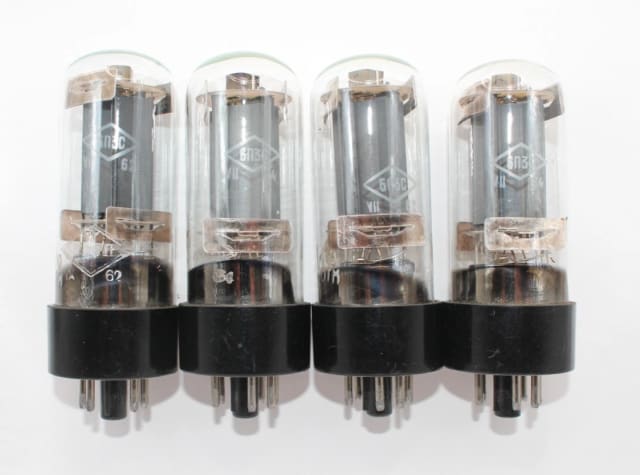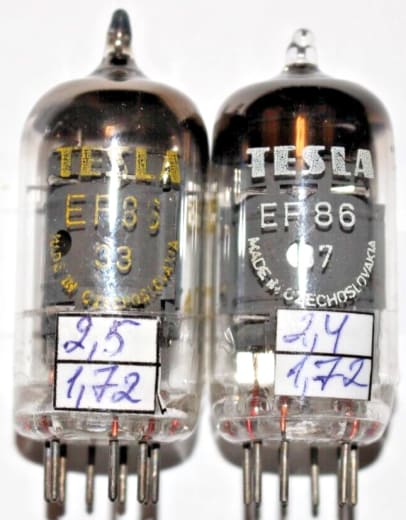

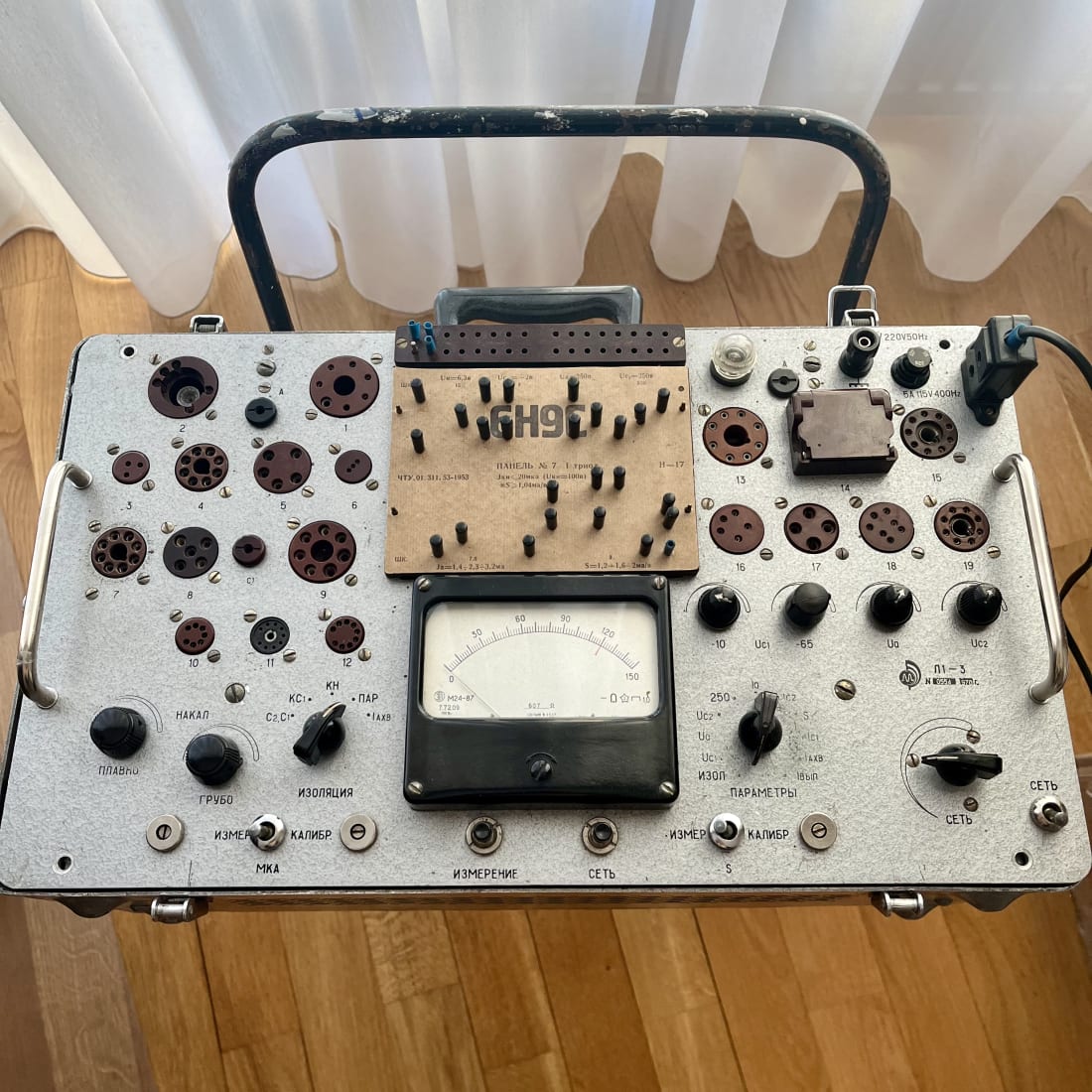
Almost every tube in this shop carries the same line in its listing: tested on L3-3. Usually that means a paper label is attached to the tube with its measured values written on it by hand. Those numbers are an important part of the listing, so we’d like to explain where they come from, and what makes the L3-3 special.
The short version: the L3-3 (Л3-3) is a Soviet tube tester built around flexibility. One instrument handles hundreds of different tube types and reads a whole set of real parameters on each (transconductance, anode and screen current, reverse grid current, leakage) against the operating point printed in that tube’s own datasheet, and even more with modifications and adapters. And it does all of that from one self-contained box: the supplies, transformers, signal source, and meters that a tube test would normally take a whole workbench to assemble. When a tube here shows handwritten numbers on its label, those numbers came from this instrument.
What the L3-3 actually is
The full Soviet name is измеритель параметров электронных ламп, “electron tube parameter meter.” It was built to measure and control the real parameters of receiving and amplifying tubes (anode dissipation up to 25 W), low-power generator tubes, kenotrons (rectifiers), diodes, and gas-discharge stabilizers. It can even plot static characteristics, which is real lab work.
You found these in warehouses, repair shops, laboratories, and on production lines. One detail from the manual shows who it was built for: besides 127/220 V 50 Hz mains, it runs on 115 V at 400 Hz, the power standard of Soviet aviation and shipboard equipment. This was a service instrument for places where a failed tube was a real problem.
It is also a serious lump of hardware: roughly 515 × 320 × 230 mm and up to 22 kg. The weight is the interesting part, because of what is inside.
Testing a tube properly is not one reading off one meter. It means recreating the tube’s entire datasheet operating point at the same time: a regulated heater supply, a stabilized high-voltage anode supply, a separate screen-grid supply, an adjustable negative grid-bias supply, an AC signal source for the transconductance measurement, and an accurate meter for each of them. On a bench, that is a pile of separate equipment: a couple of transformers, several regulated power supplies, a signal generator, bias supplies, load resistors, and meters, all wired up by hand, then re-wired for the next type of tube.
The L3-3 folds every bit of that into one calibrated case, and the card set reconfigures the whole arrangement for hundreds of different tube types. That is the real point of it: not that it is big, but that it is a complete tube-measuring bench in a single box. It is complicated for exactly the reason it is useful.
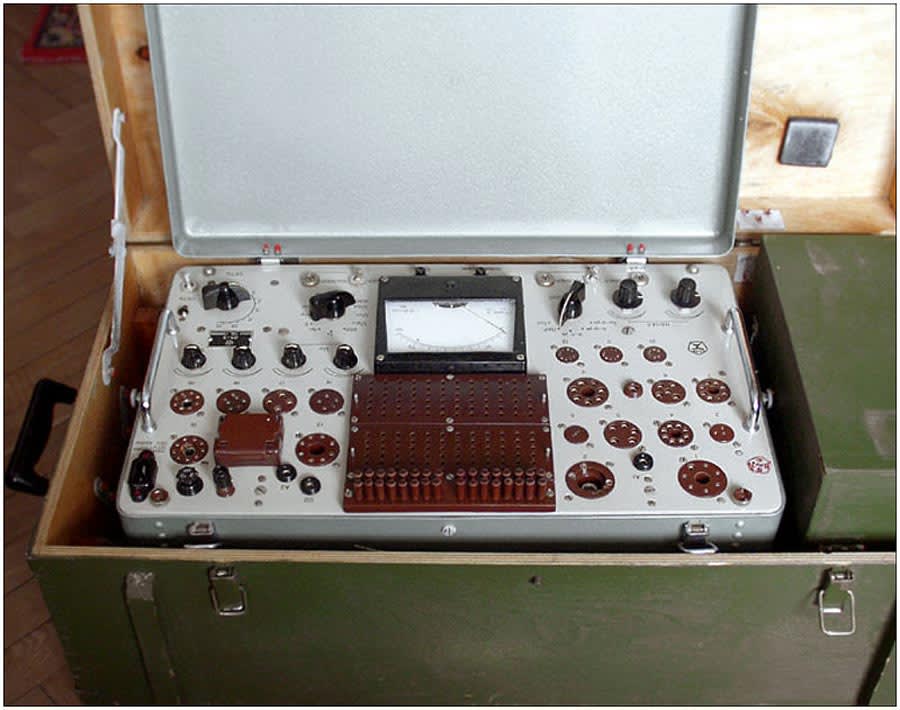
The L3-3 in its field case: around 22 kg of meters, transformers, and regulated supplies. Photo: rw6ase museum of Soviet radio equipment.
What’s inside
The L3-3 is the modernized version of the earlier L1-3, which started life in the late 1950s as the MILU-1. Over its production run (which lasted into the late 1980s) the rectifier tubes and gas voltage-stabilizer tubes were gradually swapped for semiconductors. But it never stopped being, at heart, a tube instrument.
Open it up and the bench-in-a-box becomes literal. Everything runs from one large multi-winding power transformer, feeding four rectifiers and five separate, electronically regulated supplies. And the measuring section has a nice irony to it: this tube tester is itself built from around a dozen vacuum tubes. Pentodes (6P1P) sit in the regulators that hold each supply steady; a tuned 6Zh3P / 6N3P selective amplifier reads the transconductance; and a 6N3P triode generates the 1400 Hz signal the whole measurement rides on. A machine for testing tubes, run by tubes.
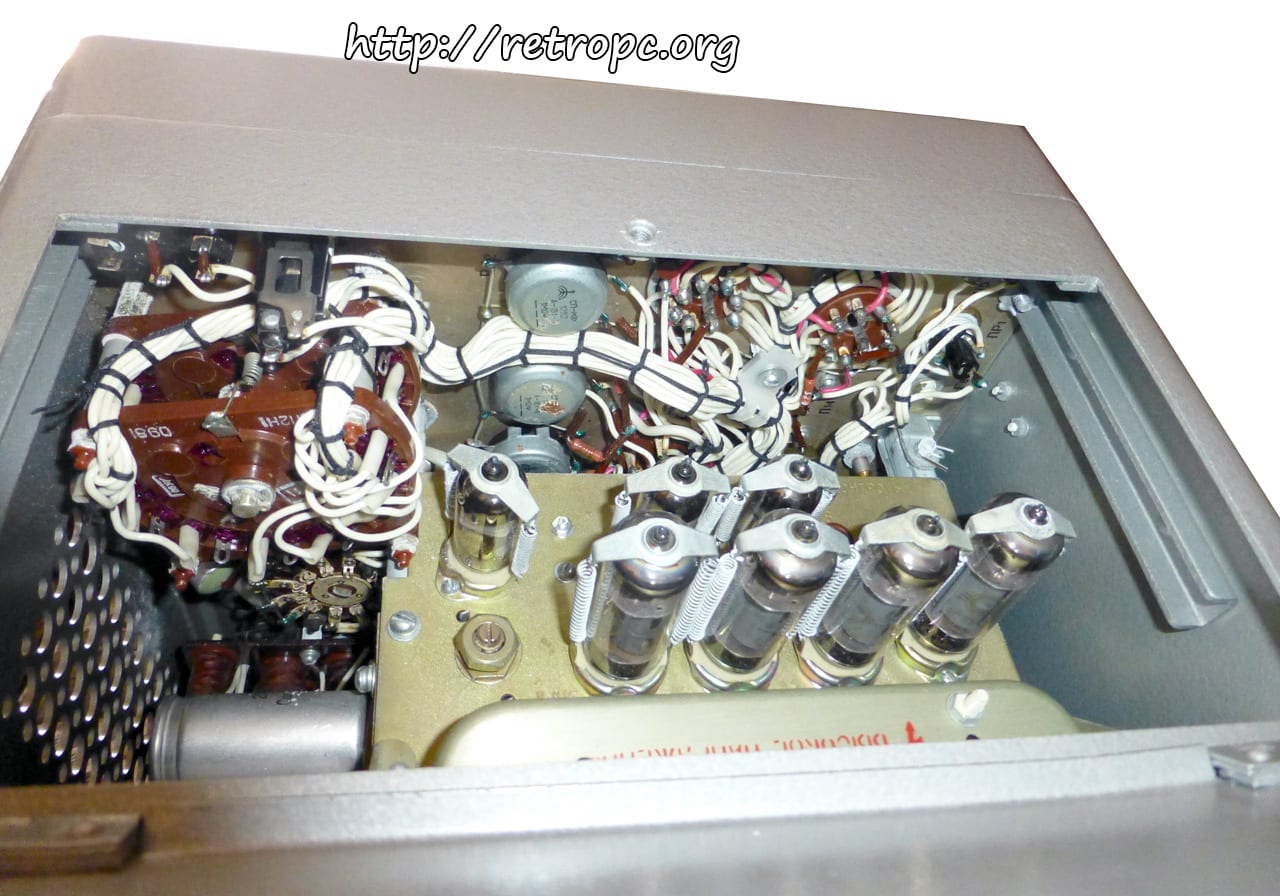
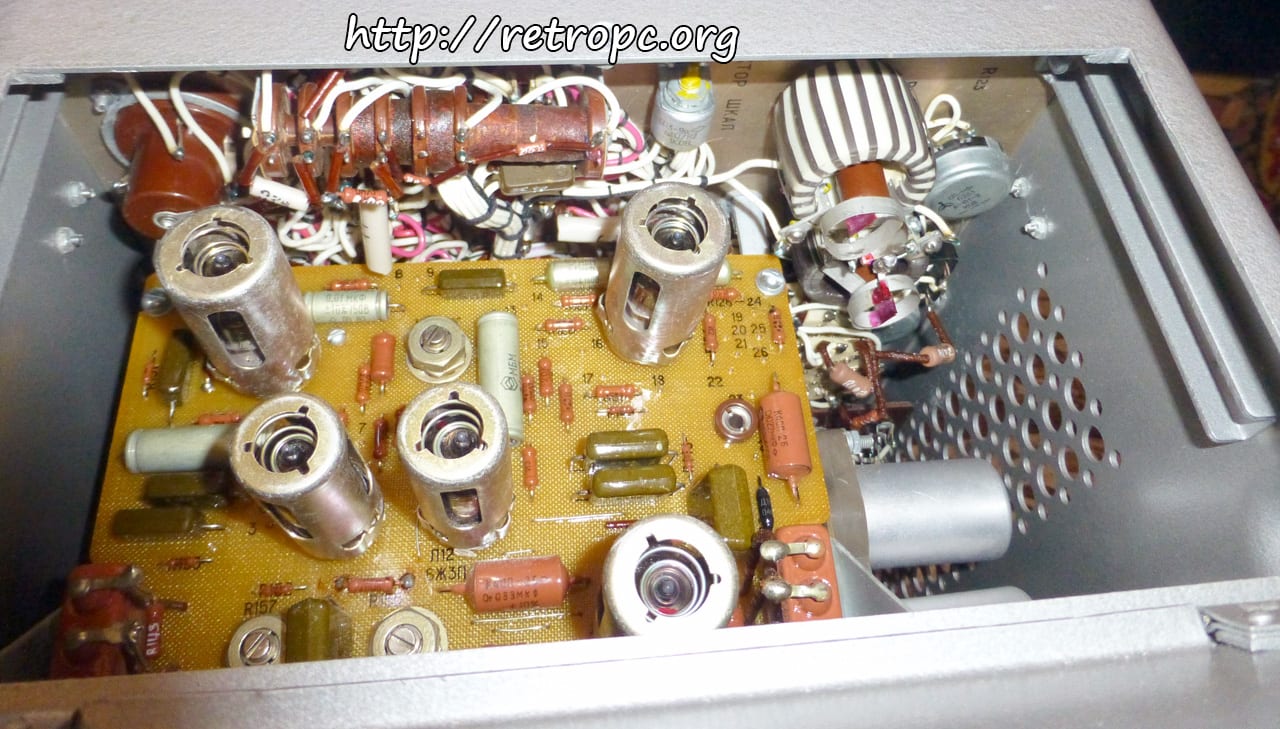
Inside an L3-3: its own vacuum tubes (metal-shielded, held in spring clips) and the regulator and amplifier circuits around them. Photos: retropc.org.
All of that has a price. A dozen ageing valves, five regulated supplies, a meter movement, and a commutator panel full of switched contacts add up to a lot that can drift or fail, and on these instruments the usual culprits are the mechanical ones: dirty contacts, worn buttons and switch wafers, and tired tube sockets. Trustworthy numbers depend on a healthy tester, and a healthy one is not a given. We have already replaced three of these testers, and I know people who have gone through a dozen!
The card system
This is the clever part. The L3-3 has no tube-type selector knobs to dial in wrong. Each tube type has its own test card from the factory card set. You place the card on the commutator panel, and plugs pushed through the holes in the card route the heater, grid, screen, and anode supplies to the correct pins of the socket, and connect the right meter circuits at the same time.
In other words, the card physically encodes the datasheet test conditions for that exact tube type. The operator sets the voltages the card calls for, and the meters read the result. On a double triode, the two sections are measured one at a time, so each half gets its own numbers, which is exactly what honest matching needs.
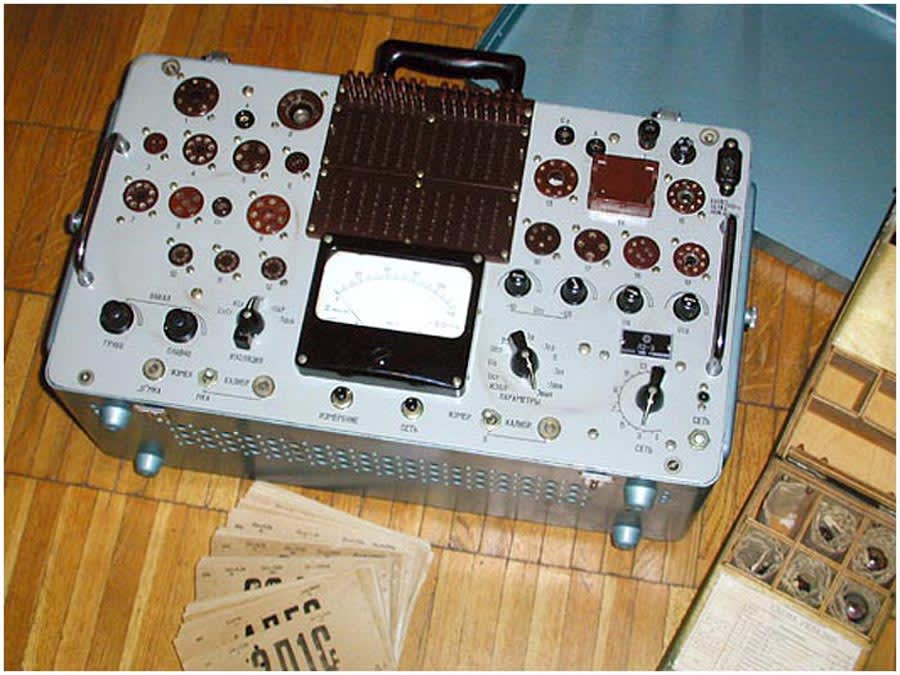
The L3-3 with part of its card set. Each card wires the datasheet test conditions for one tube type. There are no type knobs to misread. Photo: rw6ase museum of Soviet radio equipment.
The factory card set was not small: a few hundred cards covering on the order of 200 Soviet tube types. The same idea works for European and American equivalents: the diyAudio crowd that adopted the L3-3 in the West tests types like ECC83 and EL84 directly, with a small adapter box for the few sockets the instrument lacks.
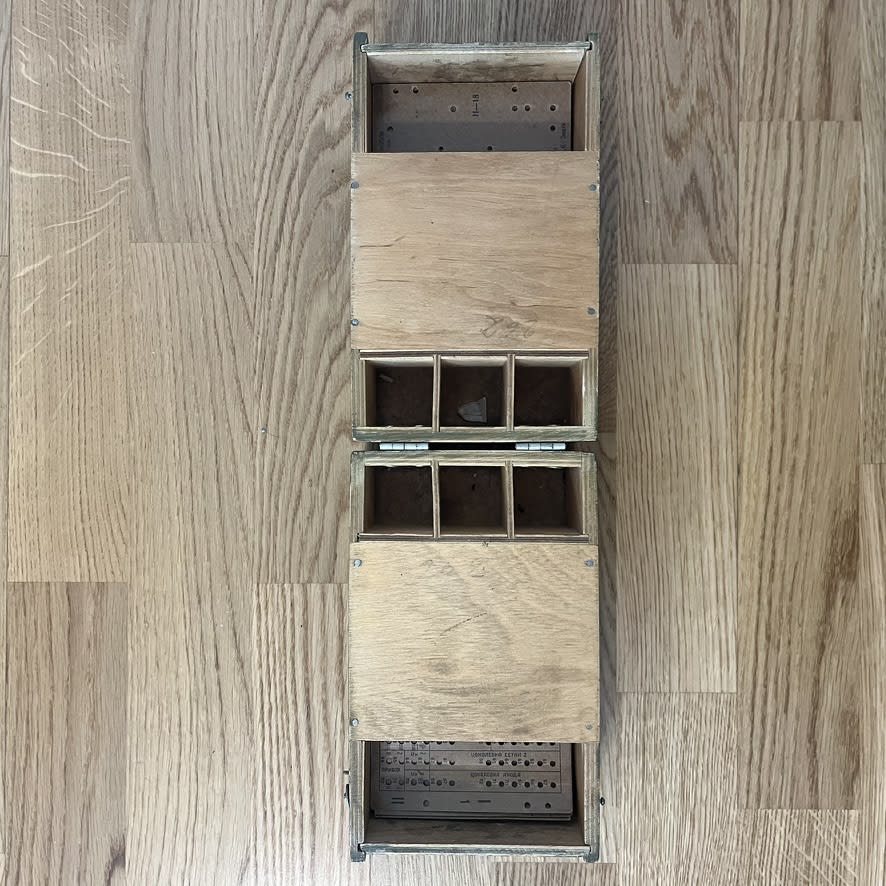
The wooden case that stores the L3-3 card set.
What it actually measures
The manual specifies, per class of tube:
| Parameter | What the L3-3 does | Why it matters |
|---|---|---|
| Transconductance (S) | Seven ranges from 0.75 to 75 mA/V, measured with a 1400 Hz test signal and a selective amplifier | This is the true “how alive is this tube” number. A real AC measurement at the datasheet operating point, not an emission guess. |
| Anode current | Scales from 1.5 to 150 mA | Confirms the tube idles where the datasheet says it should. It is also the basis for matching. |
| Screen (grid 2) current | 0.75–15 mA ranges | Catches weak or gassy output tubes like 6P3S and 6P14P-EV before they fail in an amp. |
| Reverse grid current | Microamp-level measurement, smallest scale 75 µA full scale | This is the gas test. A gassy tube drifts its bias and can run away in a fixed-bias amp. |
| Electrode leakage and shorts | Checked at 100 V and 250 V between electrodes | Finds heater-to-cathode leakage — a classic cause of hum in preamp tubes. |
| Emission / rectified current | For diodes and kenotrons, including full-wave AC supplies up to 2×500 V | A rectifier like 5C3S gets tested doing its real job, under real AC. |
| Ignition and stabilization voltage | For gas-discharge stabilizer tubes | The parameters that decide whether a regulator tube actually regulates. |
The supplies behind those readings are lab-grade too: a heater rail from 1 to 14 V DC or 2.5–25 V AC, anode and screen up to 300 V, and adjustable grid bias. Basic accuracy is within ±1.5% of full scale on voltages and currents, and ±2.5% on the transconductance and leakage ranges, which is the whole reason the numbers are worth recording in the first place.
How the numbers are recorded
Every tube here goes through the same sequence: the correct card, the instrument warmed for its full 30 minutes, both sections measured on double triodes, and the values checked against the datasheet for that type. The numbers are then written by hand on a paper label on the tube, and shown in the listing photos, so a buyer sees measurements, not just the word “tested.”
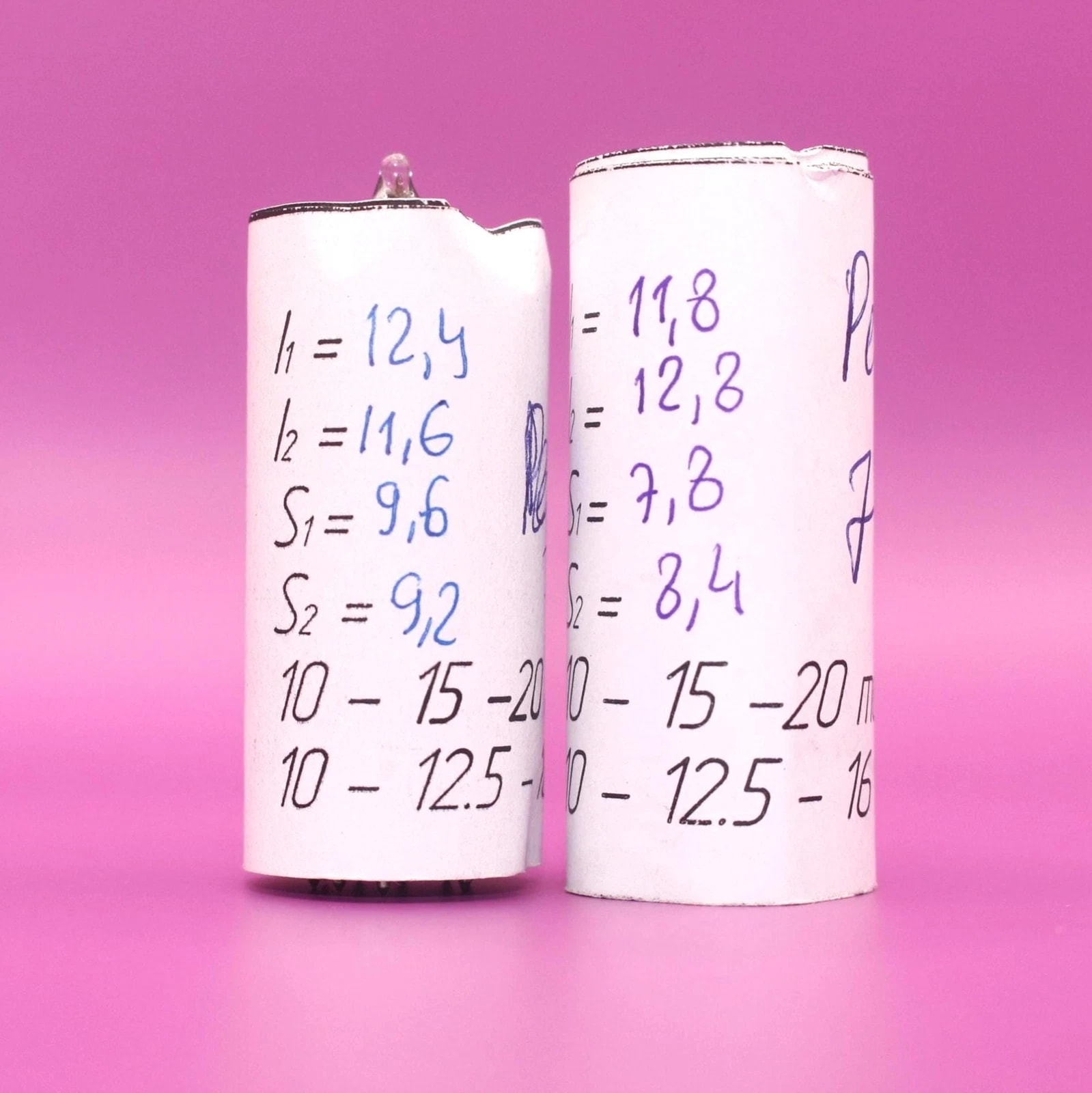
Measured values written by hand on the paper labels of a Reflector 1974 6N23P SWGP pair: anode current (I) and transconductance (S) for each triode section.
Matching means the same thing, in numbers. A matched pair of NEVZ 6N8S or Voskhod 6N23P SWGP is a pair whose measured transconductance and anode current sit close together, on the same card, on the same day, on the same instrument. The same goes for MELZ metal-base 6N8S and 6N9S octals, Svetlana 4P1L pairs, and non-Soviet stock like Tesla ECC802S and Tesla EF86, which test on this same machine through their Soviet-equivalent cards. (Telling those Soviet factories apart by their logos and date codes is its own subject, covered in the Soviet tube factories and logos guide.)
Indicator tubes get one extra step the L3-3 cannot judge: a 6E5S magic eye is also lit and graded by eye for brightness, which is why those listings quote a brightness percentage instead of only electrical values.
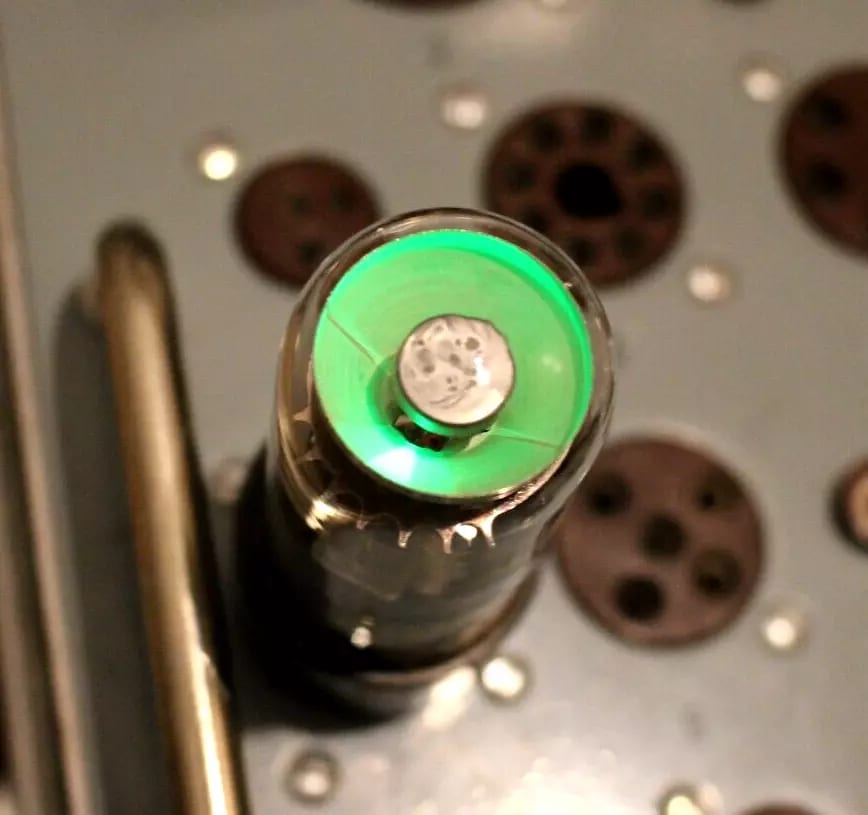
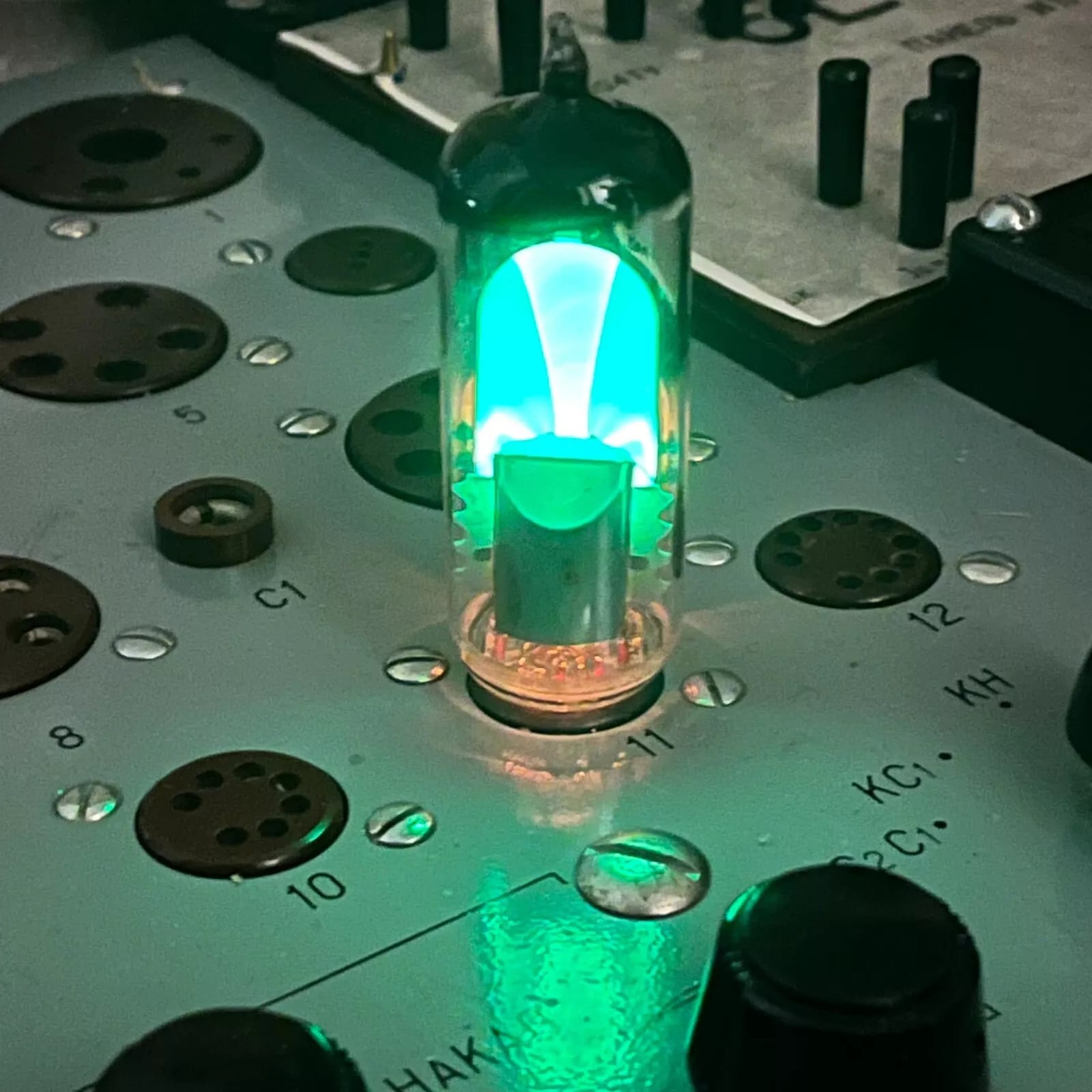
Indicator tubes lit on the tester and graded by eye for brightness: a 6E5S (left) and a 6E1P / EM80 (right).
What the L3-3 cannot tell you
The numbers matter more than the name on the box, so here is what no tester can prove:
- How it sounds in your circuit. The card reproduces the datasheet operating point. Your amplifier may bias the tube somewhere else, and the gain there can differ.
- Microphonics and noise. A tube can measure perfectly and still ring when you tap it. That is a separate check, not an L3-3 reading.
- Remaining lifetime. Strong transconductance today is the best available predictor, but it is a snapshot, not a promise of hours.
- Whether a tube will match one tested elsewhere. Readings carry the fingerprint of the instrument that made them (its calibration, the line voltage, the card, the operator’s routine), so two good testers can read the same tube a little differently. That is why a matched pair is best measured on one tester, rather than assembled from tubes checked in different places.
Western counterparts of the era
Outside the USSR, the same job (measuring real tube parameters rather than just checking emission) was handled by a small group of professional instruments, and the L3-3 sits naturally among them.
Closest in method is the British AVO Valve Characteristic Meter (VCM163), AVO’s most elaborate tester. Like the L3-3, it reads mutual conductance (transconductance) together with plate and screen current, set up from the tube’s published datasheet figures. It measures with a transistor audio oscillator and a frequency-selective amplifier, the same trick the L3-3 uses with its 1400 Hz signal and selective amplifier.
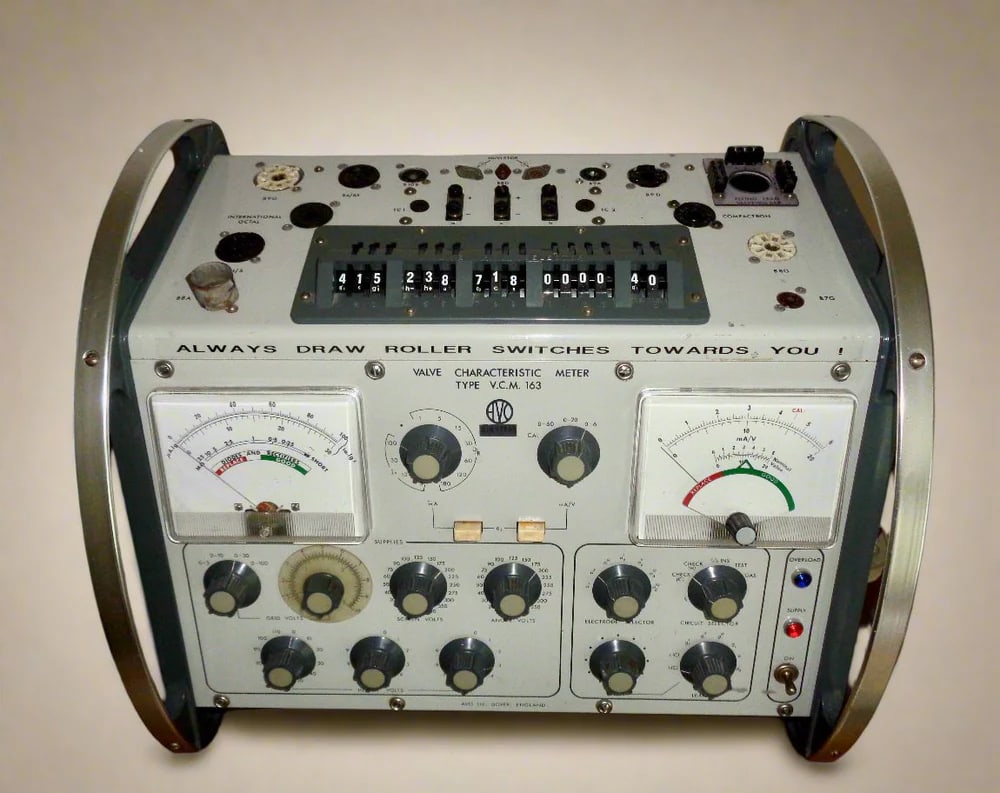
The British AVO VCM163 reads transconductance and electrode currents from a tube’s datasheet figures, the closest Western analog to how the L3-3 measures. Photo: Mullard Antiques.
Closest in concept is the American Hickok Cardmatic, sold to Western Electric as the KS-15750. It set up each tube’s test from a punched card read by a bank of spring-loaded pins: the card decided which voltages reached which pins, exactly the job the L3-3’s cards do, and its card set lived in a separate case about the size of the tester. Hickok’s mutual-conductance testers were the American standard for measuring transconductance rather than emission, though the simpler ones did not always hold the tube at its true operating point.
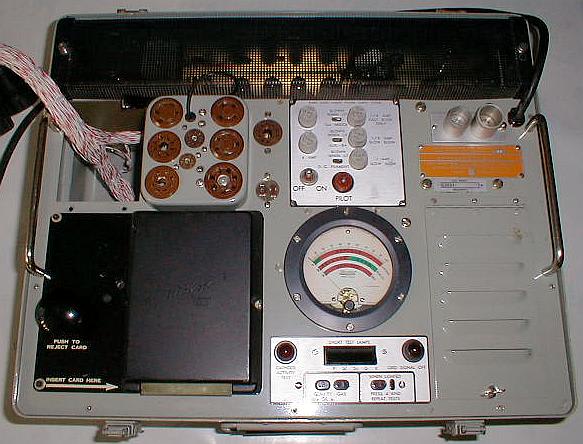
The Hickok Cardmatic, here in its military USM-118B form. A punched card slides in at the lower left (“insert card here”) to set up each tube’s test, the same idea as the L3-3’s cards. Photo: TubesOnTheWeb.
At the top end sat the Tektronix 570 (1955), a dedicated tube curve tracer with built-in regulated supplies that plotted a tube’s characteristics and ran two tubes side by side at full voltage and current, the same characteristic-plotting territory the L3-3 reaches. In Western Europe, makers such as Funke and Neuberger built comparable professional testers.
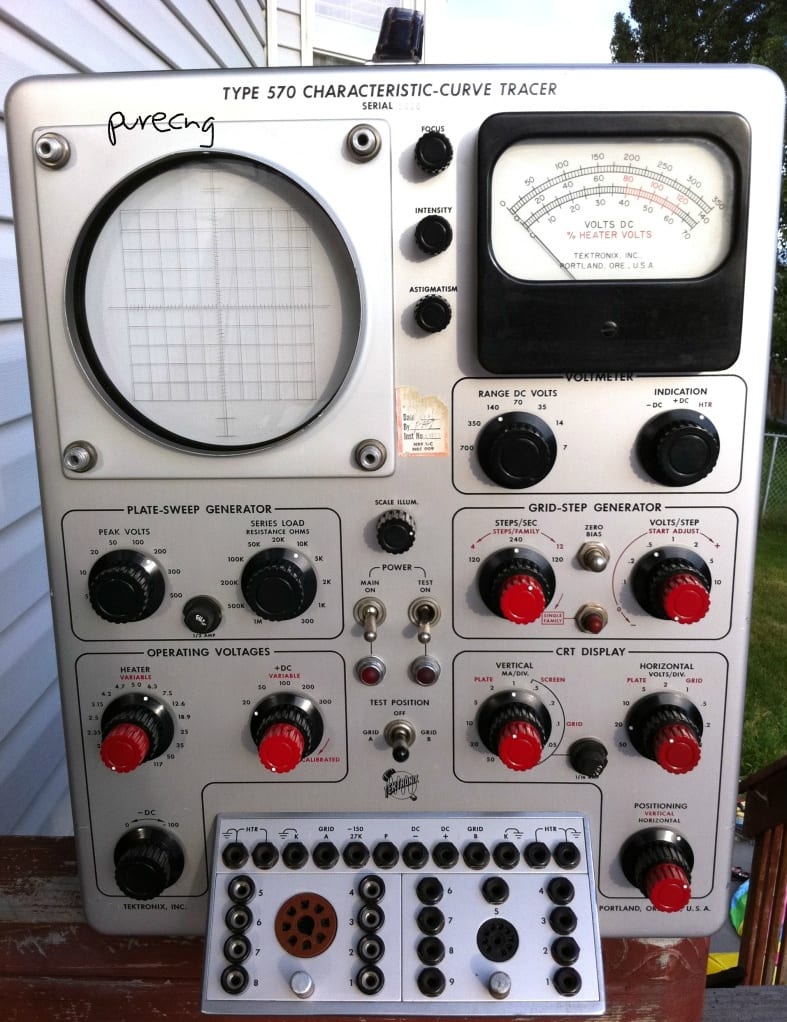
The Tektronix 570, a 1955 vacuum-tube curve tracer: the characteristic-plotting end of the same family. Photo: TekWiki.
In short, the L3-3 is no oddity: it is the Soviet member of the same family as the AVO VCM, the Hickok Cardmatic, and the bench curve tracers: card-programmed like the Cardmatic, and measuring much like the AVO.
The future?
The L3-3’s one real weakness is built into it: a tester made largely of vacuum tubes ages and drifts like any other tube gear, and its hundreds of switch contacts wear out. The obvious next step is a tester with no tubes inside at all: a fully solid-state instrument run by transistors and a microcontroller instead of valves and a needle meter.
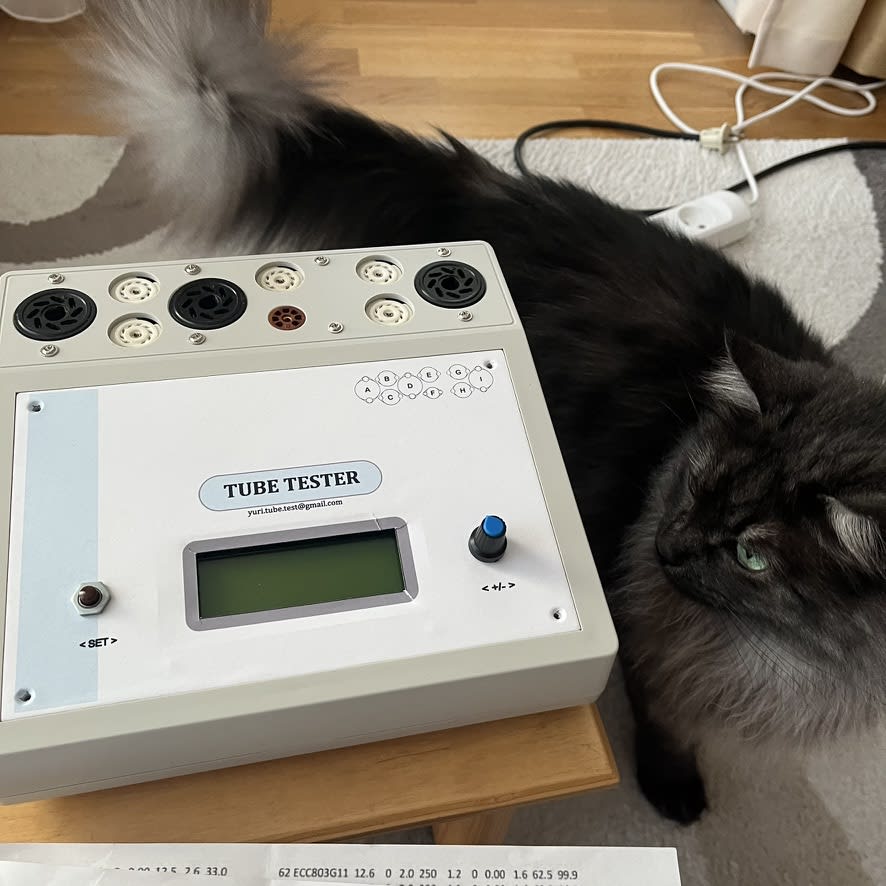
We recently picked one up, with quality control by Martha, the shop’s little inspector.
It is a compact “Tube Tester” built by an independent maker, entirely from semiconductors (transistors and a microcontroller), with no vacuum tubes of its own. In place of an analog meter and a card panel, it has a row of tube sockets, a small LCD, and a single knob.
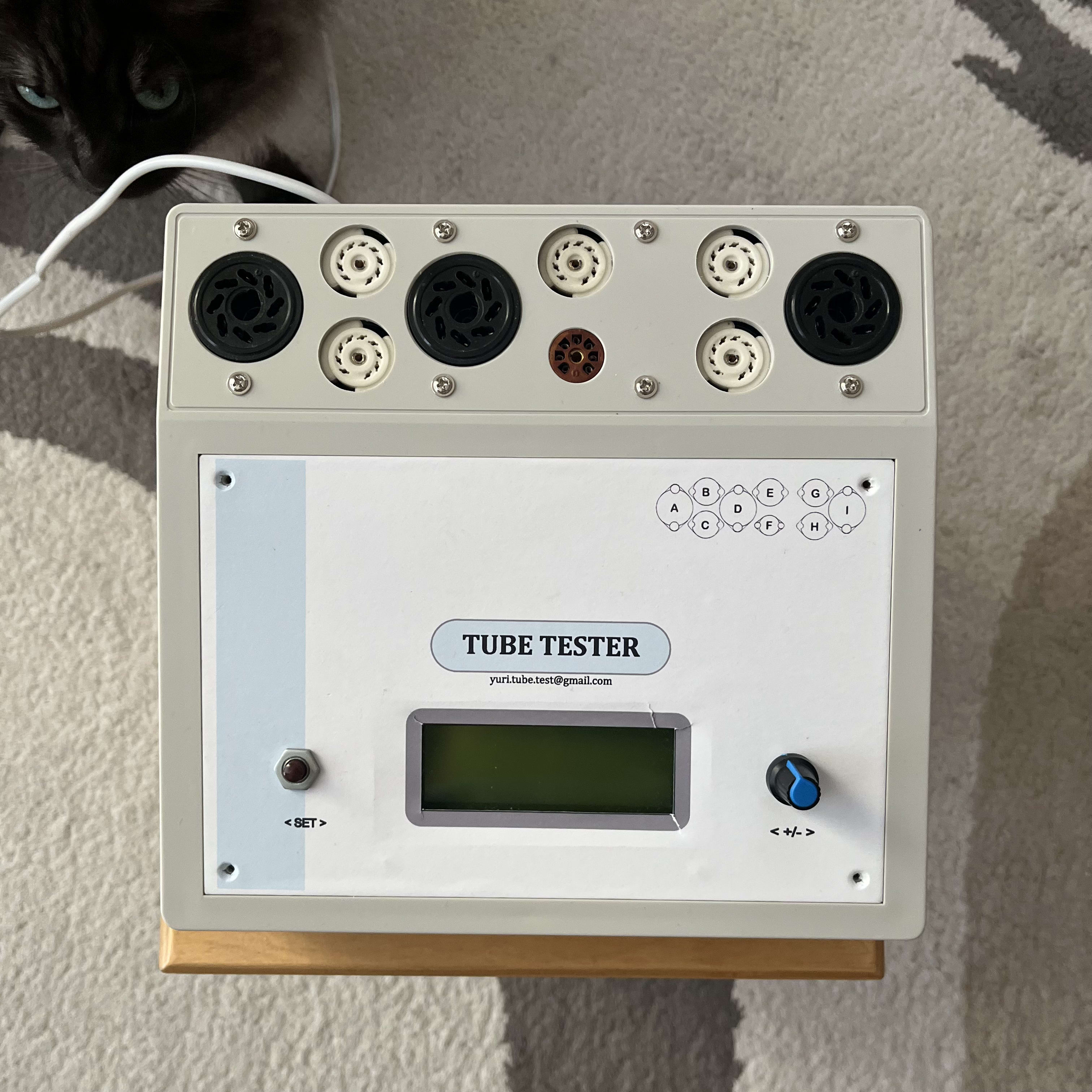
The solid-state tester from above: tube sockets, an LCD, and one control knob.
It works the other way round from the L3-3. The datasheet operating points live in its firmware as a tube list — you scroll to the type, plug the tube in, and it applies the right voltages and reads the parameters straight onto the LCD. New types go into a user-defined list rather than onto a punched card, and there are no internal tubes to warm up or replace.
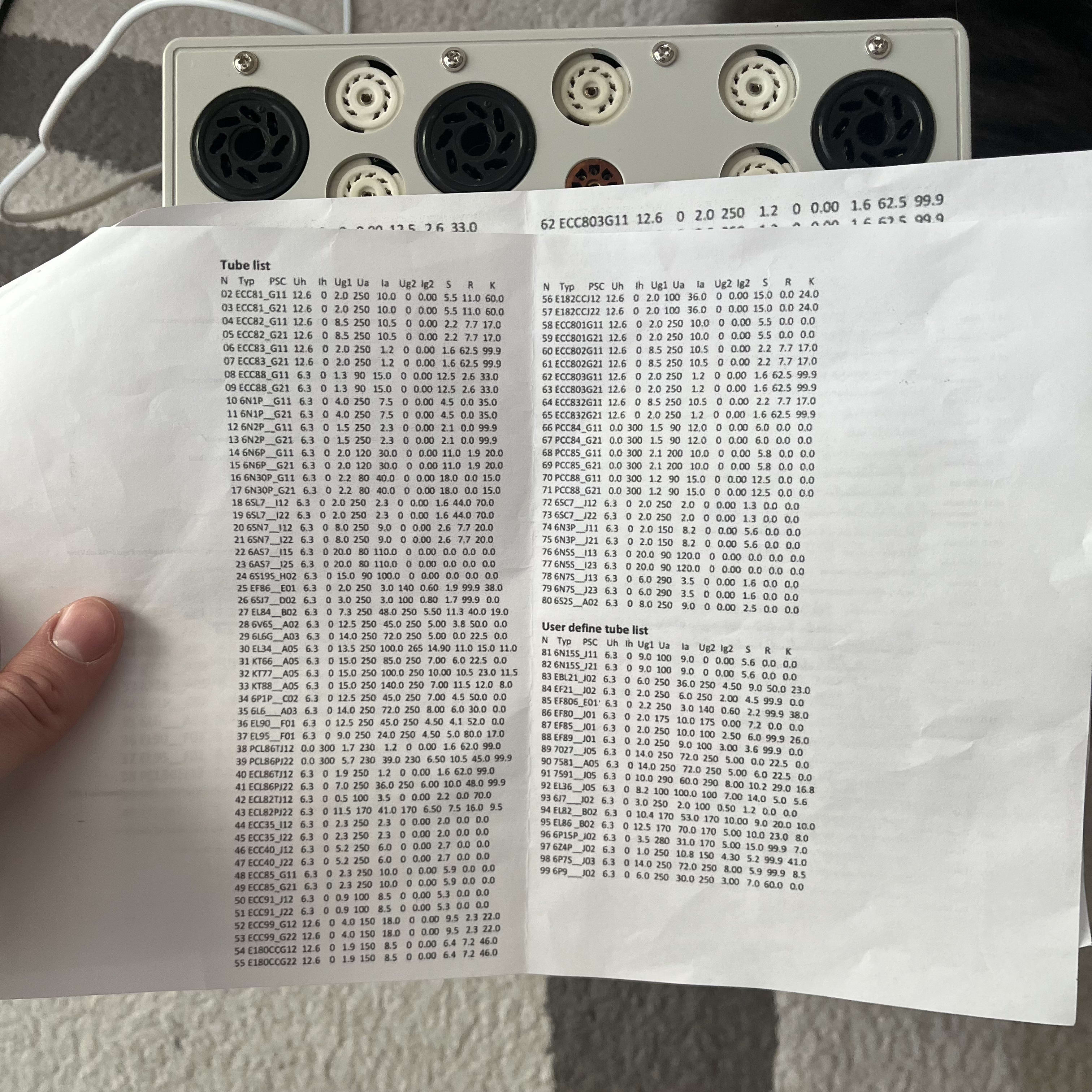
Its built-in tube list — each entry stores a type’s datasheet operating point, with spare slots for user-defined tubes.
On paper that fixes the L3-3’s biggest problem: with no valves inside, the main thing that ages and fails is simply gone, and the readout is direct and digital.
In practice it is not a replacement yet, not for us anyway. Its tube list is a fraction of the L3-3’s few-hundred-card library of Soviet and Western types, so there is plenty it cannot test at all. And measuring tube parameters accurately with semiconductors at high voltage turns out to be a hard problem: this unit is far more sensitive and, so far, more failure-prone than the L3-3. It still wants some fine-tuning and a few upgraded parts on our side before it is ready to take over everyday testing. Until then, the L3-3 stays on the bench and earns its keep.
Bottom line
The L3-3 is pretty much a “Swiss Army knife” for the electrical parameters of a vacuum tube. One instrument measures hundreds of tube types, Soviet and Western alike, reliably enough to filter out the weak or leaky ones and match the good ones into pairs and quads.
It does not do audio tests, and says nothing about how a tube sounds. But for finding healthy tubes and matching them by the numbers, few instruments do it better.
Thank you for reading!
References used:
- Л3-3 tube tester page, rw6ase museum of Soviet radio equipment
- Л3-3 technical description and instruction, Technoantique copy
- Л3-3 original manual PDF
- Л3-3 technical description, schematics, and card set, QRZ.ru archive
- Л3-3 parameter meter description, Magictubes
- L3-3 specifications, Zapadpribor catalog
- Russian L3-3 tube tester thread, diyAudio
- Л3-3 repair thread (common failures), Datagor practical electronics forum
- Л3-3 description with internal photos, RetroPC.org
- AVO VCM163 Valve Characteristic Meter, Radiomuseum
- The Cardmatic tube testers (Hickok / Western Electric KS-15750), TubesOnTheWeb
- Tektronix 570 and curve-tracer tube testing, AEA Audio
- Л1-3 tube tester description, Radteh
- Local product file: Reflector 1974 6N23P SWGP with handwritten L3-3 values