


In 1985, thousands of Soviet readers were flying a damaged spacecraft home from the Moon. The youth magazine Техника — молодёжи was serializing Mikhail Pukhov’s science-fiction story «Путь к Земле» (“A Way to Earth”), about the small lunar ship «Кон-Тики» — and installments came with program listings. Readers keyed them into a pocket calculator, pressed В/О and С/П, and flew a leg of the journey themselves: burns, fuel margins, descent rates, and the very real possibility of mistyping one digit and sailing past the planet.
A space simulator, distributed on paper, running on a calculator. It sounds like an improvisation, and it was — in 1985 a home computer was still something most Soviet readers had only seen in photographs. But the improvisation worked, because the machine under those listings was never really “just a calculator”. It ran stored programs with branches, loops and subroutines. It had a software scene, a hacking scene, and magazine columns that functioned as an app store with a national print run.
The short version: what Soviet industry called a программируемый микрокалькулятор — a programmable microcalculator, ПМК for short — sat much closer to a pocket computer than to an arithmetic aid. The line opened in the late 1970s with the Электроника Б3-21, the first mass-produced pocket programmable calculator made in the USSR — programmable desktop machines such as the Искра line came earlier, so the Б3-21’s achievement was making that capability personal. The Museum of Soviet Calculators plainly calls it “a veritable portable mini PC”. It continued through the beloved Б3-34 and МК-61, gained permanent memory and plug-in ROM cartridges with the МК-52 — which rode along on Soyuz TM-7 as a backup re-entry computer — and ended with the МК-85, which finally printed «микрокомпьютер» right on the faceplate.
Three months’ pay for sixty steps: the Б3-21
The Б3-21 was designed at the Kristall research institute in Kyiv and reached shops in the late 1970s at 350 rubles — almost three months of a young engineer’s starting salary, which was around 120 rubles a month. (Sources put its development in 1975–77 and its arrival in shops in 1977–78; the Museum of Soviet Calculators dates the design to early 1977 and the first sales to the beginning of 1978.) People paid it, because nothing else on a Soviet shop counter could do what it did.
What the money bought was a genuinely original machine, not a copied HP — though the family resemblance in logic is there. It worked in reverse Polish notation: values first, operation second, no equals key, the same entry discipline Hewlett-Packard users swear by. Behind the keys sat two working registers, seven memory registers and a six-register ring stack; the program memory held 60 steps and supported conditional jumps and subroutines — enough for a real algorithm: a numerical integration, an amortization table, a crude lunar lander. It executed a few operations per second, slow enough to watch a loop run step by step. Two prefix keys, F and P, gave every key a second and third meaning, and one key computed sine and cosine at the same time. When the collector behind rskey.org examined one decades later, he noted the rough edges and the cheap paper of the manual, then concluded the design “puts to shame several contemporary Western models”. (He also said its chunky rechargeable button cells looked like “miniature land mines”, which is fair.)
Early production runs used red LED digits behind magnifying lenses; later units switched to the green vacuum-fluorescent display that became the family’s signature glow. The 1981 unit with its carrying case and БП2-3 mains adapter, tested and working, is the green kind.
One thing the Б3-21 could not do was remember. Its memory was volatile: switch off, and the program evaporated. So software lived on paper — in squared notebooks, on index cards, in the margins of textbooks — and every working session began with a couple of minutes of keying the library back in. By 1980 the official list price had fallen to 190 rubles, and by 1981 to 80, which is roughly the moment programmable calculating stopped being an institutional luxury and became a personal hobby. The prices dropped, but the notebooks stayed.
1980: the Б3-34, and software distribution by magazine
In 1980 came the machine that turned a clever product into a culture: the Электроника Б3-34. It cost 85 rubles — reachable for a determined student, an evening-course engineer, a physics teacher — and offered 98 program steps, a four-level stack and 14 addressable registers.
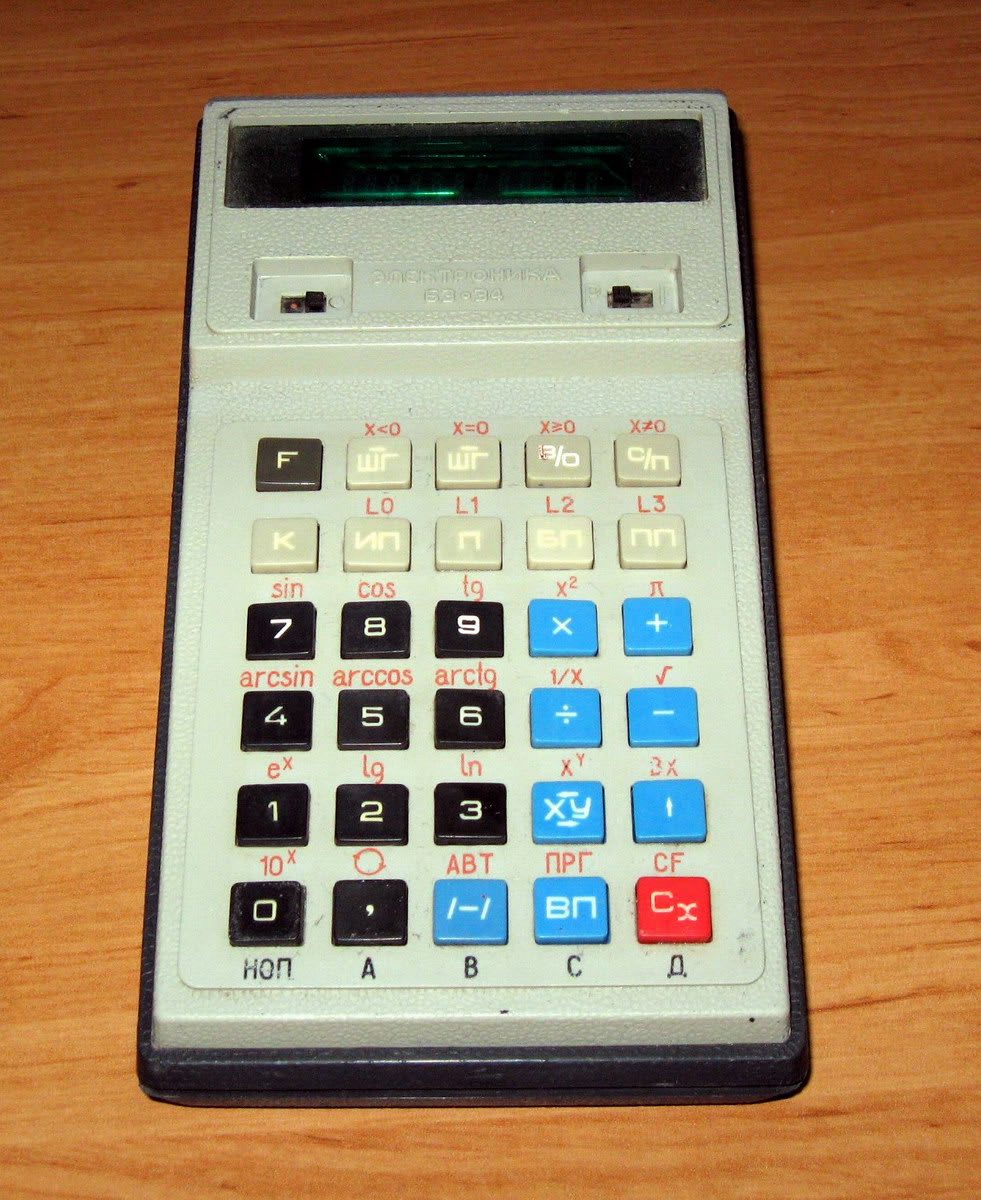
The Б3-34 of 1980 — 98 program steps for 85 rubles, and the machine whose command set became the de facto standard of Soviet pocket computing. Photo: S. Levchenkov / Wikimedia Commons (public domain).
Just as importantly, its command set became the standard. The МК-54, МК-56, МК-61 and МК-52 that followed all ran essentially the same machine code — the x86 of Soviet pocket computing. A program listing printed once ran on five different machines across a decade, and that made printing listings worthwhile.
And print they did. Наука и жизнь (Science and Life) ran a regular microcalculator section; Техника — молодёжи (Technology for Youth) opened its «Клуб электронных игр» — the Club of Electronic Games. The distribution channel for Soviet consumer software was, in effect, the state printing press. A 98-step listing takes ten minutes to key in and one wrong digit to ruin, so careful typing, double-checking and communal debugging became part of the routine.
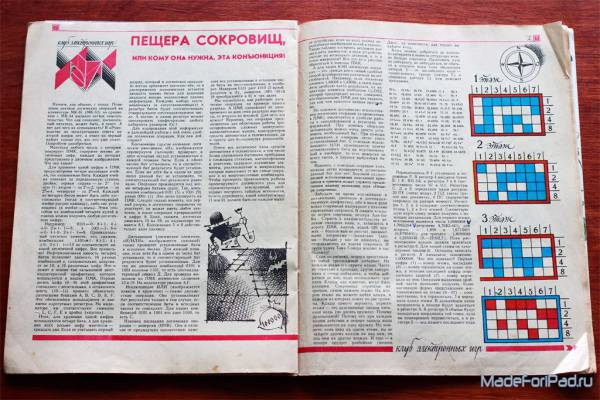
A «Клуб электронных игр» spread in «Техника — молодёжи»: the article on the left, its calculator program listings on the right. This was how Soviet software actually reached readers — printed, and keyed in by hand.
The Club’s masterpiece was the «Кон-Тики» series of 1985–86: Pukhov’s story installments came with programs simulating segments of the Moon–Earth flight, and the readers flew them at their kitchen tables. Getting home took fuel discipline, orbital intuition and several evenings, and a careless descent program simply returned a number showing you had crashed.
ЕГГОГ: the error message that became a field of study
Push a Б3-34-family machine past its limits — say, past ±9.9999999·10⁹⁹ — and instead of crashing, it printed a word: ЕГГОГ. That is the display’s best attempt at the English “Error” in segment shapes, which a Russian eye promptly reads as “YEGGOG”. It became the most famous non-word in Soviet engineering.
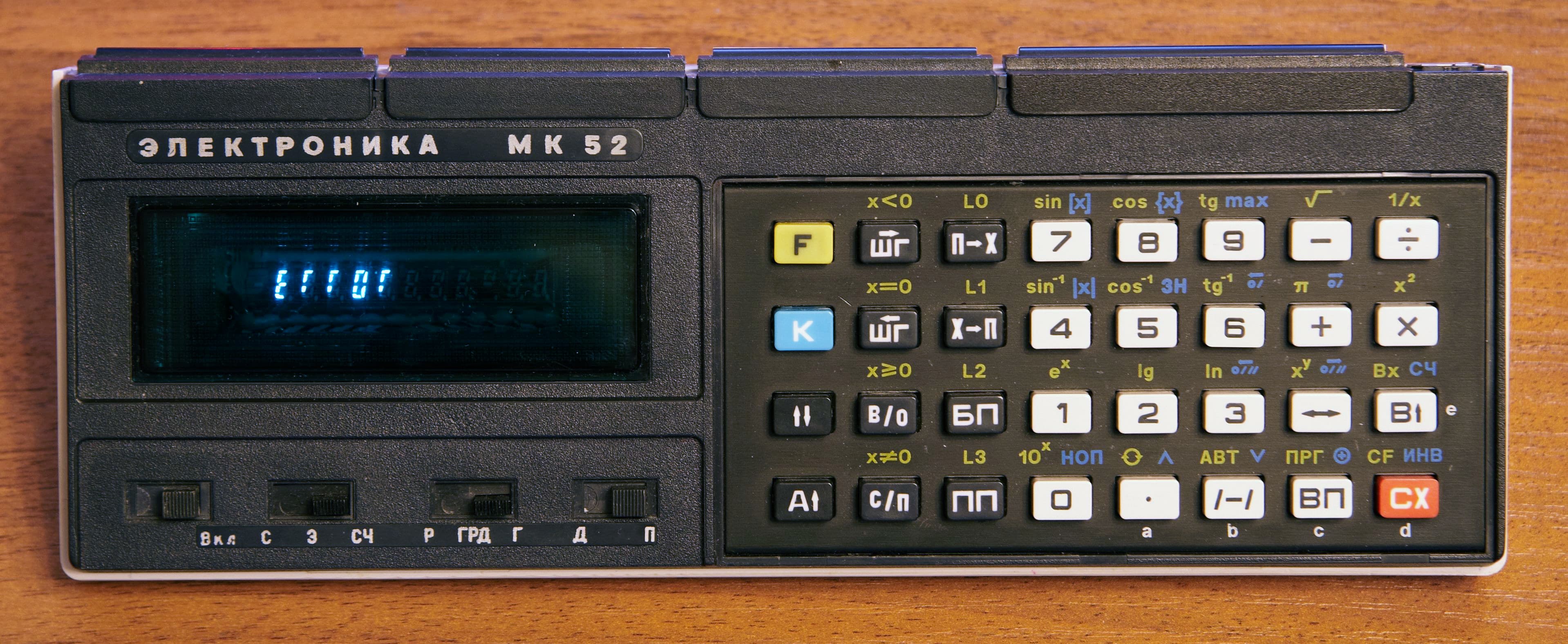
ЕГГОГ in the flesh: an МК-52 trying to say “Error” with the segments it has. For a generation of Soviet users this word meant “here be dragons” — and an invitation. Photo: Panther / Wikimedia Commons (CC BY-SA 3.0).
Because the machines kept computing past the error, enthusiasts went in after them. The undocumented territory turned out to be large: “non-standard” numbers beyond the official range were mapped into numbered tiers with their own names — «ЗГГОГи», «ОС-оборотни» (the shape-shifters), «Тьма» (Darkness, a state where the display simply goes black), «длинные монстры» (the long monsters). There were undocumented arrow commands for indirect register access, and tricks for painting arbitrary symbols onto the display. The whole pursuit earned a name, еггогология — “eggogology”, the science of ЕГГОГs — and magazines printed new findings as they were discovered. This was community research, documented in magazines and enthusiast wikis rather than factory manuals, so the exact tier names and boundaries vary from one telling to the next.
A community does not build a research hobby around an adding machine’s overflow behaviour. It builds one around a computer.
МК-61 and МК-52: cartridges, permanent memory and a seat on a Soyuz
In the mid-1980s the standard machine split in two. The МК-61 (made from the mid-1980s to 1994, 85 rubles) was the people’s model: 105 program steps, 15 registers, and the classic 12-digit green VFD panel — type ИЛЦ2-12/8Л, eight digits of mantissa, two of exponent, two signs. That exact panel type was used across Elektronika calculators and still turns up new old stock — single tested pieces, lots of ten or a full box of a hundred — which matters, because a dead display is the most common thing standing between a flea-market find and a working machine. It is the same green-glow family as the ИВ-6 digits beloved by clock builders.
The МК-52 (115 rubles, built until 1992 at plants in Ukraine) was the deluxe sibling, and it fixed the family’s oldest sorrow: it remembered. A built-in 512-byte EEPROM, rated for some 10,000 rewrites, kept programs and data through power-off — after eight years, the squared notebook finally got a backup. Better still, a socket on the top edge accepted БРП plug-in ROM modules: «Астро» with navigation programs for the merchant marine, БРП-3 with sixty mathematics programs (16 rubles), БРП-4 with games in 1989 — plug-in cartridges in the same sense a game console uses the word.
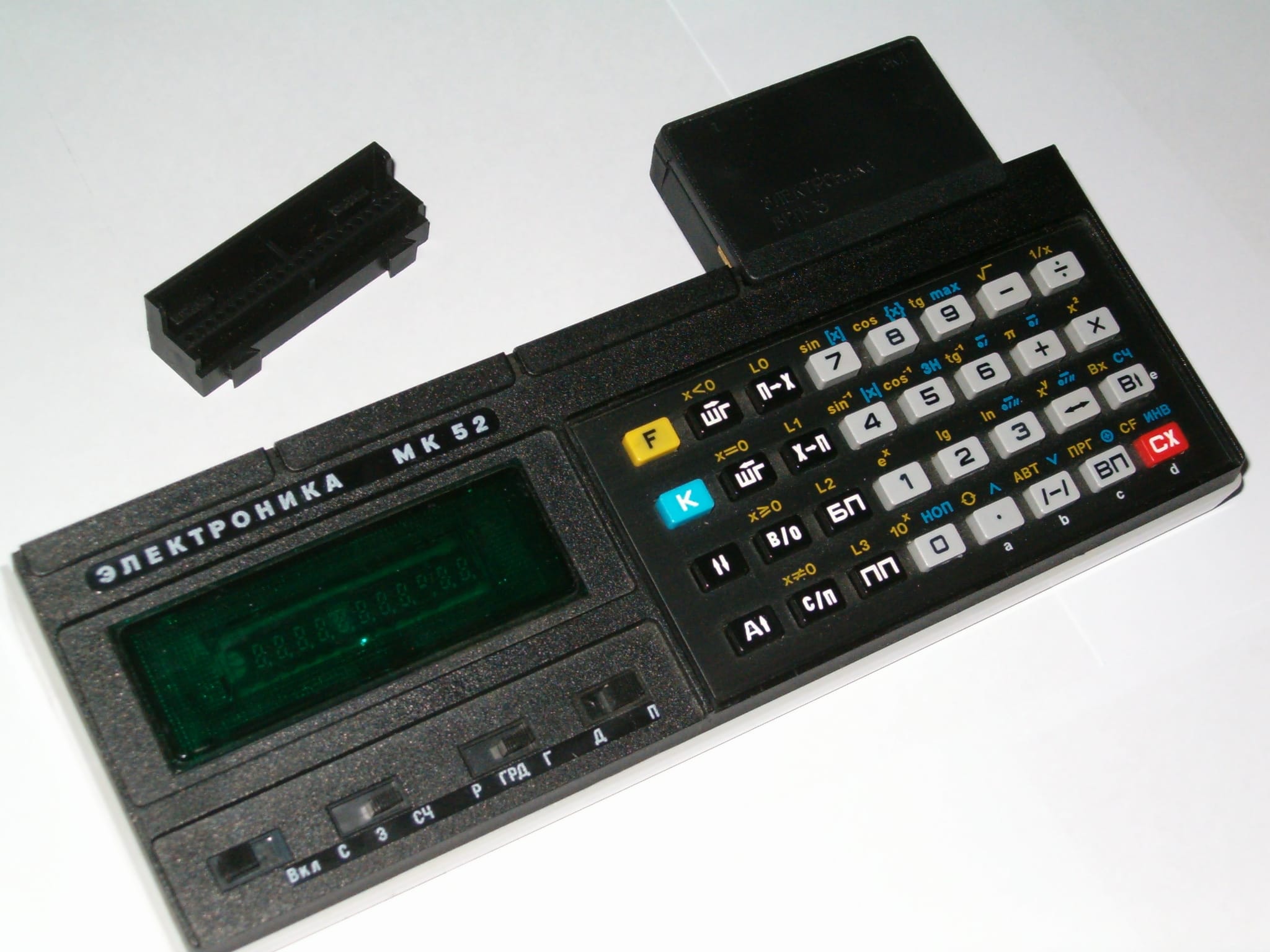
An МК-52 with the socket cover removed and a БРП ROM module — plug-in software for a “calculator”. Photo: Jiri Brozovsky / Wikimedia Commons (CC BY 2.0).
Then the family picked up its space story, a real one this time. In November 1988, an МК-52 flew on Soyuz TM-7, carried as the backup means of computing the landing trajectory had the onboard computer failed — insurance that, by all accounts, was never actually needed. The backup navigation computer of a crewed spacecraft was, in effect, the deluxe version of the same machine schoolchildren used for their ЕГГОГ experiments. (The Б3-21 itself never flew; the space story belongs to the МК-52 alone.)
The word on the faceplate: МК-85
The line’s last word came in 1986. The Электроника МК-85 answered Japan’s pocket BASIC machines — Casio’s FX-700P most directly — with a QWERTY keyboard, BASIC in ROM and a 145-ruble price tag. And on the faceplate the industry finally used a different word: not «микрокалькулятор» but «микрокомпьютер» — microcomputer.
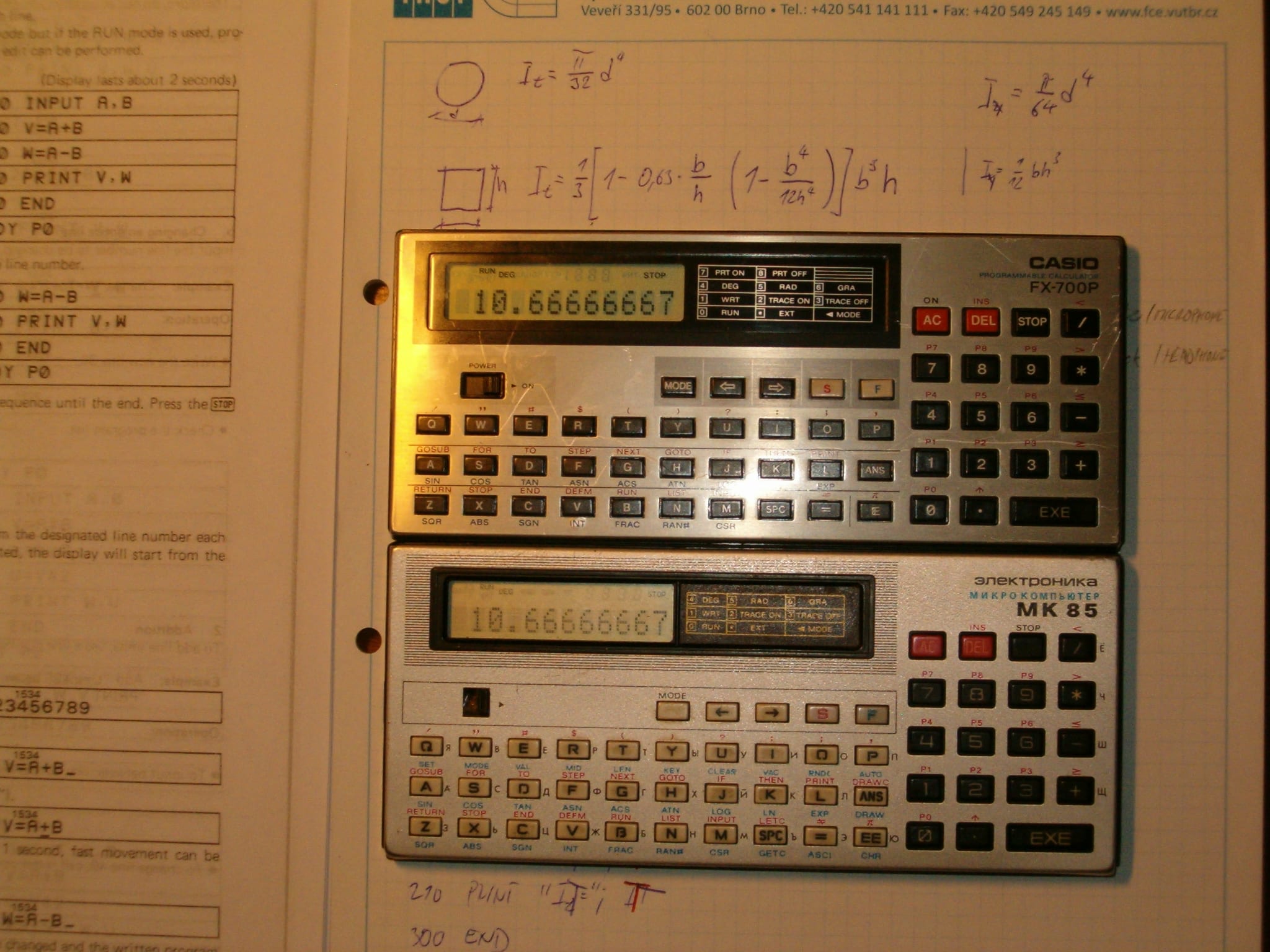
The Casio FX-700P and the МК-85, agreeing on the answer. Note the Soviet machine’s badge: «микрокомпьютер» — microcomputer, the label the earlier models never carried. Photo: Jiri Brozovsky / Wikimedia Commons (CC BY 2.0).
Buying one today: what actually matters
Treat a Soviet ПМК the way you would any forty-year-old electronic instrument, with the priorities in this order:
- The display first. A full, even glow across every digit is the thing to confirm — LED digits and VFD segments are the components that age. A scratch on the protective window is cosmetic; a dead segment is not. For the МК-61 generation, NOS ИЛЦ2-12/8Л panels make a repair realistic; for other models, spares are the hunt.
- Completeness. The carrying case and the mains adapter were the first things lost, and battery compartments are where old machines usually hurt — so a surviving kit with a working mains path, like the 1981 Б3-21 with case and БП2-3 adapter, is worth real preference over a bare unit.
- Working state, honestly described. “Powers on” is not “computes correctly” — a seller who has actually run a program and says so plainly (flaws included) is telling you something a photo cannot.
- Provenance in the stamps. Dating and attribution work like they do for tubes — factory mark plus date code; the guide to reading Soviet date stamps and markings applies almost unchanged.
Which model to want is a matter of taste. The Б3-34/МК-61 generation has the software culture and the ЕГГОГ folklore; the МК-52 has the EEPROM, the cartridges and the Soyuz story; the Б3-21 has primacy — first of the line, two display variants to hunt, and the strongest claim to the phrase “first Soviet pocket computer”.
Whichever you chase, a working Б3-21 with its case and power brick is a real piece of that story — the opening object of Soviet personal computing, from the years when “software” meant a squared notebook and a national magazine. And if a dead display is all that separates a flea-market МК-61 from a running one, the right green panel still exists, new in the box.
Thank you for reading!
References used:
- Elektronika B3-21 — Museum of Soviet Calculators (Sergei Frolov)
- Elektronika B3-21 — RSKey.org collector article
- A History of Soviet Calculators — xnumber.com (Sergei Frolov)
- Электроника Б3-34 — Музей вычислительной техники (b3mk.ru)
- Электроника МК-61 — Музей вычислительной техники (b3mk.ru)
- МК-61: история, эмуляция, устройство — Habr
- Электроника МК-52 — каталог Музея Фролова
- Программируемый калькулятор МК-52 — Habr
- Электроника МК-85 — Музей вычислительной техники (b3mk.ru)
- Еггогология и таксономия «нештатных» чисел — pmk.arbinada.com
- Калькулятор Электроника МК-61 (teardown, ИЛЦ2-12/8Л display) — priborazbor.ru
- Elektronika MK-61 English operating manual (PDF scan) — wass.net


