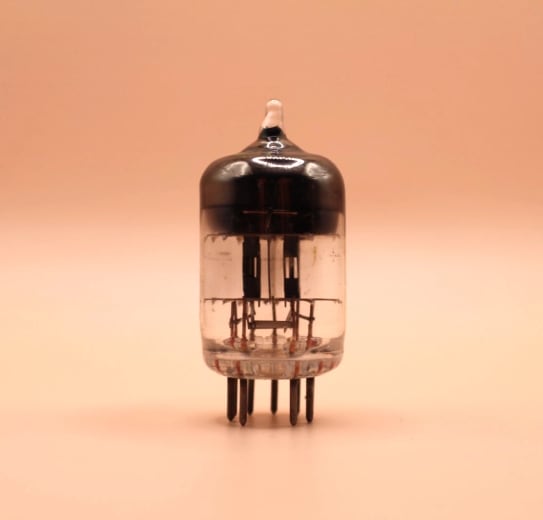

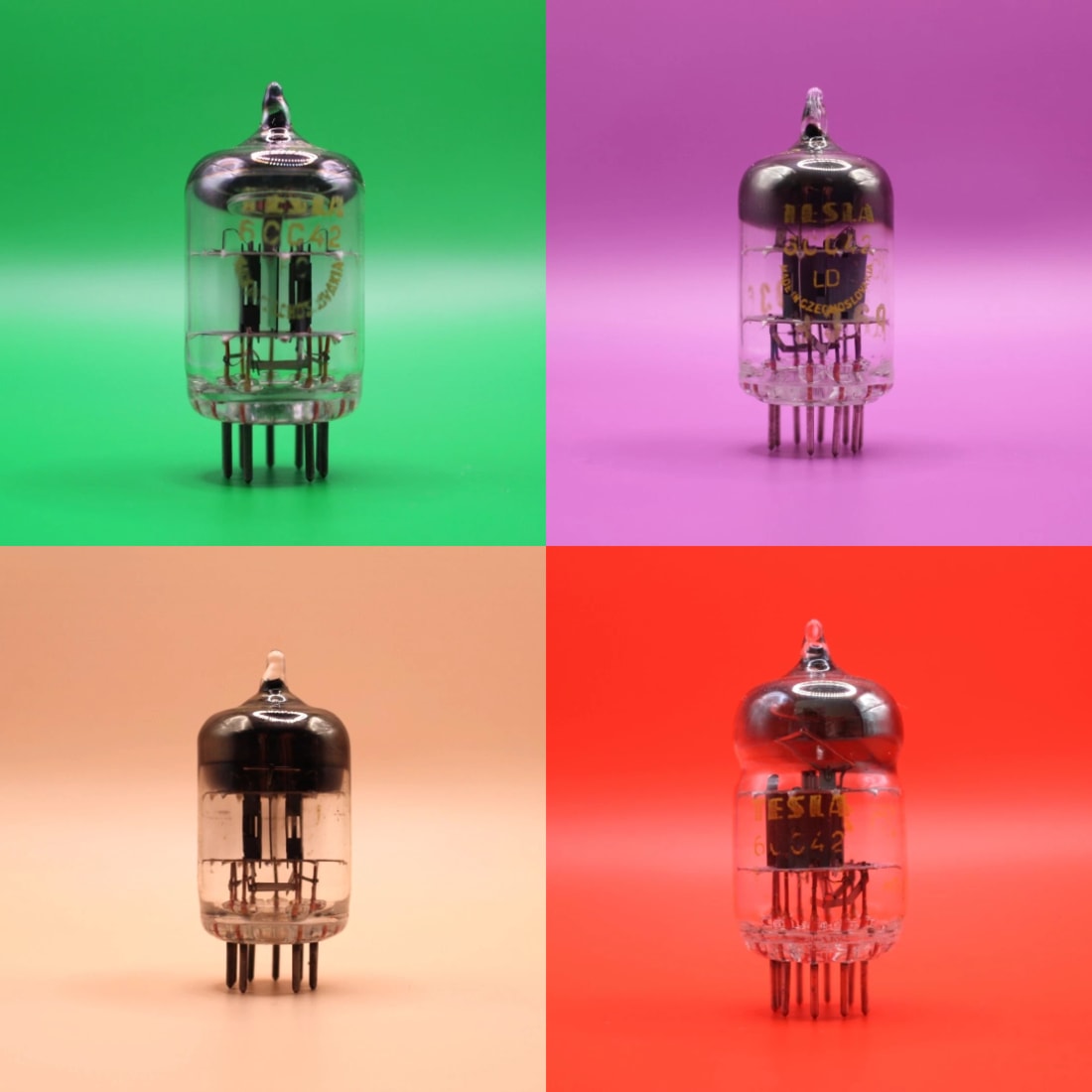
Few vacuum tubes carry as many names as this one. The same double triode is sold as 2C51, 396A, 5670, 5670W, 6385, CV2831, Tesla 6CC42, the Soviet 6Н3П (6N3P) with its alphabet of suffixes, and the Chinese 6N3. Anyone rolling tubes in a headphone amp or small preamp runs into the family sooner or later, usually with two questions: which of these are interchangeable, and why is it not a 6922?
The short version: all of these are variations of one 1946 Bell Labs design. 2C51 and 396A are two names for the same Western Electric tube; 5670 is the long-life industry version; 6385 is a ruggedized premium cousin; 6CC42 is Tesla’s Czechoslovak version; 6N3P is the Soviet near-copy. They share one unusual pinout — heaters on pins 1 and 9, an inter-section shield on pin 5 — so none of them fits a 6DJ8/6922 socket without an adapter.
Where the family began: Bell Labs, 1946
The original tube is the Western Electric 396A, developed at Bell Telephone Laboratories and registered with the Radio Manufacturers Association as the 2C51 in November 1946. One tube, two names from birth: 396A is Western Electric’s in-house code, 2C51 the industry registration.
Bell Labs laid out the design goals in its September 1947 Bell Laboratories Record. The postwar telephone network was adding microwave radio relay links (the TD-2 system, whose first New York–Chicago route opened in 1950), and the terminal equipment needed a compact double triode for high-frequency switching, multivibrator and cathode-follower work. That meant small size, two independent triode sections, low capacitances and high transconductance. The 396A delivered, with a grid-to-cathode spacing of 0.0035 inch and a shield between the sections; in Bell’s tests it oscillated up to 800 MHz with both sections in parallel.
The base is worth a note of its own. Two independent triodes need at least eight pins — two heaters, plus plate, grid and cathode per section — and the 7-pin miniature base of the day could not provide them, so Bell introduced “a new nine-pin miniature stem … as an additional standard.” The 396A/2C51 is one of the first noval tubes: the 9-pin base that later carried the 12AX7, the EL84 and most of the tube world.
All names and equivalents
| Name | Origin | What it is |
|---|---|---|
| 396A | Western Electric, 1946 | The original; WE’s in-house code |
| 2C51 | RMA registration, Nov 1946 | The same tube’s industry name |
| 5670 | Registered 1948 | Long-life industry version of the 2C51; made by GE, Sylvania, Tung-Sol, Raytheon and others |
| 5670W / 5670WA | US military | Ruggedized MIL-grade 5670, usually JAN-branded |
| 6385 | Bendix Red Bank, advertised 1954 | Premium ruggedized cousin with triple-mica construction; also made by GE |
| CV2831 / CV4013 | UK military | British CV numbers for the 2C51/5670 |
| 6CC42 | Tesla, Czechoslovakia, mid-1950s | Czechoslovak version — more on it below |
| 6Н3П (6N3P) | USSR, from ~1954 | Soviet near-copy with its own suffix system |
| 6N3 | China | Chinese version of the 6N3P; the stock tube in many budget preamps |
Electrically the core numbers are the same across the family: heater 6.3 V at 300–350 mA depending on the maker’s datasheet, amplification factor about 35, transconductance about 5–5.5 mA/V, a typical operating point of 150 V and 8 mA per section, maximum plate voltage 300 V and dissipation 1.5 W per triode.
The 6385 is a near-equivalent rather than a clone: a taller bulb and a heater draw of 0.5 A, above the family norm, so in heater-budget-critical gear it is not a blind drop-in.
The Soviet branch: 6N3P
The Soviet 6Н3П appears in equipment from about 1954 and stayed in production for decades, mostly in FM tuners, measurement gear and military radios. Its datasheet numbers track the American original closely — µ = 36 ± 8, transconductance around 4.9–6 mA/V, 300 V and 1.5 W per triode maximums — with a slightly larger 22.5 mm bulb as the visible difference. Even the base version was rugged on paper, rated for 100 g linear acceleration and −60…+70 °C. Full data is on the 6N3P-E datasheet page, and the Soviet handbook lists 2C51, 5670, 6385 and 6CC42 as the tube’s foreign analogs.
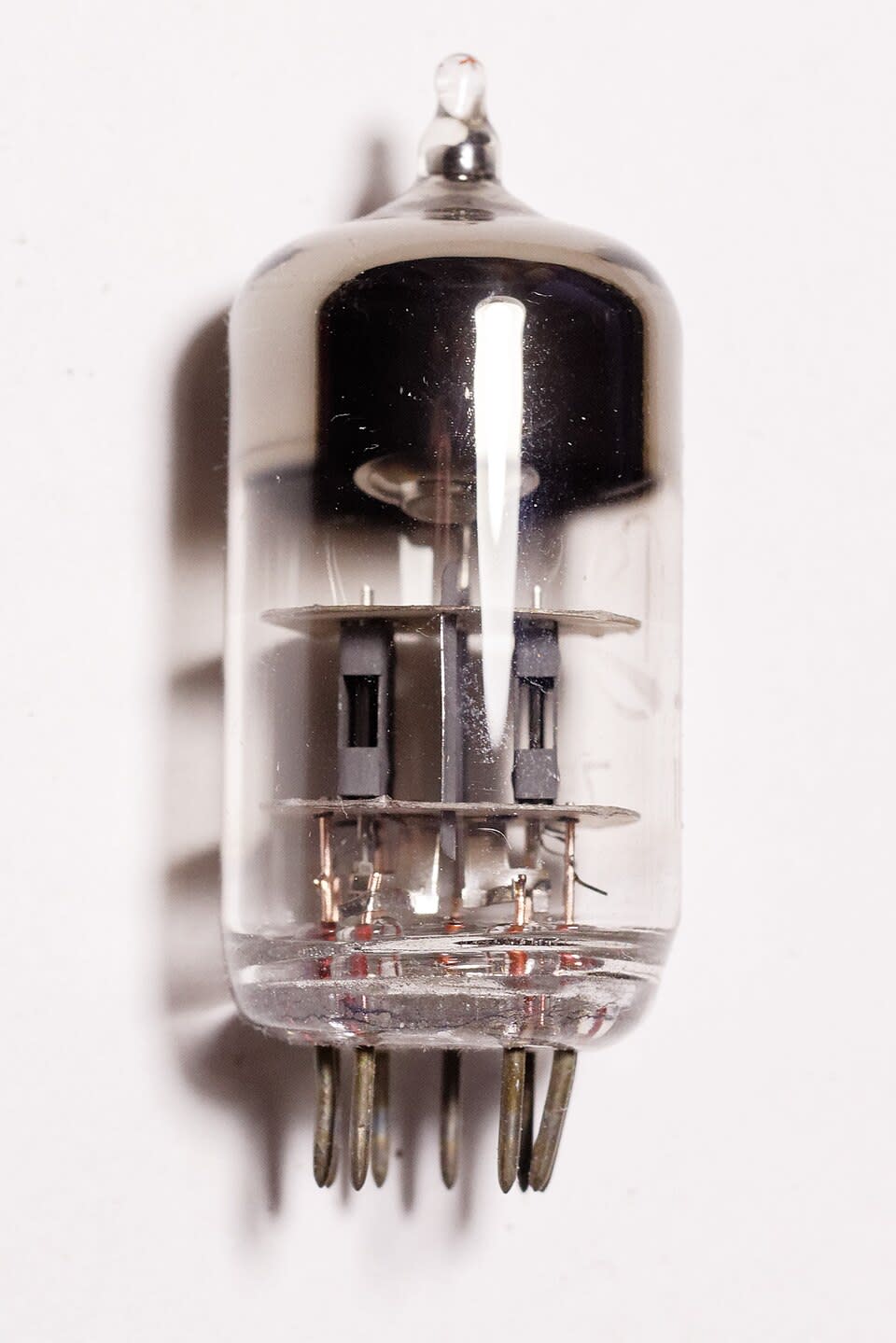
A base-version 6Н3П made in Vinnitsa in 1975. Photo: Retired electrician / Wikimedia Commons (CC0).
Three plants are associated with the type: Reflector in Saratov (behind most surviving NOS — the factory logos guide shows its “bent arrow” mark), Voskhod in Kaluga, and Oktyabr in Vinnitsa, Ukraine — the plant that made the 1975 tube in the photo above.
The suffixes: what -E, -EV and -DR actually promise
Soviet suffixes grade durability and reliability, not tone — the same system decoded in detail in the guide to Soviet tube markings. For the 6N3P family the versions that actually existed are:
| Version | Rated service life | Notes |
|---|---|---|
| 6Н3П | 500 h in early datasheets, 1500 h in later ones | The base tube |
| 6Н3П-Е | ≥ 5,000 h | Long-life version — the sweet spot of price vs. spec, as in this same-date Reflector quad |
| 6Н3П-ЕВ | ≥ 5,000 h | Long-life plus mechanical ruggedization |
| 6Н3П-ДР | ≥ 10,000 h | Special-reliability grade with triple mica spacers, intended for aerospace use |
| 6Н3П-И | — | Pulse-operation variant |
A plain 6Н3П-Д does not appear to exist for this type — only the -ДР. And none of these suffixes means “military”: a tube became military hardware by passing military acceptance, stamped as a rhombus on the base, which turns up on -ЕВ and -ДР stock but is separate from the suffix itself.
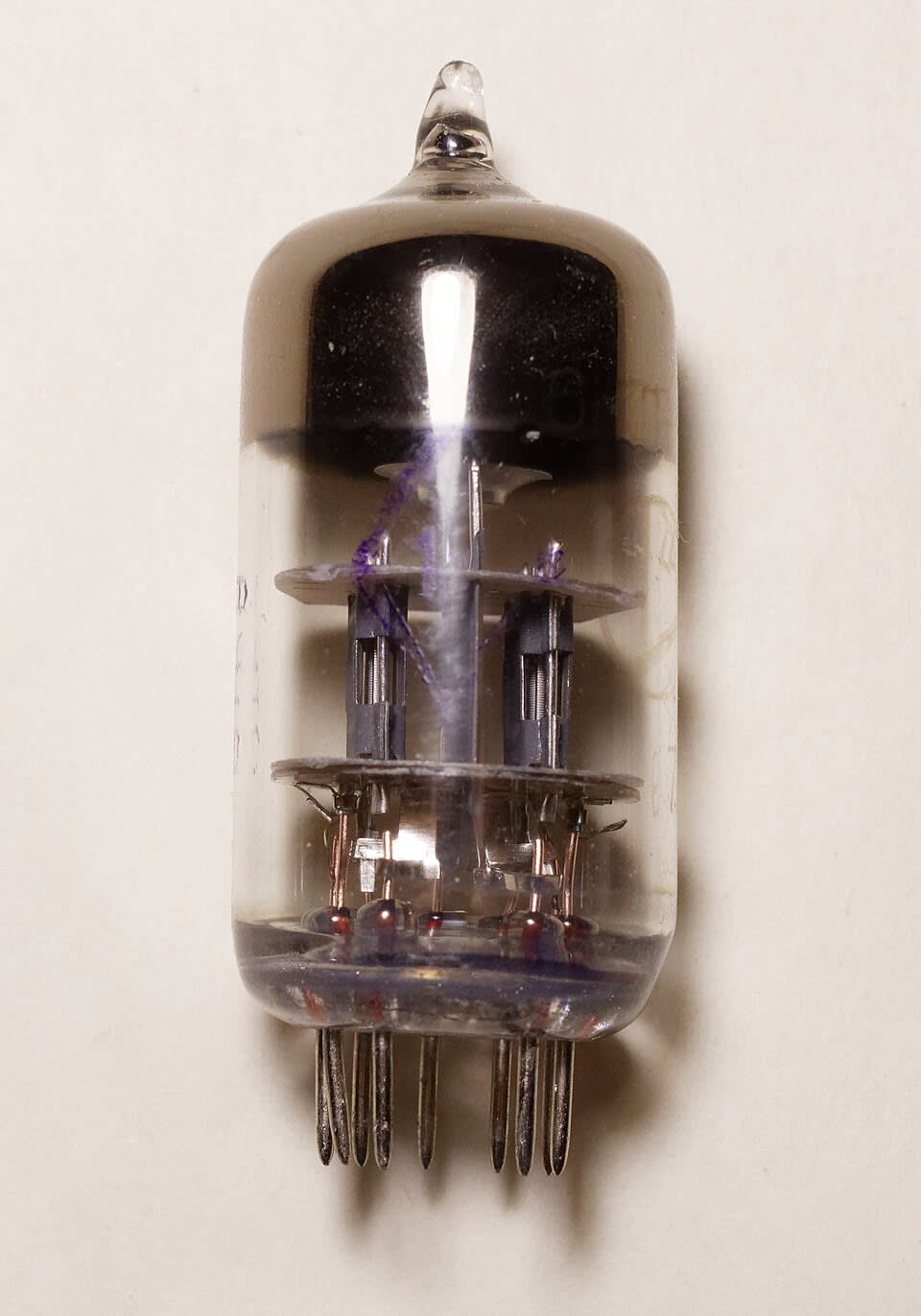
The ruggedized long-life version: a 6Н3П-ЕВ from 1979. Photo: Retired electrician / Wikimedia Commons (CC0).
The Czechoslovak branch: Tesla 6CC42
Tesla’s 6CC42 is the family’s collector favorite, and its paperwork survives: the factory datasheet (1955 and 1958 editions) describes a double triode for grounded-grid RF amplification and mixing up to 300 MHz and states that it “replaces the foreign types 5670 and 2C51.” The 1955 edition calls the 6Н3П the “Soviet equivalent”; the 1958 revision softens that to “approximate Soviet type” and raises the maximum anode dissipation from 1.5 to 2.5 W per system.
The name decodes by Tesla’s own system: 6 for the 6.3 V heater, CC for double triode (as in ECC), 4 for the noval base, 2 as the sequence number. Its specs sit where the family lives: 8 mA and 5.25 mA/V at 150 V / −2 V, µ = 35, with an internal shield between the sections. As a mid-1950s noval tube it likely came from the Rožnov pod Radhoštěm works, where Czechoslovak all-glass noval production was concentrated from 1951, though no surviving document ties the type to a plant.
What makes the 6CC42 interesting to collectors is not the datasheet — it is the glass.
The pinched waist
Early 6CC42s have a pinched waist: the bulb narrows in the middle, as if cinched with a belt. Legible date codes run from 1956 to 1959, and this is the rarest and most sought-after variant of the type — this NOS pinched-waist 6CC42 with an inclined D-getter shows the shape clearly.
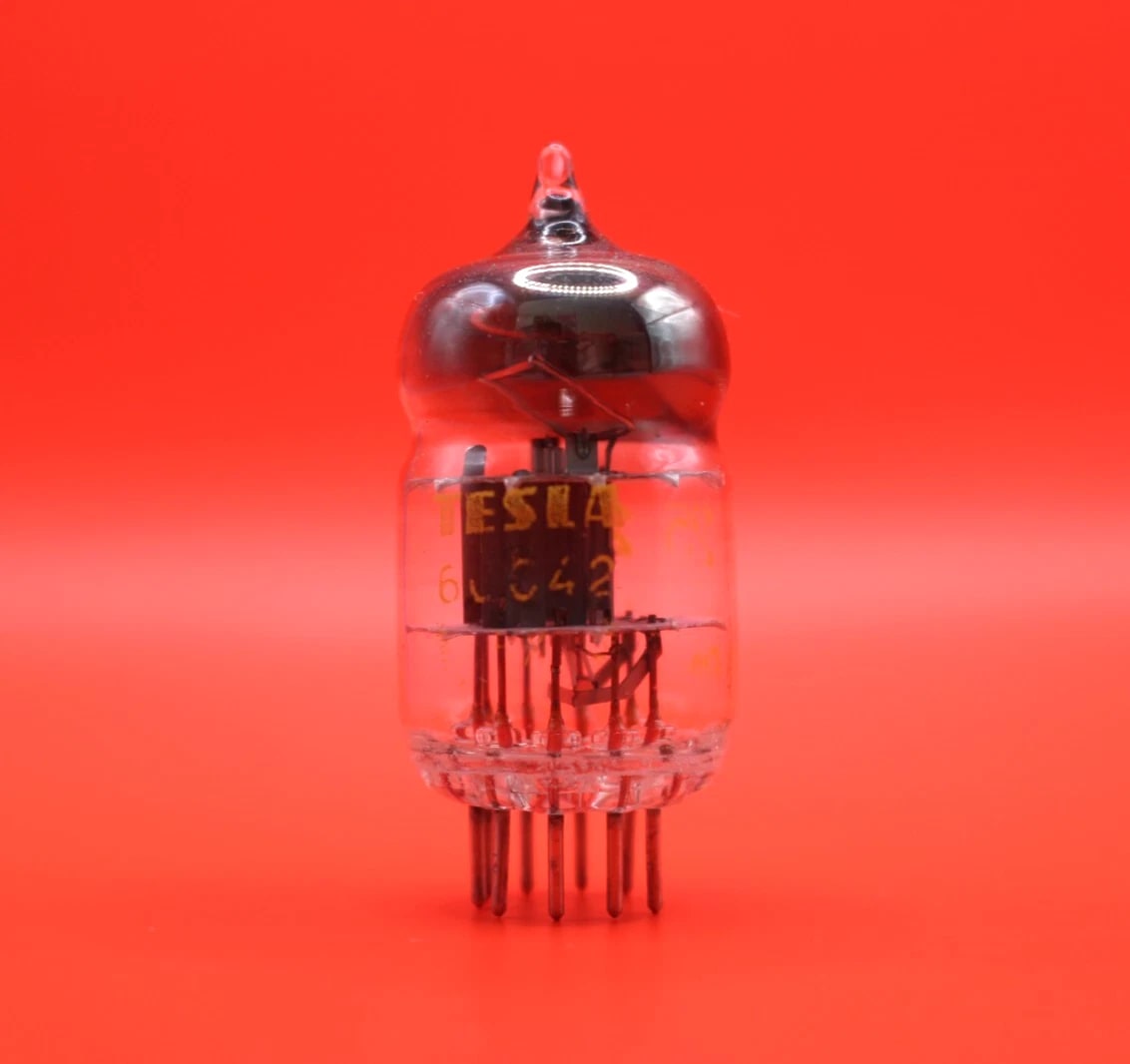
A pinched-waist Tesla 6CC42: the envelope narrows at the level of the mica spacers.
The pinched waist is not a Tesla invention — it is a 1950s European manufacturing signature, best known from the Philips/Amperex E88CC/6922 made at Heerlen around 1957–59. The constriction is thought to lock the internal mica spacers against the envelope wall, cutting vibration and microphonics; it was expensive to make and gave way to straight glass after a few years. That rationale is documented for the Philips tubes rather than in Tesla’s own records, but the scarcity is real either way — pinched-waist production ran only a few years at any factory.
Getters: D, square, inclined
The getter — the metal loop holding the flash material that keeps the vacuum clean — also helps date a tube. Broadly, D-shaped and square getters mark 1950s production, round halo/O-getters the 1960s, and A-frame supports the 1970s. Tesla 6CC42s appear with the full range of 1950s types, often mounted at an angle (“inclined”):
- Inclined D-getter — on the pinched-waist tube above;
- Inclined square getter — as on this square-getter 6CC42 mounted at an angle;
- Square getter, straight mount — as on this square D-getter example;
- Later straight-bottle production — the affordable way into the type, as with this tested 6CC42.
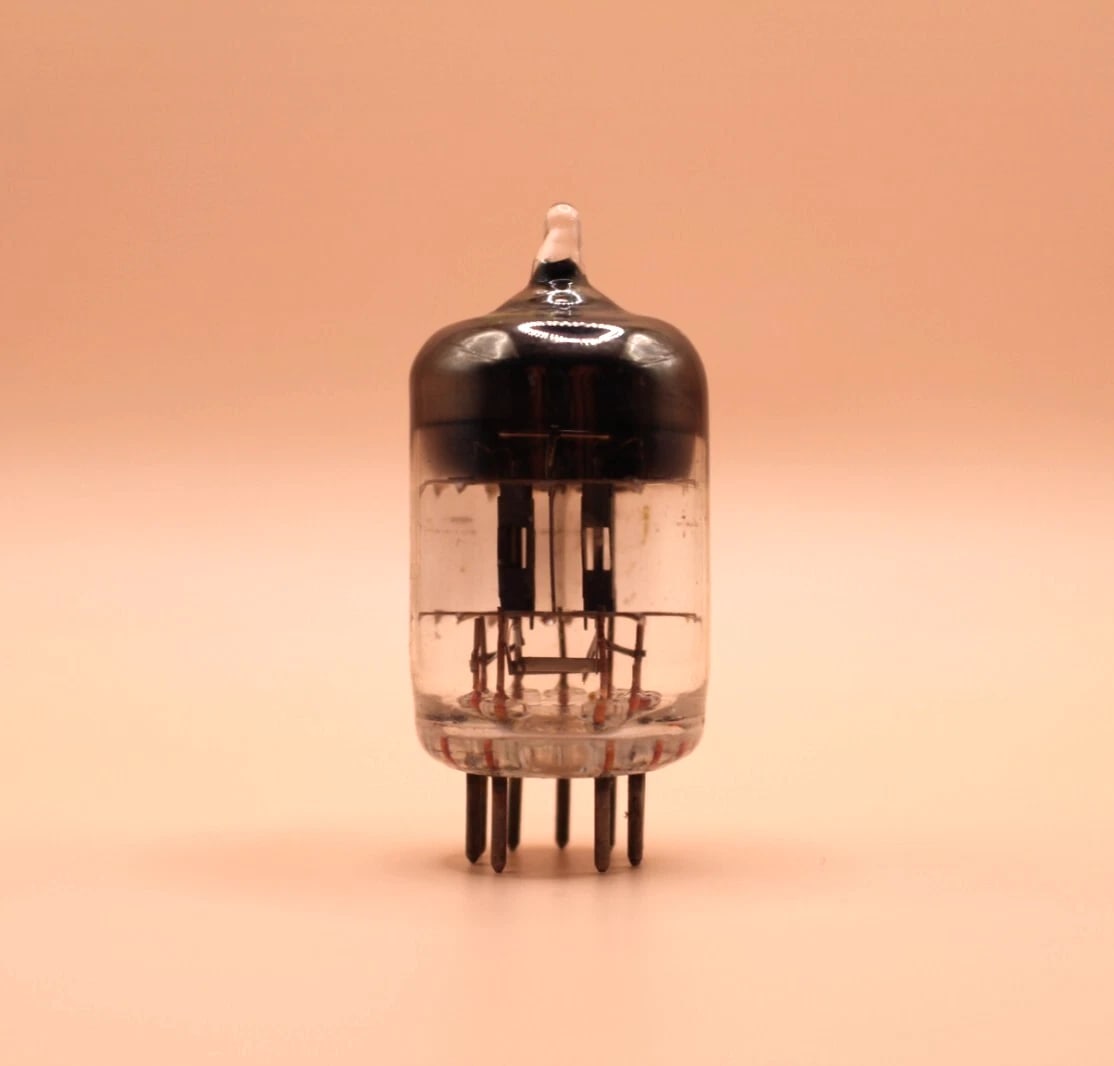
Square getter at the dome of a 1950s Tesla 6CC42.
Getter shape and glass profile date a tube but don’t certify it, so sixty-year-old stock should be bought measured — the L3-3 tester article covers what that testing verifies. Tesla’s date codes are a subject of their own; a reference chart for 1947–1984 codes is listed in the references below.
The early Tesla has a strong reputation among audio users, usually placed alongside the Bendix and Tung-Sol versions just below the Western Electric original. That side is subjective — the measurable facts are the specs, the construction, and the test numbers on the label.
Not a 6922
The 6N3P/5670 family and the 6DJ8/6922/ECC88 family are both medium-mu double triodes on a noval base, with similar amplification factors (≈35 vs ≈33), which makes them easy to confuse. They are not interchangeable, because the pins are wired differently:
| Pin | 2C51 / 5670 / 6N3P / 6CC42 | 6DJ8 / 6922 / ECC88 |
|---|---|---|
| 1 | heater | plate 1 |
| 2 | cathode 1 | grid 1 |
| 3 | grid 1 | cathode 1 |
| 4 | plate 1 | heater |
| 5 | internal shield | heater |
| 6 | plate 2 | plate 2 |
| 7 | grid 2 | grid 2 |
| 8 | cathode 2 | cathode 2 |
| 9 | heater | shield |
Nearly every pin is in a different place, so a 5670 will not work in a 6922 socket. Across the family the heaters are on pins 1 and 9 and the inter-section shield on pin 5 (usually grounded) — the same on the GE and Soviet datasheets alike.
A socket adapter bridges the two. 5670→6922 adapters are cheap and common, and let owners of 6922 gear try the 5670/6N3P. The adapter fixes the wiring but not the circuit: the 6922 has about twice the transconductance (≈12.5 vs ≈5.5 mA/V), so bias and gain shift and results depend on the design. For gear built around the 6DJ8/6922, the closer Soviet options are the 6N23P (the true electrical equivalent) and the 6N1P-EV (same pinout, but heavier heater draw and lower gain).
Modern uses and availability
Only one member is still made: the Chinese 6N3, produced by Shuguang and supplied new in current budget gear. Everything else in the family — Western Electric 396A, Bendix 6385, Tesla 6CC42 and the Soviet 6N3P — went out of production decades ago and is sold only as new-old-stock. For a tube designed for 1940s telephone relays, it still turns up in plenty of places:
- Budget Chinese hybrids. The Chinese 6N3 is the stock tube in many inexpensive preamps and buffers — FX-Audio Tube-01/03/06, Little Bear P3 and similar boards. A common first upgrade is swapping it for a Soviet 6N3P-E or 6N3P-EV, or an American JAN 5670W — same pinout, drop-in fit, tighter spec.
- Headphone amp rolling. The whole family gets rolled through hybrid and OTL headphone amps. One caution for Little Dot owners: the MK-series amps are wired for the EF95/6AK5 pentode family, so 5670-family tubes fit only via adapters.
- 6922-socket gear via adapters, with the transconductance caveat above.
- Collecting. Western Electric 396As, Bendix 6385s and pinched-waist Teslas form the premium tier — which is exactly where buying measured, labeled stock matters most.
Bottom line
Behind the wall of names — 2C51, 396A, 5670, 6385, CV2831, 6CC42, 6N3P, 6N3 — sits one 1946 Bell Labs design: the double triode that introduced the 9-pin noval base. Its American, Czechoslovak, Soviet and Chinese branches share its specs and its heater-on-pins-1-and-9 basing, so they are interchangeable with each other but not with the 6DJ8/6922 without an adapter. The Soviet suffixes are a durability ladder (-Е at 5,000 hours, -ДР at 10,000), not a tone control. And the early Tesla 6CC42 with a pinched waist and D-getter is worth buying the same way as the two-dollar 6N3P-E: measured, labeled, and with its markings intact.
Thank you for reading!
References used:
- G. C. Dalman, “A New Miniature Double Triode,” Bell Laboratories Record, September 1947
- 2C51 — radiomuseum.org
- 5670 — radiomuseum.org
- 6385 — radiomuseum.org
- 2C51 exhibit — The Valve Museum (r-type.org)
- GE GL-5670 datasheet — frank.pocnet.net
- Soviet 6Н3П handbook datasheet — frank.pocnet.net
- Tesla 6CC42 factory datasheet, 1955/1958 editions — frank.pocnet.net
- Радиолампа 6Н3П — vt-tech.eu
- 6N3P — English Wikipedia
- Deciphering Soviet tube suffix — tubemaze.info
- Amperex 6922 pinched waist D-getter — tubemaze.info
- European tube factories tour — tubemaze.info
- Střípky z historie Tesly Rožnov pod Radhoštěm (2014 exhibition guide, PDF)
- Code chart for Tesla tubes 1947–1984 — tubes-store.com
- 6DJ8 family getter chronology — Brent Jessee (audiotubes.com)
- 5670 W396A 2C51 6N3P tube thread — Head-Fi
- Little Dot tube amps: vacuum tube rolling guide — Head-Fi
- Little Bear P3 opinions (6N3 → 6N3P-EV upgrade reports) — diyAudio
- 5670 tubes: do they really replace a 6N3 Chinese tube — Audiokarma
- How is the GE 5670 compatible with the 6922 — iFi Audio FAQ
- 6CC42 Tesla NOS — Tube Amp Doctor