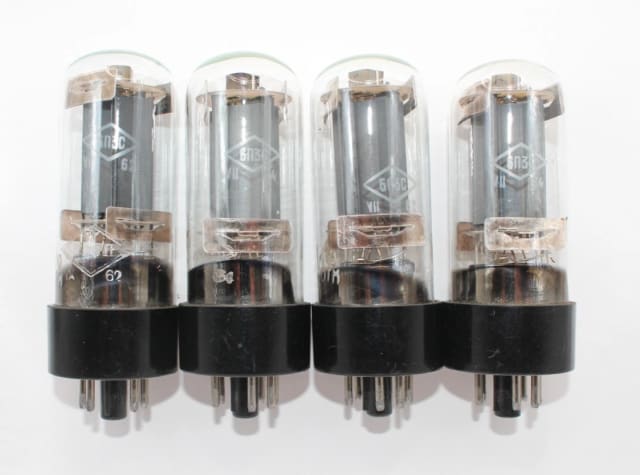

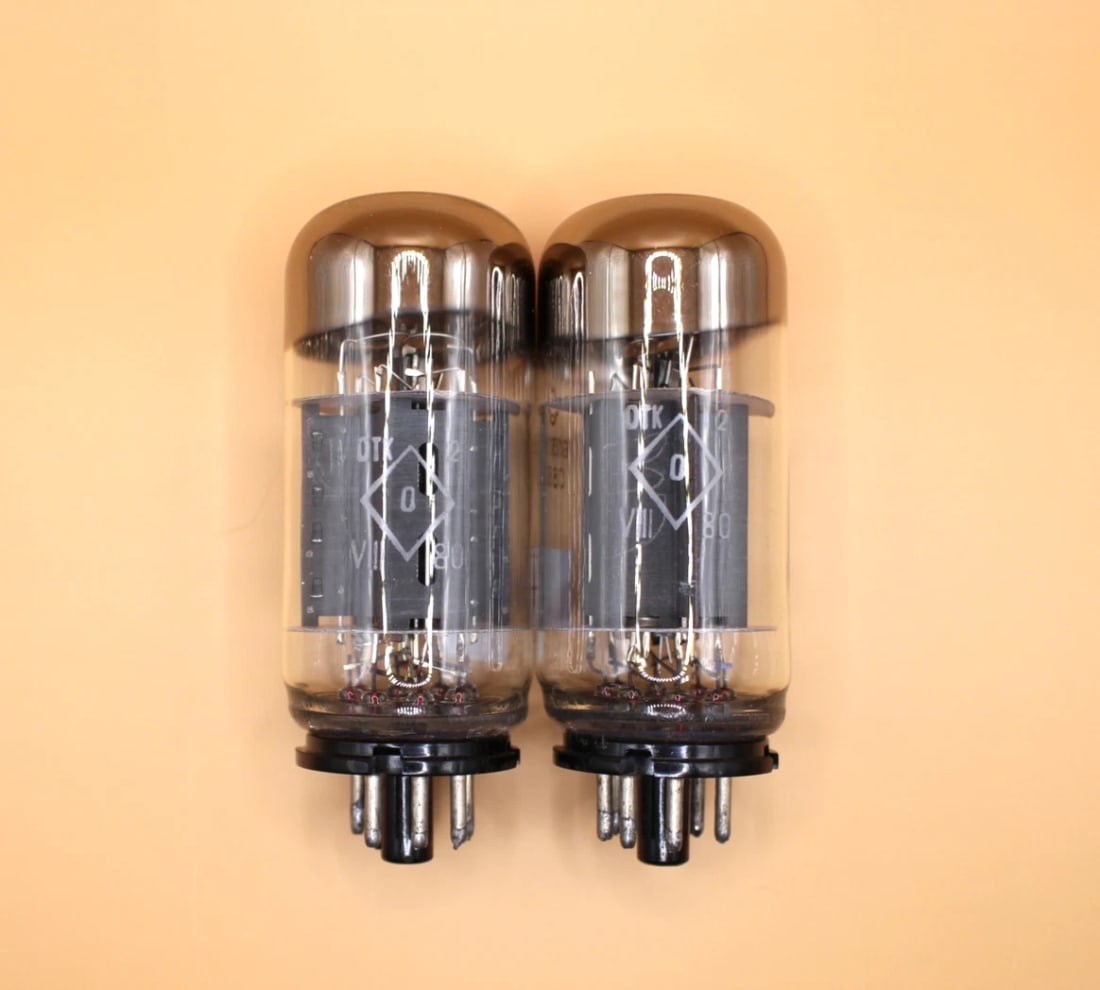
A buyer recently asked whether Soviet 6P3S or 6P3S-E tubes would be suitable for a 100W build with about 445V on the plates.
Short answer: I would not treat standard 6P3S as a safe 450V 6L6GC replacement. For 6P3S-E, some builders run them around 400V or higher, but that is not the same as having a 6L6GC-style datasheet rating for 445-450V operation.
Datasheet Numbers
The confusing part is that “6L6 equivalent” does not always mean “6L6GC rating.”
- A 6L6GC datasheet gives a maximum plate voltage of 500V, maximum screen voltage of 450V, and maximum plate dissipation of 30W.
- An original Tung-Sol 5881 datasheet gives 400V maximum plate voltage, 400V maximum screen voltage, and 23W maximum plate dissipation.
- A 6P3S listing from Russian Electronics gives 400V maximum anode voltage, 300V maximum screen-grid voltage, and 20.5W maximum anode dissipation.
- A translated Soviet 6P3S / 6P3S-E table gives lower limited operating values: 375V anode voltage for 6P3S, 250V anode voltage for 6P3S-E, 300V screen voltage for 6P3S, 250V screen voltage for 6P3S-E, and about 20-20.5W anode dissipation.
So if the amplifier really expects a full 6L6GC rating, 6P3S and 6P3S-E should be checked carefully instead of installed only because the names are often cross-listed.
What People Do In Practice
Russian-language forum discussions show that builders do run these tubes above the conservative table values. The useful part of those discussions is not “600V is fine.” It is the repeated warning that the circuit details matter.
In one NewAudioportal thread, a user asking about 400V on 6P3S was told that the answer depends on the circuit: single-ended or push-pull, tetrode or triode connection, fixed or cathode bias. Another post in the same thread gives a practical rule for 400V operation: keep plate dissipation within the datasheet limit and keep the screen grid around 250-300V.
A Klyachin forum discussion asks almost the same kind of question: a 6P3S amplifier with about 430V on the plates and fixed bias. The replies are mixed, but the useful caution is consistent: do not look only at plate voltage; watch plate dissipation, bias method, protection from fault conditions, and mains-voltage drift. These forum reports are useful field notes, not formal ratings.
My Practical Answer
For a 445-450V build:
- Standard 6P3S: I would not recommend it as a direct substitute for a circuit designed around true 6L6GC limits.
- 6P3S-E: possible in some conservative builds, but I would want controlled screen voltage, screen resistors, conservative idle current, good ventilation, and tested/matched tubes.
- If the screens are also near 445V: use real 6L6GC-rated tubes instead of assuming Soviet 6P3S or 6P3S-E will tolerate it.
Before choosing tubes, check the actual plate-to-cathode voltage, screen-grid voltage, idle current, bias type, and output transformer load. The plate-voltage number alone is not enough.
Bottom Line
For 400V plate operation with controlled screens, 6P3S and especially 6P3S-E may be usable if the circuit is conservative and the tubes are tested. For a 445-450V 100W build, I would treat them as borderline and would not sell them as guaranteed 6L6GC replacements.
Thank you for reading!
References used: