

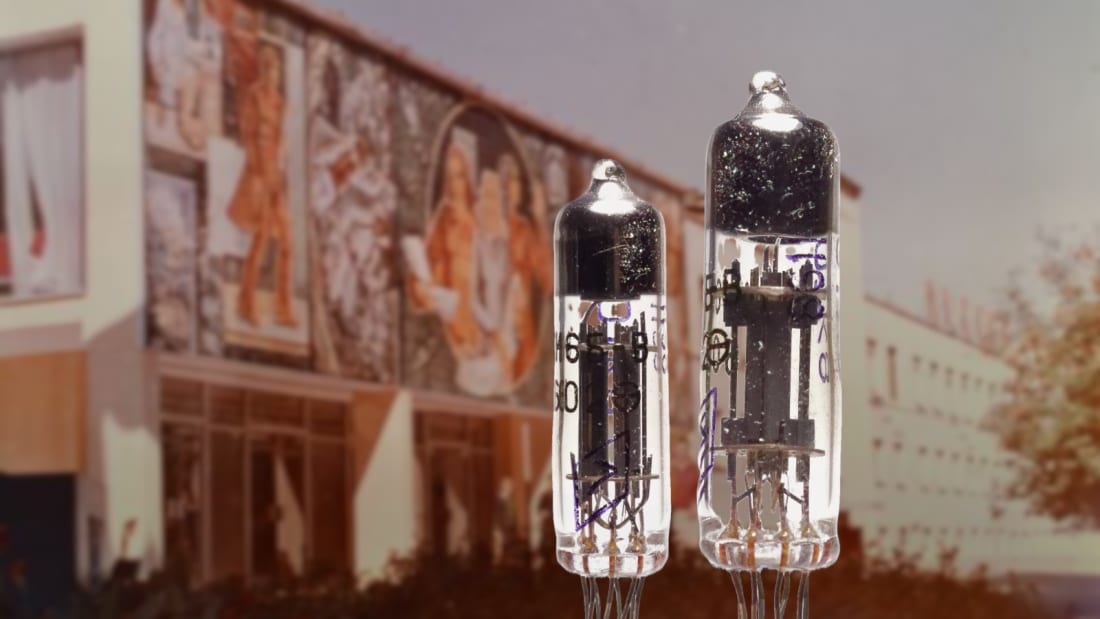
Some of the subminiature tubes we sell, such as 6S7B-V and 6N17B-V, came from the Orel Electronic Devices Plant (ORZEP). The plant opened in 1961 and was built for one job: making subminiature tubes. It kept making them until 1991.
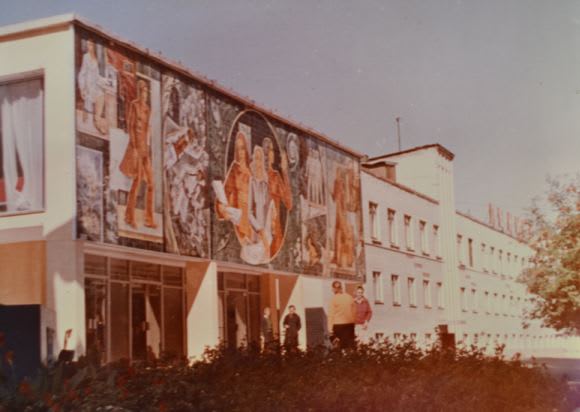
The Orel plant.
Tubes this small need a complex, precise process and a lot of hand work. So below we follow a tube through the plant in order: first what Orel made, then how the parts were made, how they were assembled, how the tube was sealed and pumped, and how it was tested before it could ship. Along the way you’ll see where details you notice on these tubes come from, such as the “gold grid,” the long flexible leads and the little glass tip on top. At the end, we’ll sum up what makes these tubes special.
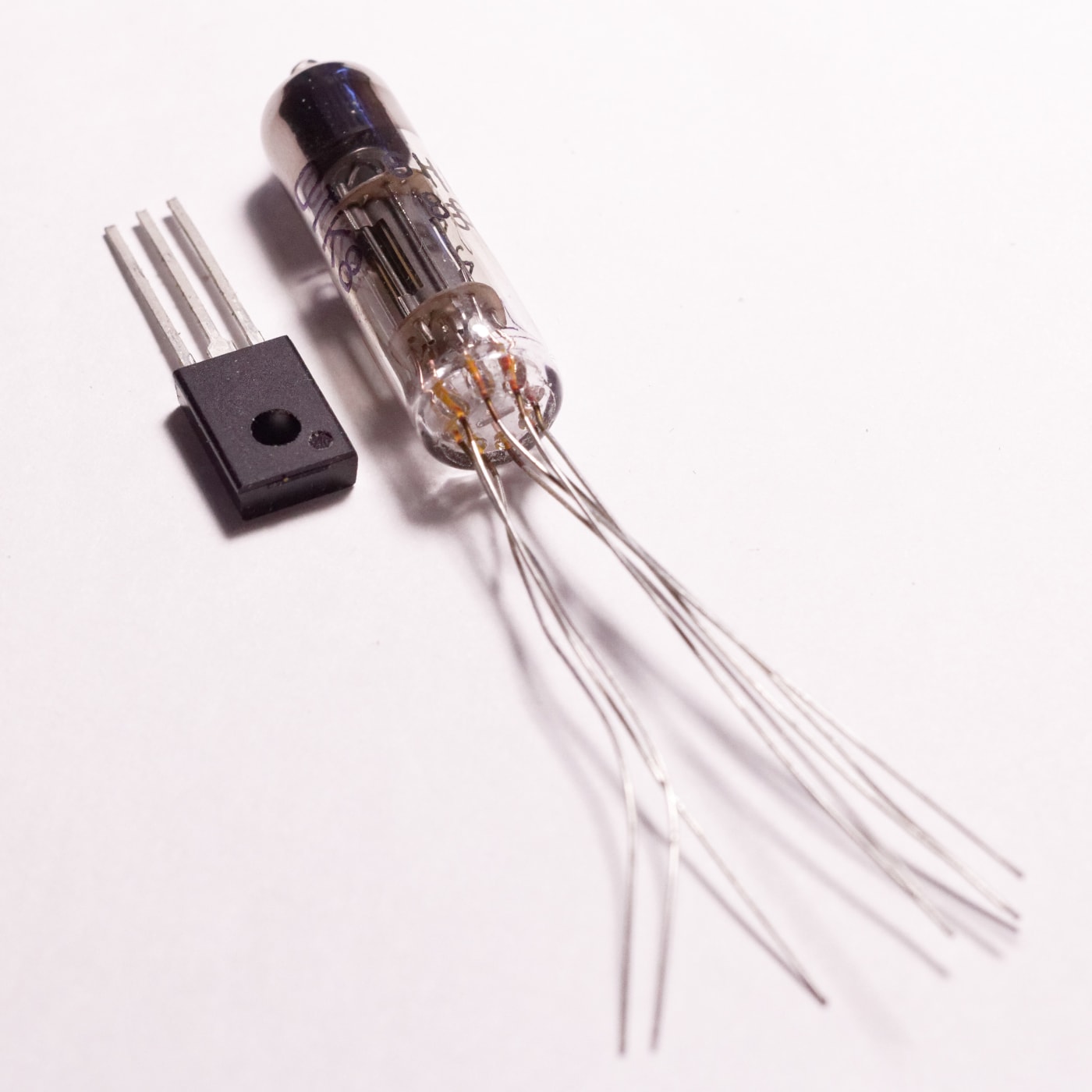
A 1986 Orel 6N16B-V next to a modern plastic transistor.
What the Plant Made
Two families from Orel’s lineup are in our shop:
- The “Drob” (Дробь) series: 6N16B-V, 6N17B-V, 6S6B-V and 6S7B-V, among others, all 10.2 mm in diameter.
- Rod tubes designed by Valentin Avdeev: 1J29B-V and 1P24B-V, among others.
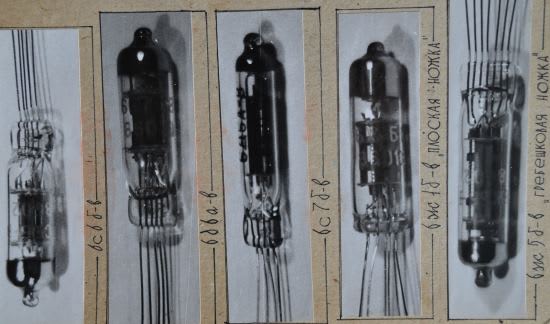
Drob-series tubes from the plant, labeled 6S6B-V, 6D6A-V, 6S7B-V, 6Zh1B-V and 6Zh5B-V.
Orel wasn’t the only source. Rod tubes were also made in Novosibirsk, and MELZ in Moscow made other types in the same subminiature style. To tell an Orel tube, look for the plant’s logo: the symbol for an electron, a circle with a minus sign inside. Every Soviet tube plant had its own mark, and our guide to Soviet tube factories and logos shows the others side by side. Orel’s is on the factory boxes.
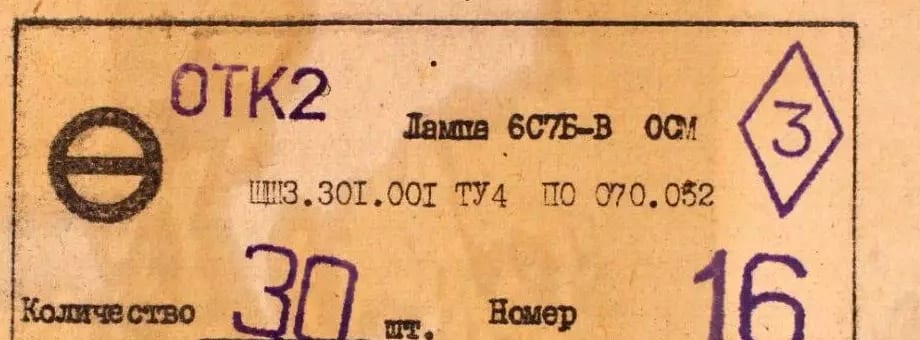
The Orel logo on the factory label of our 6S7B-V tubes.
It’s also printed on the glass, next to the date code.
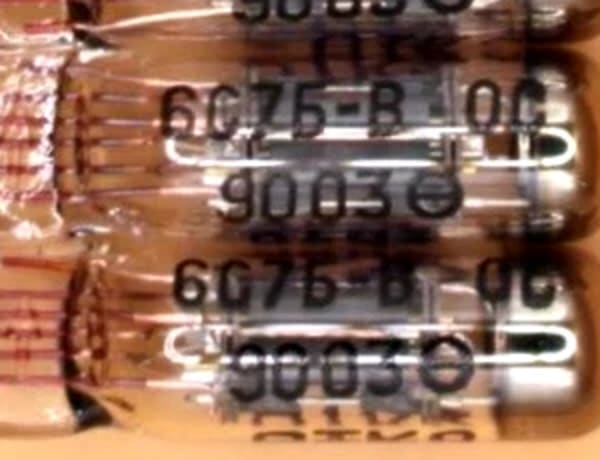
The same circle on the glass of those 6S7B-V tubes.
Besides the 6S7B-V, the circle is on the factory box of our 6N17B-V lot. On our 6N16B-V gold grid, 6S6B-V, 1J29B-V and 1P24B-V lots we haven’t confirmed the factory, so we list them as Soviet without naming the plant.
Making tubes like these took far more than an assembly hall. A tube plant had to produce most of its own parts, so that’s where a tube’s story starts.
Making the Parts
Orel ran its own stamping, glass, grid-winding and chemical-treatment shops. Between them they made thousands of different parts, some in quantities of millions a month.
Metal parts were stamped from very thin sheet and wire. The materials had to be ones that don’t release gas when heated in a vacuum, so mostly nickel and refractory metals.
The glass shop made the bulbs and stems from lead glass. The stem is the glass base that carries the leads into the tube. Stems for ordinary miniature tubes got rigid pins, while stems for subminiature tubes got flexible leads, which is why these tubes come with long wires instead of pins. The leads are platinite wire, an iron-nickel core in a copper sleeve, which expands with heat at the same rate as the glass, so the seal stays vacuum-tight.
Orel pressed flat stems on multi-spindle machines: small glass discs with the leads sealed straight through them. The 6N16B-V has one.
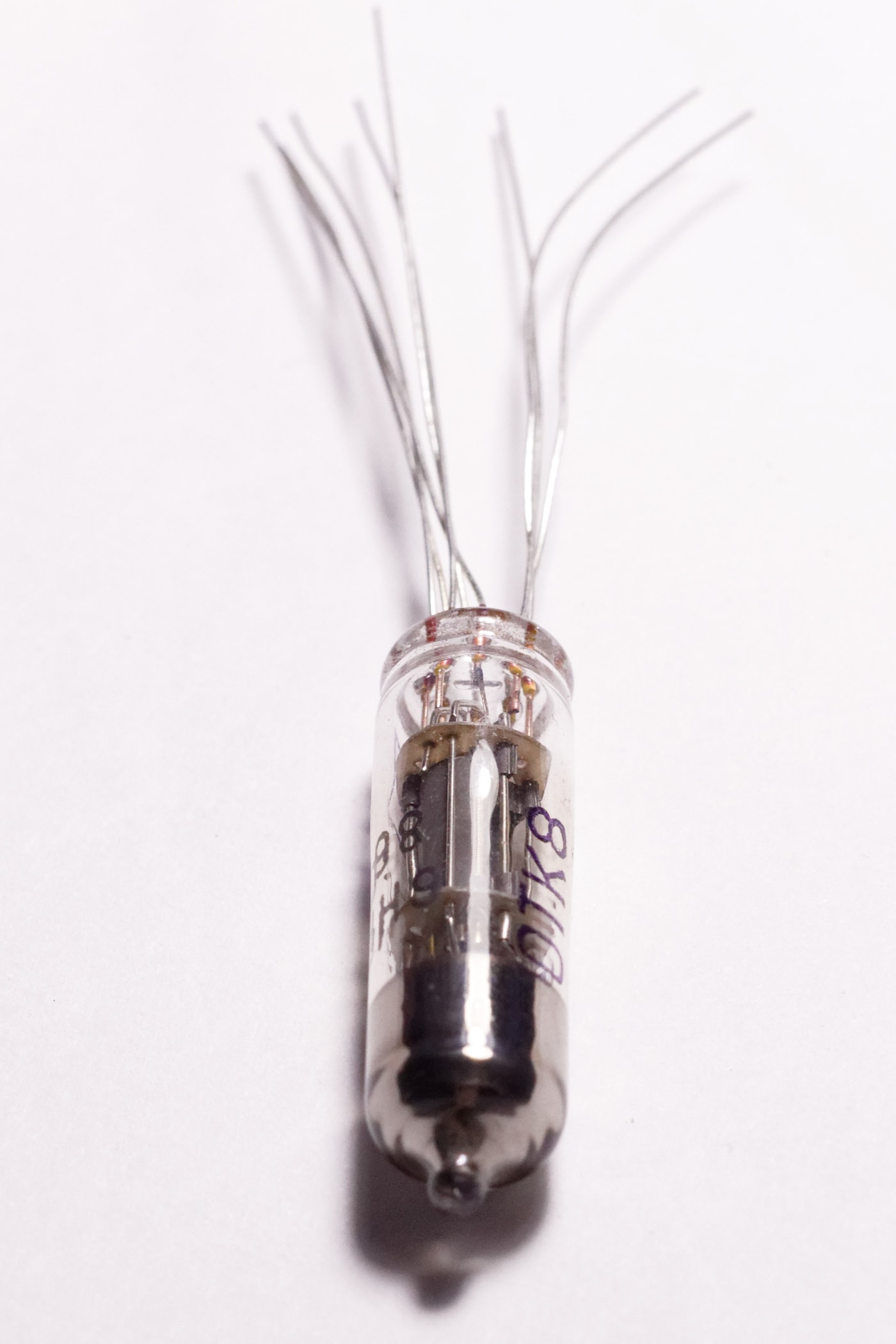
The flat stem of a 1986 Orel 6N16B-V, with the flexible leads sealed straight through it.
Some Drob types used an older design, the comb stem. It starts as a short glass tube that’s flared at one end and flattened at the other, and the leads are sealed through the flattened end. It was the first way tube makers brought a group of leads through glass, and it suits hand work.
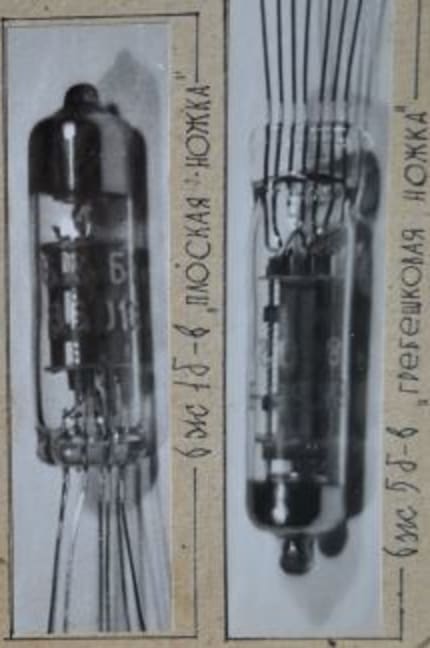
From the plant’s display: a 6Zh1B-V with a flat stem (left) and a 6Zh5B-V with a comb stem (right, shown leads up).
Grids were wound on machines that were partly brought from Germany after the war and partly Soviet copies built by a plant in Saratov. The first grid was wound with gold-plated tungsten wire. The second and third grids used molybdenum wire, and the side rods were nickel. So at Orel, “gold grid” meant gold-plated tungsten on the first grid. That’s Orel’s practice; it doesn’t tell you what wire other plants used.
The chemical shop made heaters and directly heated cathodes, and cleaned every part that would go inside a tube. Parts were washed in deionized water, sometimes with ultrasound, and annealed in furnaces filled with hydrogen or nitrogen, or in vacuum. The point was to keep parts from releasing gas, both during production and later inside a working tube. Cleaned parts went into sealed cabinets under a steady flow of nitrogen, and they had to be assembled and pumped within a set time.
With the parts ready, the tube moved to the most labor-intensive step: putting it together.
Assembly in Clean Rooms
Assembly took 40–50% of the labor in each tube, and it was the least mechanized step. Rooms held 300 to 600 assemblers at once, working under dust hoods with filtered air blown in. Staff wore lint-free clothing, cosmetics were banned, people entered through an airlock, and hand sweat was checked twice per shift.
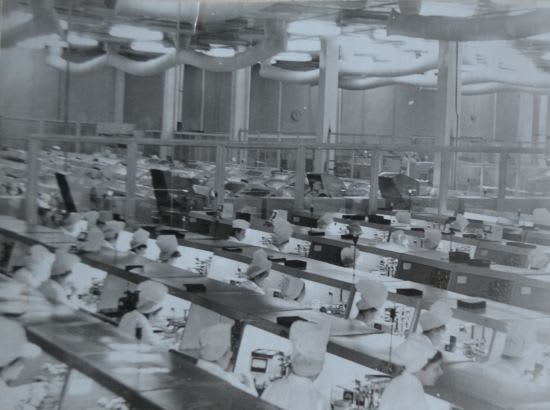
An assembly room at the plant.
For Drob tubes, Orel took over an assembly line from MELZ that the Moscow plant had never managed to get running. Orel’s engineers rebuilt it and added parts of their own, and the plant had to tighten tolerances on grids and anodes to make it work. Training a new assembler dropped from nine months to three. From then on, all Drob triodes and pentodes in series production were assembled on copies of this line. No other plant in the USSR assembled these wound-grid subminiatures by machine.
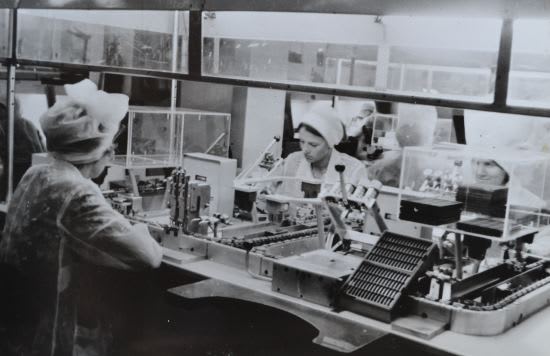
Assemblers at work.
Rod tubes were never mechanized. They were built on mandrels under a microscope, and welding in the directly heated cathode took real skill. Every assembler left a personal mark on their work, so defects could be traced back to whoever built the tube.
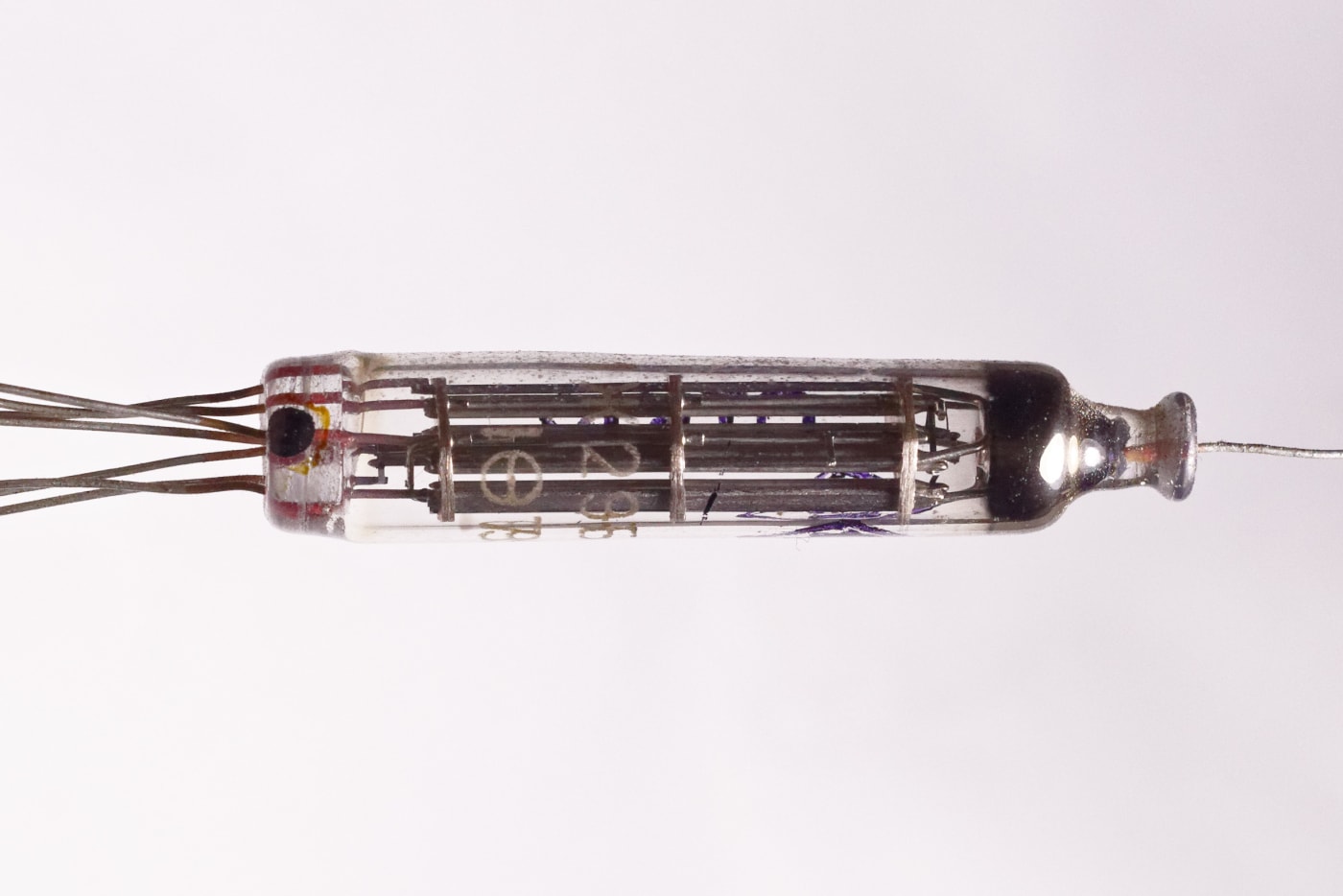
A 1979 Orel 1Zh29B-V rod pentode. The rods that give these tubes their name run the length of the bulb, and the Orel circle is printed on the glass.
Each finished assembly was checked under a microscope and washed again in deionized water. The plant went through tons of alcohol, but only for drying. Then the getter was welded on, a glass bulb with a pumping tube was slipped over the assembly, and the tube moved on to what the plant called the “hot operations.”
Sealing and Pumping
First the bulb was sealed to the stem on 24-spindle carousel machines. Then the tube was pumped down to about 10⁻³ mm Hg on 36-position carousels. While it was pumping, a tunnel furnace drove gas out of the glass and mica, high-frequency induction heated the metal parts, and the heater was switched on to activate the cathode by turning its carbonate coating into oxides.
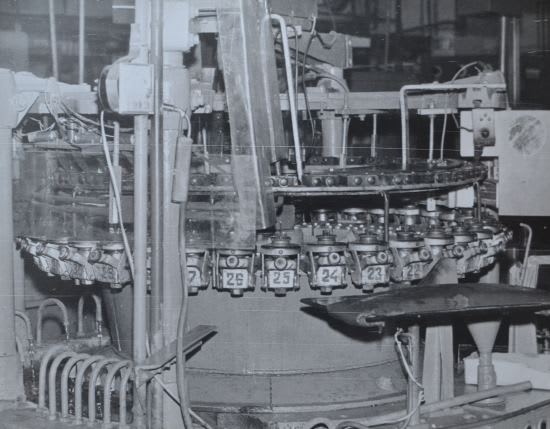
A carousel pumping machine, with the positions numbered around the rim.
Subminiature tubes were then sealed off by hand with a gas torch. That’s the small glass tip you see on top of each tube in our photos. Finally the getter was flashed by high-frequency induction heating, which took the pressure down to around 10⁻⁶.
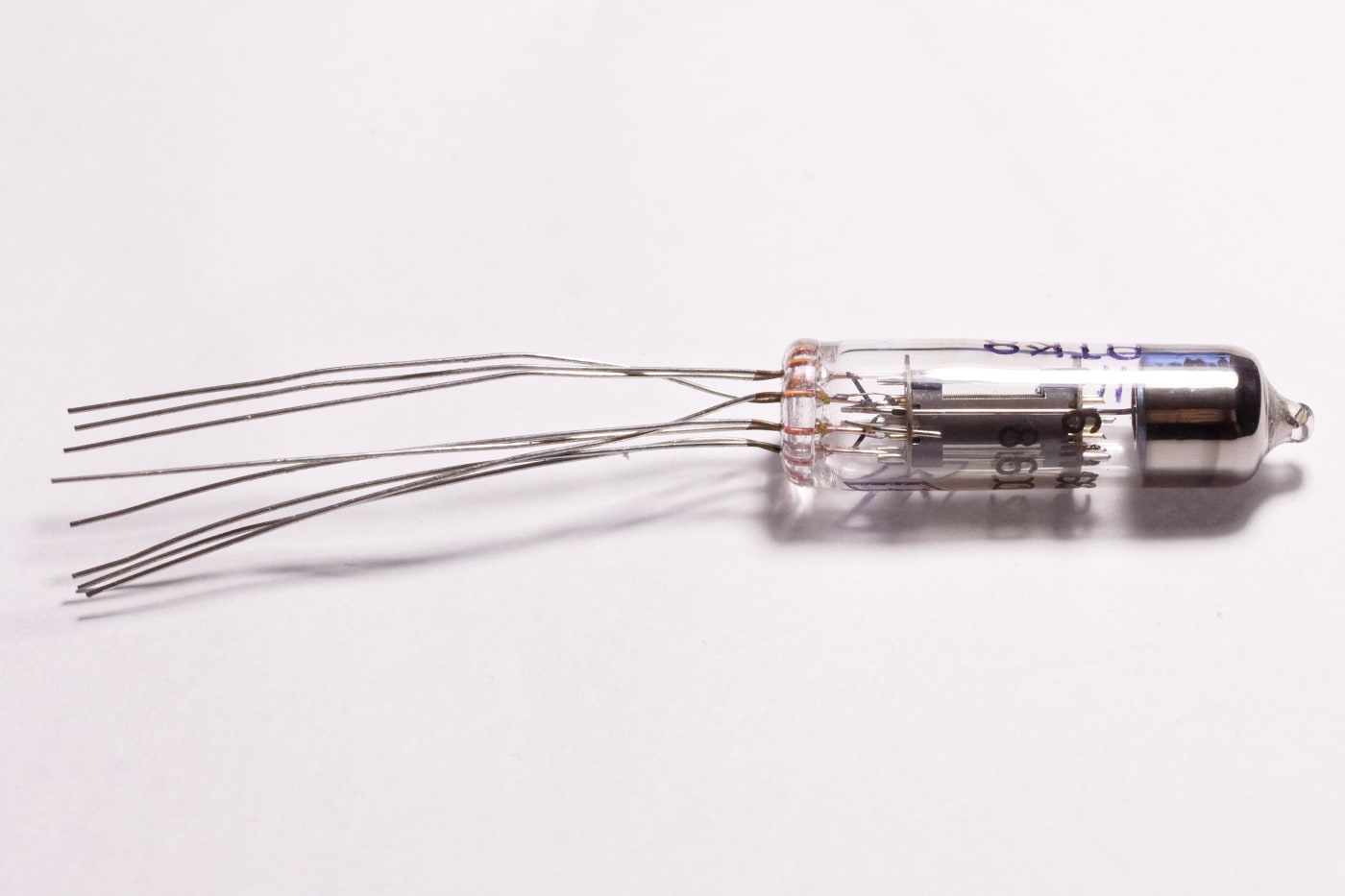
A finished 6N16B-V. The glass tip on the right is where it was sealed off.
A sealed tube still wasn’t ready to sell. Its cathode had to settle, and the weak tubes had to be found.
Burn-In and Testing
Every tube went through a multi-stage burn-in. It finished activating and stabilizing the cathode, drove the last gas out of the electrodes and settled the tube’s parameters. One stage deliberately ran tubes at the maximum allowed load to weed out weak ones. Higher-reliability tubes finished with a 24–72 hour stabilization run.
Acceptance testing checked for shorts and open circuits, electrical parameters, vibration resistance and microphonics. After that, higher-reliability tubes, including all subminiatures, sat in storage for two weeks, then were tested and inspected again. Only then could they ship.
Each lot of up to 1,000 tubes was also judged by a random sample of 100, checked on every parameter and on appearance. If any tube in the sample failed, the whole lot was rejected.
With checks this strict, many tubes never made it out.
Only Two in Three Passed
Yields were counted from the sealing step onward. Ordinary miniature tubes passed at over 90%, partly thanks to rework. Drob and rod tubes passed at only 65–70%. In bad spells the yield fell almost to the level of “accidentally good.”
What Makes Them So Special
Follow one tube through Orel and three things stand out.
Control at every step. Every tube was burned in, tested, held for two weeks and tested again. A single failure in a sample of 100 rejected a whole lot of up to 1,000. Incoming materials were all inspected, and the most critical ones went into production only after a trial run. Bonuses equal to 60% of wages depended on quality, and the cost of defective tubes was charged to whoever was responsible. The result: complaints from customers ran at hundredths to thousandths of a percent of the tubes shipped. The 65–70% yield is the other side of the same coin.
Materials chosen for the job. Gold-plated tungsten for the first grid, molybdenum for the others, nickel side rods, metal parts made only from metals that don’t release gas in a vacuum, and platinite leads that expand at the same rate as the lead glass around them. Parts going inside the tube were washed in deionized water, annealed in hydrogen or nitrogen, and kept under nitrogen until assembly.
A whole industry under one roof. The plant made its own bulbs and stems, stamped its own parts, wound its own grids and made its own cathodes. To run all that, it kept its own nitrogen and oxygen station, hydrogen electrolyzers, a deionized water plant, compressed air and backup power for processes that couldn’t be stopped, all connected by about 30 km of stainless steel piping. These support systems alone used about 40% of the plant’s electricity. The Soviet electronics industry was an island: tube plants made their own glass, platinite and refractory-metal wire because there was no one else to rely on.
That last point is also why it’s so hard to bring back. Once demand fell and electricity got expensive, all that energy-hungry infrastructure became one of the main reasons tube plants collapsed so quickly. Orel’s subminiature tubes ended in 1991. Every new-old-stock Orel tube is a finished product of a system that no longer exists.
Thank you for reading!
This article is based on a two-part account written in 2013 by Gennady Kulibabin, who worked at ORZEP for more than 25 years and rose from lab engineer to technical director. The plant photos come from the same account. The photos of a 1986 Orel 6N16B-V, including the header, and a 1979 Orel 1Zh29B-V come from Wikimedia Commons (public domain, CC0).
References used:


