

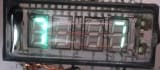
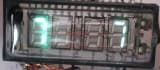

Soviet / IVL2-7/5
1x IVL2-7/5 vintage VFD USSR clock indicators / Original package / NOS / New
Green display tube in original packaging, NOS with same production dates, for VFD clocks
$3.0020 in stock
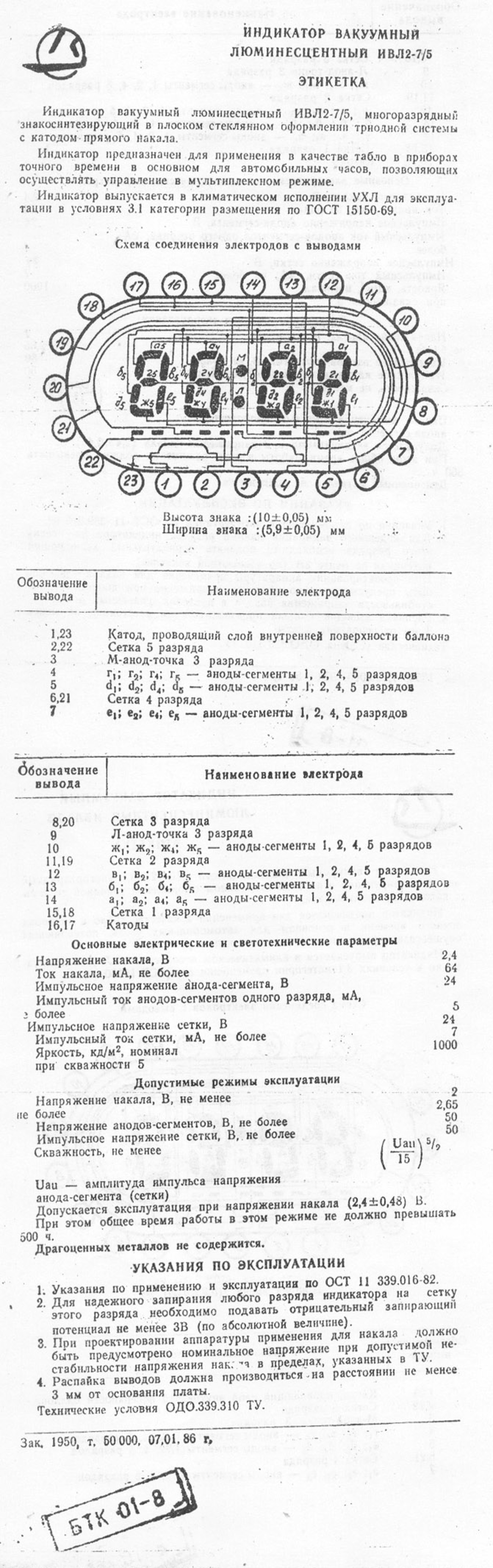
The scan is the IVL2-7/5 factory label (этикетка).

The IVL2-7/5 is a vacuum fluorescent indicator (индикатор вакуумный люминесцетный). It is multi-digit (многоразрядный) and character-synthesizing (знакосинтезирующий), in a flat glass design (в плоском стеклянном оформлении), of the triode system (триодной системы), with a directly heated cathode (с катодом прямого накала).

The indicator is intended for use as a display panel (табло) in precise-time devices (приборах точного времени), mainly for car clocks (автомобильных часов), that allow control in multiplex mode (управление в мультиплексном режиме).

The indicator is made in climatic version (климатическом исполнении) УХЛ, for operation in the conditions of placement category (категории размещения) 3.1, according to ГОСТ 15150-69.
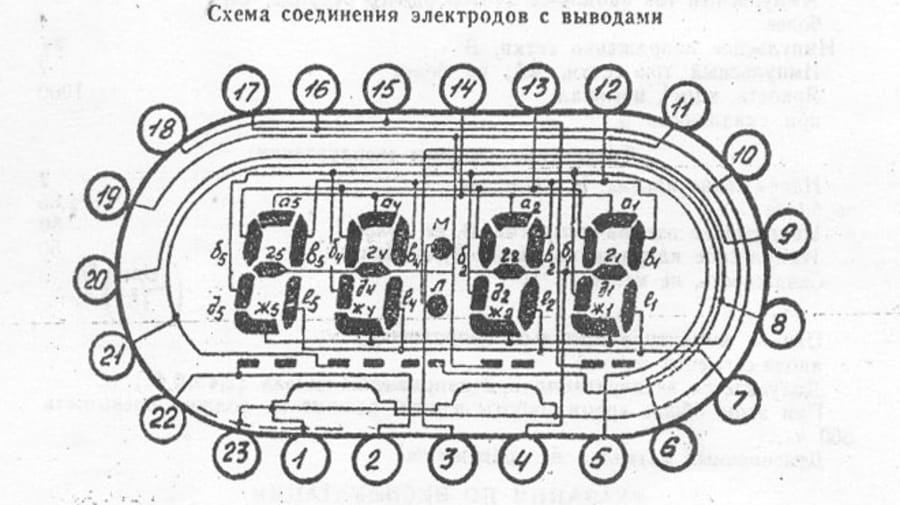
The leads are numbered circles around an oval outline. Lead 1 is at the bottom, near the left. From there the numbers run to the right along the bottom (1 to 6), up the right-hand end (7 to 11), from right to left along the top (12 to 17) and down the left-hand end (18 to 22), so lead 23 sits at the bottom left, next to lead 1.
Inside are four digits in a row, each drawn as seven filled segments, with two round dots between the second and third digit. Thin lines run from the leads along the inside of the outline and between the digits; at each rounded end several of them follow the curve of the outline. Under the digits is a row of short thick dashes. Below that, two outlines with a raised middle sit near the bottom edge, one above leads 1 and 2 and one above leads 3 and 4. A dashed line runs inside the outline from lead 22 along the bottom to lead 2.
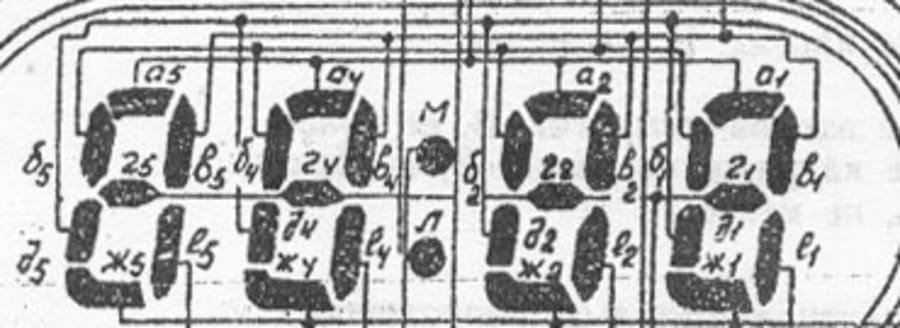
Each segment has a letter beside it, followed by the number of its digit. From left to right the digits carry the numbers 5, 4, 2 and 1. In every digit, а is by the top segment, б by the upper left, в by the upper right, г by the middle one, д by the lower left, е by the lower right and ж by the bottom one. The г is written in a script form that looks like a 2. The upper dot is labelled М and the lower one Л.

| Character size | Value |
|---|---|
| Character height (высота знака), mm | 10 ± 0.05 |
| Character width (ширина знака), mm | 5.9 ± 0.05 |
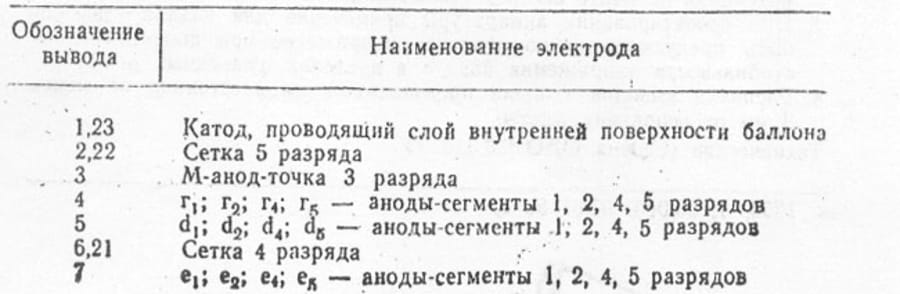
| Lead | Electrode | On the label |
|---|---|---|
| 1, 23 | Cathode, conducting layer of the inner surface of the bulb | Катод, проводящий слой внутренней поверхности баллонэ |
| 2, 22 | Grid of the 5th digit | Сетка 5 разряда |
| 3 | М anode-dot of the 3rd digit | М-анод-точка 3 разряда |
| 4 | г1; г2; г4; г5: anode-segments of the 1st, 2nd, 4th and 5th digits | г1; г2; г4; г5 — аноды-сегменты 1, 2, 4, 5 разрядов |
| 5 | d1; d2; d4; d5: anode-segments of the 1st, 2nd, 4th and 5th digits | d1; d2; d4; d5 — аноды-сегменты 1, 2, 4, 5 разрядов |
| 6, 21 | Grid of the 4th digit | Сетка 4 разряда |
| 7 | е1; е2; е4; е5: anode-segments of the 1st, 2nd, 4th and 5th digits | е1; е2; е4; е5 — аноды-сегменты 1, 2, 4, 5 разрядов |
The lead 5 row prints its letter as d, while the drawing letters the segments а, б, в, г, д, е and ж.

| Lead | Electrode | On the label |
|---|---|---|
| 8, 20 | Grid of the 3rd digit | Сетка 3 разряда |
| 9 | Л anode-dot of the 3rd digit | Л-анод-точка 3 разряда |
| 10 | ж1; ж2; ж4; ж5: anode-segments of the 1st, 2nd, 4th and 5th digits | ж1; ж2; ж4; ж5 — аноды-сегменты 1, 2, 4, 5 разрядов |
| 11, 19 | Grid of the 2nd digit | Сетка 2 разряда |
| 12 | в1; в2; в4; в5: anode-segments of the 1st, 2nd, 4th and 5th digits | в1; в2; в4; в5 — аноды-сегменты 1, 2, 4, 5 разрядов |
| 13 | б1; б2; б4; б5: anode-segments of the 1st, 2nd, 4th and 5th digits | б1; б2; б4; б5 — аноды-сегменты 1, 2, 4, 5 разрядов |
| 14 | а1; а2; а4; а5: anode-segments of the 1st, 2nd, 4th and 5th digits | а1; а2; а4; а5 — аноды-сегменты 1, 2, 4, 5 разрядов |
| 15, 18 | Grid of the 1st digit | Сетка 1 разряда |
| 16, 17 | Cathodes | Катоды |
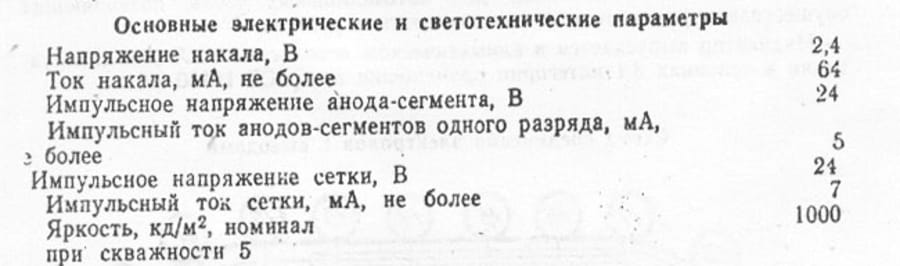
| Main electrical and lighting parameters (основные электрические и светотехнические параметры) | Value |
|---|---|
| Heater voltage (напряжение накала), V | 2.4 |
| Heater current (ток накала), mA | ≤ 64 |
| Pulse voltage of the anode-segment (импульсное напряжение анода-сегмента), V | 24 |
| Pulse current of the anode-segments of one digit (импульсный ток анодов-сегментов одного разряда), mA | ≤ 5 |
| Pulse voltage of the grid (импульсное напряжение сетки), V | 24 |
| Pulse current of the grid (импульсный ток сетки), mA | ≤ 7 |
| Brightness (яркость), cd/m², nominal (номинал), at an off-duty factor (скважность) of 5 | 1000 |
The second line of the anode-segment current row shows only the right-hand part of a letter like «е» before «более»; nothing is printed in front of it.
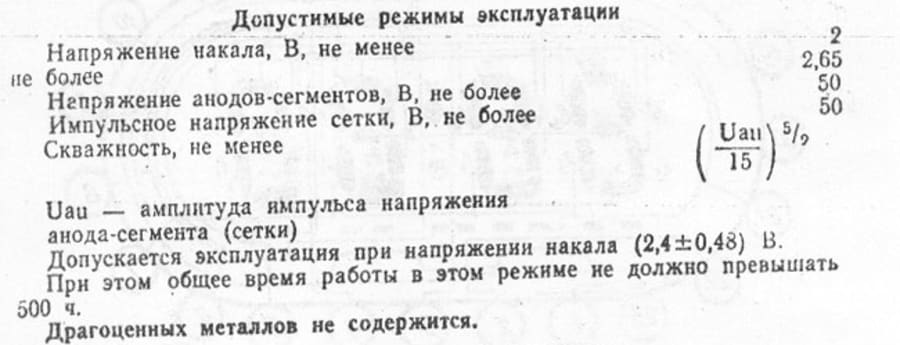
| Permissible operating modes (допустимые режимы эксплуатации) | Value |
|---|---|
| Heater voltage (напряжение накала), V | ≥ 2, ≤ 2.65 |
| Voltage of the anode-segments (напряжение анодов-сегментов), V | ≤ 50 |
| Pulse voltage of the grid (импульсное напряжение сетки), V | ≤ 50 |
| Off-duty factor (скважность) | ≥ (Uаи/15)5/… |
The column of figures sits a little higher than the lines of text.
In the formula, Uаи over 15 stands in brackets, raised to a power written as a fraction. Its top figure is 5. The figure under the stroke can’t be read with confidence: it has a rounded top and a tail curving down to the left, with no base stroke.
Uаи is the amplitude of the voltage pulse of the anode-segment (of the grid): «амплитуда импульса напряжения анода-сегмента (сетки)».
Operation is permitted (допускается эксплуатация) at a heater voltage of (2.4 ± 0.48) V. In this case the total operating time in this mode must not exceed 500 h.
Contains no precious metals (драгоценных металлов не содержится).

In item 3, the middle letters of the second «накала» are faint in the scan.
Technical conditions (технические условия): ОДО.339.310 ТУ.

The line reads «Зак, 1950, т, 50 000, 07,01, 86 г,», with the punctuation as it looks in the scan.

A stamp with a rectangular frame, pressed at a slant, reads «БТК 01-8».
The mark is drawn by hand: a circle with two short strokes in its upper half and a long, heavy stroke across its lower half that runs out past the circle on the left. It can’t be read with confidence.
Related products
Resources
Documentation
Browse our complete library of technical specifications and documentation.
Browse DatasheetsProducts
Explore our full inventory of vintage tubes, nixies, and capacitors.
View ProductsQuestions?
Need help finding the right part or datasheet? We're here to help.
Get in Touch