

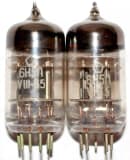

Only 3 left
Soviet / 6N5P
2x 6N5P Black Boxed anode 3x MICA ~CCa ~6N1P-E ~E88CC / Matched pair / New Nos
Black box anode, triple mica, 1960s production, matched pair, similar to CCa/6N1P-E/E88CC
$31.443 in stock
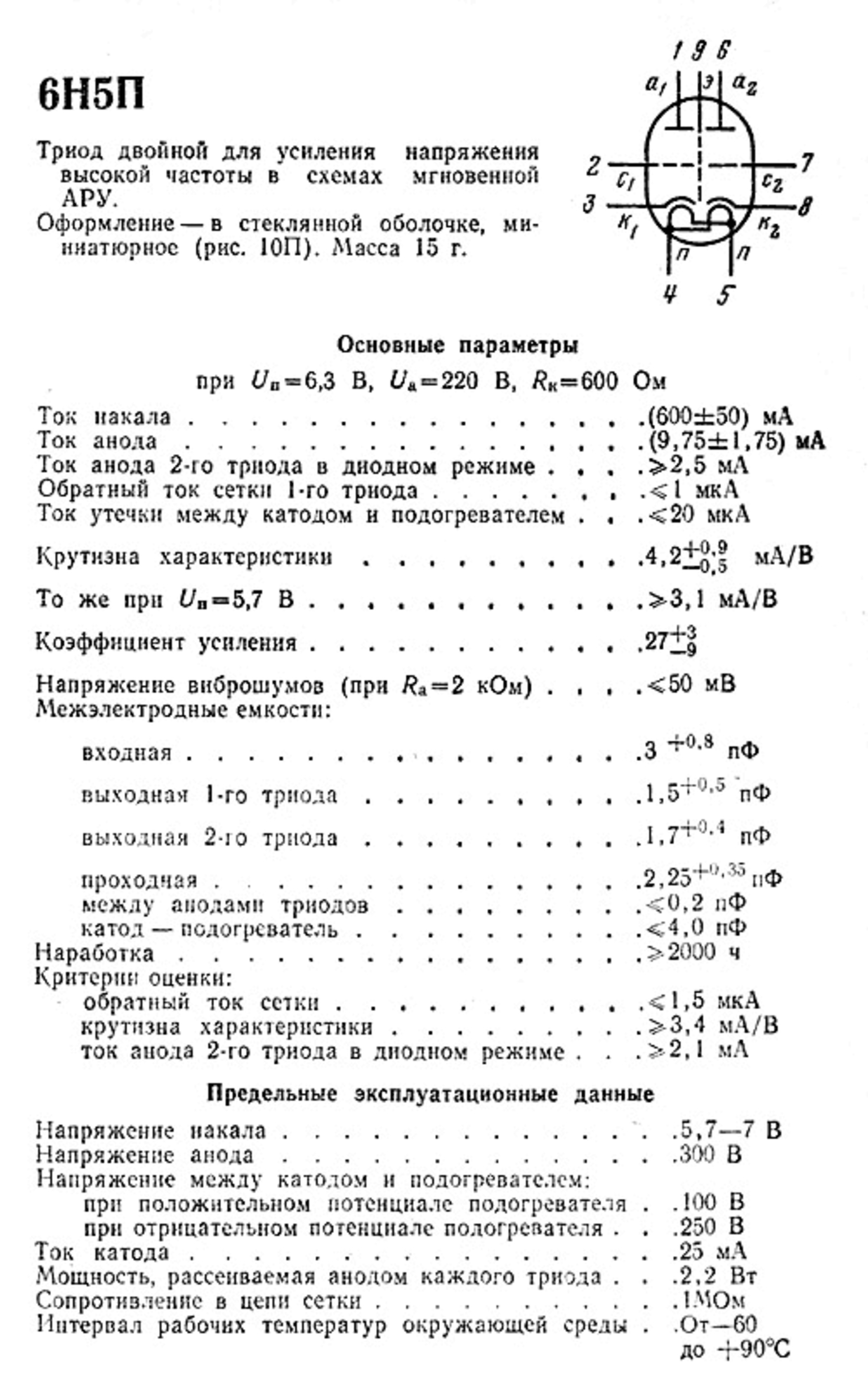
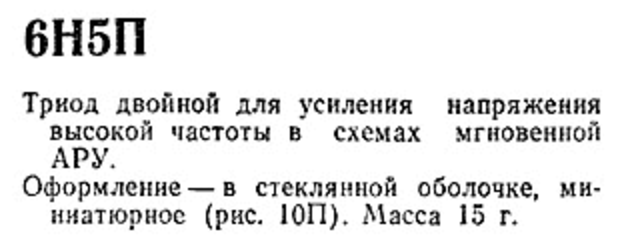
The 6N5P is a double triode. The handbook card on page 1 says it is for amplifying high-frequency voltage in instantaneous automatic gain control circuits (мгновенной АРУ). It comes in a glass envelope, miniature (the card points to its Fig. 10П, which is not part of this page), and weighs 15 g.
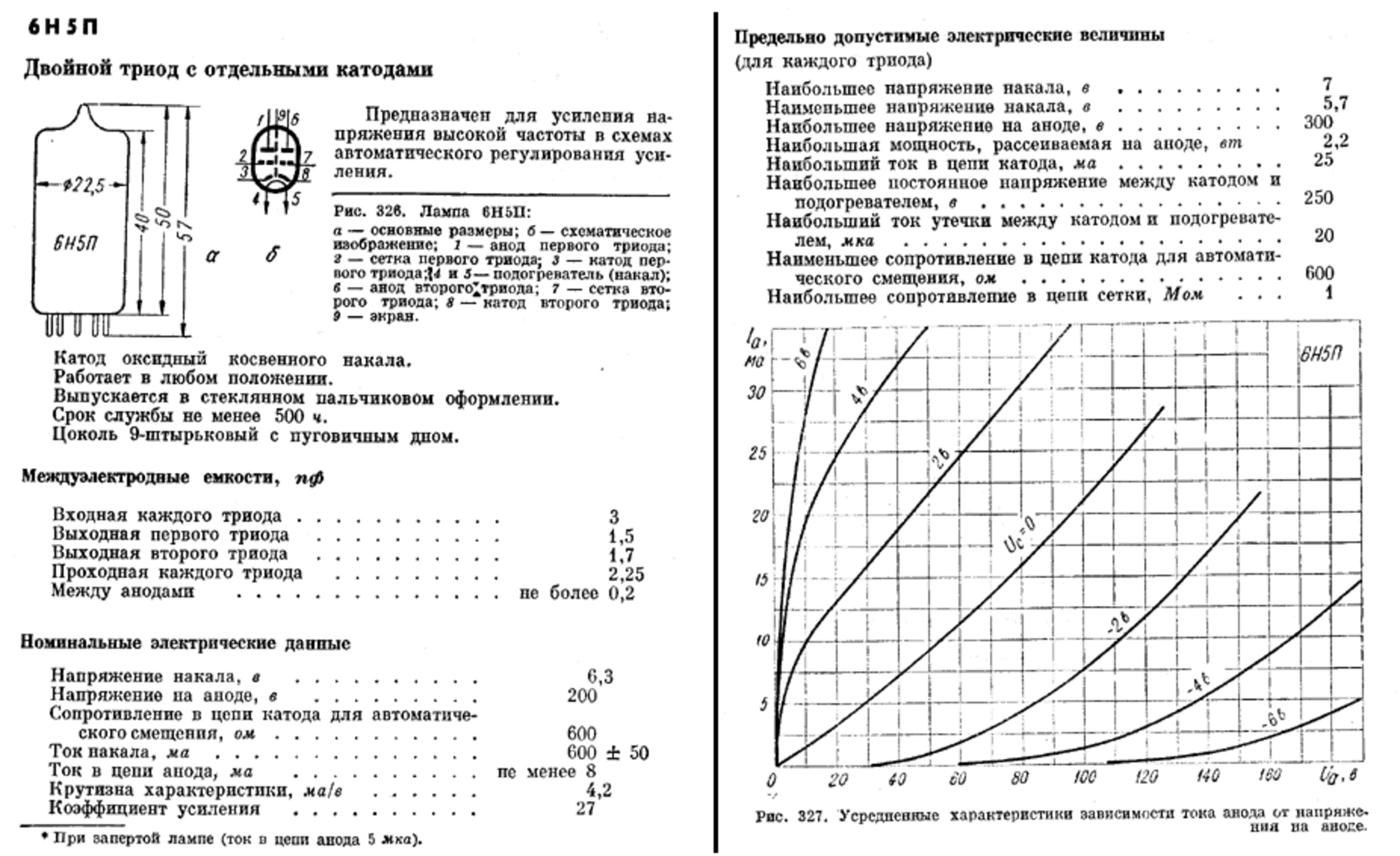
The handbook spread on page 2 calls it a double triode with separate cathodes:

It says the tube is intended for amplifying high-frequency voltage in automatic gain control circuits:

Page 1 is a handbook card and page 2 a two-page handbook spread with the outline drawing, ratings and curves. They give their main figures at different plate voltages: 220 V on page 1, 200 V on page 2.
Both documents draw the same pin arrangement: two triodes side by side, a heater on pins 4 and 5, and a screen on pin 9, drawn as a dashed line between the triodes.
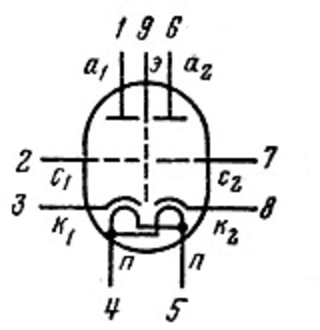

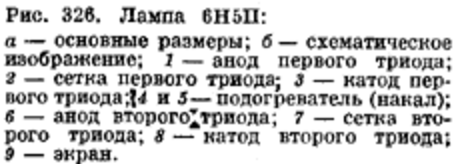
| Pin | Electrode | In the handbook (page 2) | Letter on page 1 |
|---|---|---|---|
| 1 | Plate, first triode | анод первого триода | а1 |
| 2 | Grid, first triode | сетка первого триода | с1 |
| 3 | Cathode, first triode | катод первого триода | к1 |
| 4 | Heater | подогреватель (накал) | п |
| 5 | Heater | подогреватель (накал) | п |
| 6 | Plate, second triode | анод второго триода | а2 |
| 7 | Grid, second triode | сетка второго триода | с2 |
| 8 | Cathode, second triode | катод второго триода | к2 |
| 9 | Screen | экран | э |
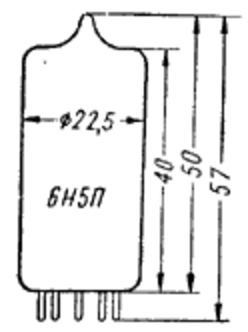
The outline gives a diameter of 22.5 and three heights, 40, 50 and 57; the drawing prints no unit. The 57 line runs from the top of the bulb tip to the ends of the pins, the 50 line from the tip to the bottom of the bulb, and the 40 line from the bottom of the bulb to the shoulder below the tip.
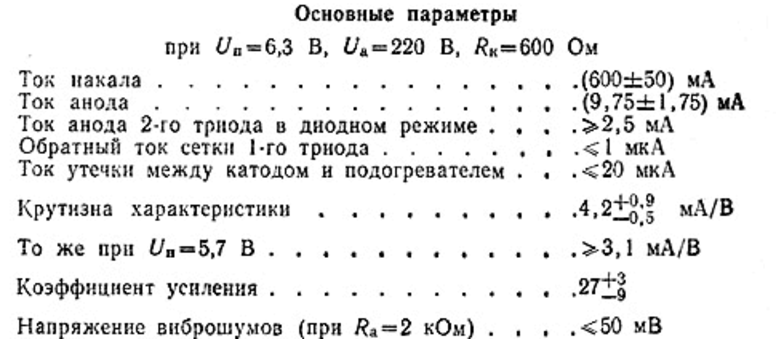
| Page 1, main parameters | |
|---|---|
| Heater current | 600 ± 50 mA |
| Plate current | 9.75 ± 1.75 mA |
| Plate current of the second triode in diode mode (в диодном режиме) | ≥ 2.5 mA |
| Reverse grid current of the first triode | ≤ 1 µA |
| Leakage current between cathode and heater | ≤ 20 µA |
| Transconductance | 4.2 +0.9/−0.5 mA/V |
| Same, at 5.7 V on the heater | ≥ 3.1 mA/V |
| Amplification factor | 27 +3/−9 |
| Vibration noise voltage (напряжение виброшумов), Rа = 2 kΩ | ≤ 50 mV |

| Page 1, interelectrode capacitances | |
|---|---|
| Input | 3 +0.8 pF |
| Output, first triode | 1.5 +0.5 pF |
| Output, second triode | 1.7 +0.4 pF |
| Transfer (проходная) | 2.25 +0.35 pF |
| Between the plates of the triodes | ≤ 0.2 pF |
| Cathode to heater | ≤ 4.0 pF |
The first four have only a plus tolerance printed. Operating time (наработка) is at least 2,000 hours.
Evaluation criteria (критерии оценки): reverse grid current 1.5 µA or less, transconductance at least 3.4 mA/V, plate current of the second triode in diode mode at least 2.1 mA.
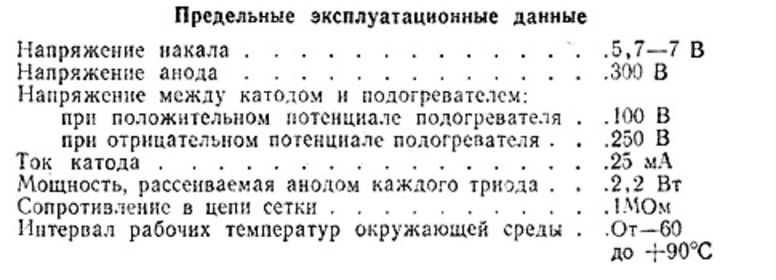
| Page 1, limiting operating data | |
|---|---|
| Heater voltage | 5.7–7 V |
| Plate voltage | 300 V |
| Cathode-heater voltage, heater positive | 100 V |
| Cathode-heater voltage, heater negative | 250 V |
| Cathode current | 25 mA |
| Power dissipated at the plate of each triode | 2.2 W |
| Grid circuit resistance | 1 MΩ |
| Ambient operating temperature | −60 to +90 °C |
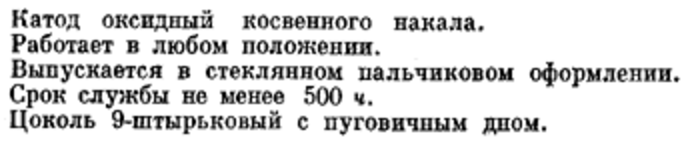
The cathode is an oxide cathode, indirectly heated (катод оксидный косвенного накала). The tube works in any position and is made in a glass miniature (пальчиковом) design. Service life (срок службы) is at least 500 hours. The base has 9 pins and a button bottom (с пуговичным дном).
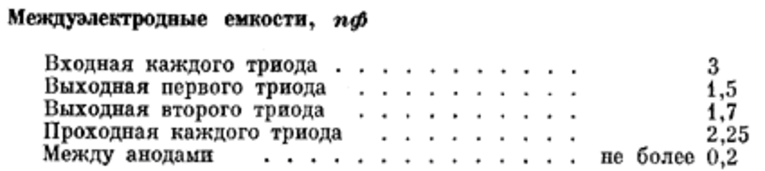
| Page 2, interelectrode capacitances, pF | |
|---|---|
| Input, each triode | 3 |
| Output, first triode | 1.5 |
| Output, second triode | 1.7 |
| Transfer, each triode | 2.25 |
| Between the plates | ≤ 0.2 |

| Page 2, nominal electrical data | |
|---|---|
| Heater voltage | 6.3 V |
| Plate voltage | 200 V |
| Cathode circuit resistance for automatic bias | 600 Ω |
| Heater current | 600 ± 50 mA |
| Plate circuit current | ≥ 8 mA |
| Transconductance | 4.2 mA/V |
| Amplification factor | 27 |
The footnote under the table, marked with an asterisk, reads «При запертой лампе (ток в цепи анода 5 мка)»: with the tube cut off (plate circuit current 5 µA). The spread doesn’t show which value the asterisk belongs to.
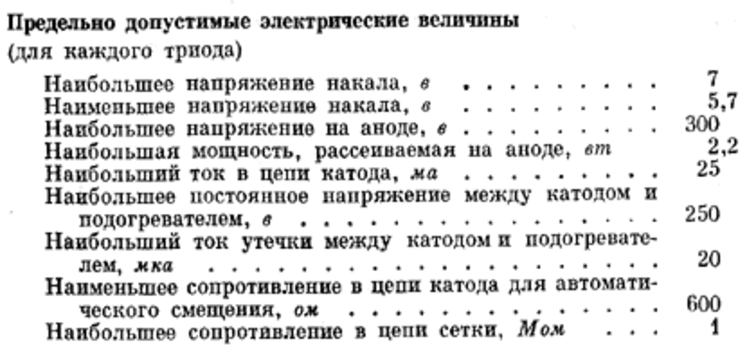
| Page 2, maximum permissible values, each triode | |
|---|---|
| Highest heater voltage | 7 V |
| Lowest heater voltage | 5.7 V |
| Highest plate voltage | 300 V |
| Highest power dissipated at the plate | 2.2 W |
| Highest current in the cathode circuit | 25 mA |
| Highest DC voltage between cathode and heater | 250 V |
| Highest leakage current between cathode and heater | 20 µA |
| Lowest cathode circuit resistance for automatic bias | 600 Ω |
| Highest grid circuit resistance | 1 MΩ |
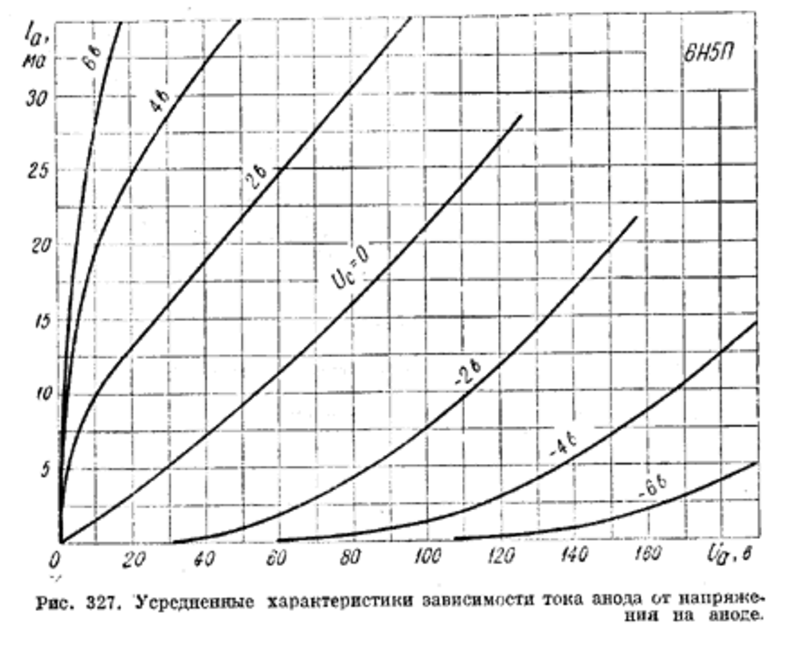
Page 2 has one set of curves: plate current (Iа, mA) against plate voltage (Uа, V), one curve per grid voltage. The curves are labelled 6, 4 and 2 V, Uс = 0, and −2, −4 and −6 V; the positive values are printed without a plus sign. The curves for 0 V and above start at the origin of the graph. The negative ones start further along the plate-voltage axis, the more negative the grid, the further. The higher the grid voltage, the further to the left the curve lies. The 6, 4 and 2 V curves rise steeply from the origin and then bend over; the 0 V curve and the negative ones curve upward.
Related products
Resources
Documentation
Browse our complete library of technical specifications and documentation.
Browse DatasheetsProducts
Explore our full inventory of vintage tubes, nixies, and capacitors.
View ProductsQuestions?
Need help finding the right part or datasheet? We're here to help.
Get in Touch