

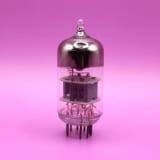

Voskhod / 6N2P
8x NOS 6N2P Same Date IV-80 Voskhod Double Triode New ~12AX7 ~ECC83 ~6CC41
Same-date NOS Voskhod double triodes from IV-80 production, selected for vintage audio and amplifier applications
$26.0010 in stock

The 6N2P is a double triode with separate cathodes.
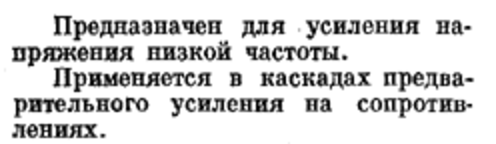
The handbook says it is intended for low-frequency voltage amplification and is used in resistance-coupled preamplifier stages (каскады предварительного усиления на сопротивлениях).
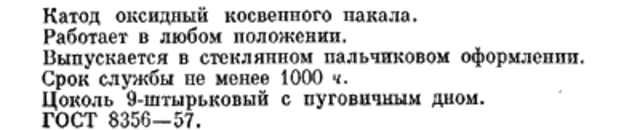
It has an oxide cathode, indirectly heated, and works in any position. It comes in a glass miniature envelope (стеклянное пальчиковое оформление). The service life is at least 1,000 hours. The base has 9 pins and a button bottom (пуговичное дно). The last line gives the standard, ГОСТ 8356—57.
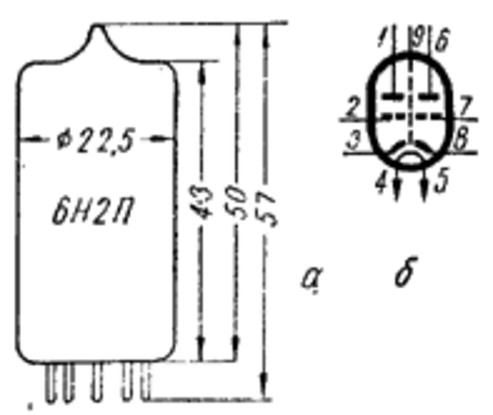
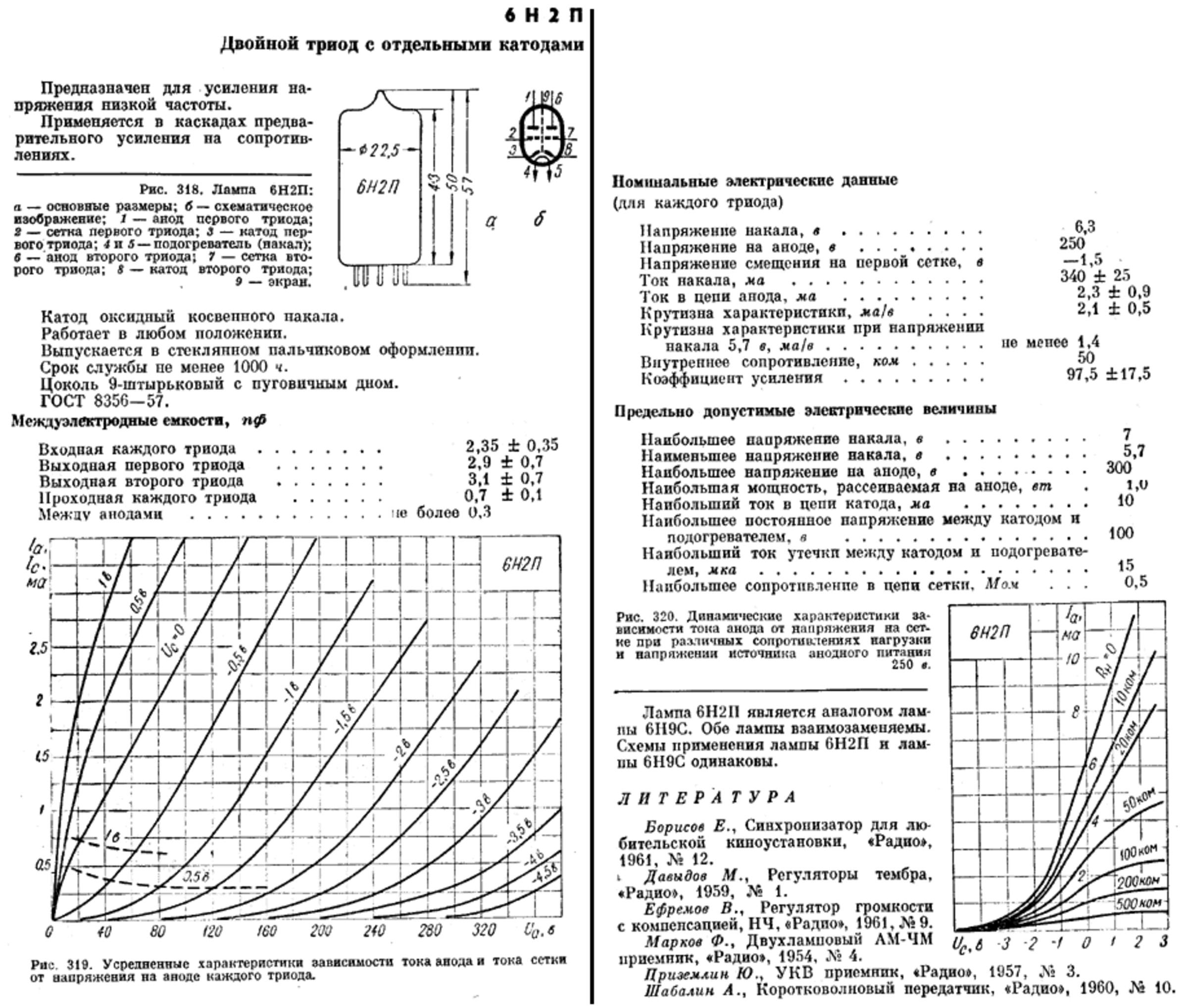
The outline prints a diameter of 22.5 (printed ф22,5) and three heights: 43 from the bottom of the glass to the shoulder, 50 from the bottom of the glass to the tip, and 57 from the tip to the ends of the pins. The drawing prints no unit.
In the symbol, pins 1, 2 and 3 are on the left half and pins 6, 7 and 8 on the right half. Pins 4 and 5 come out at the bottom, and pin 9 joins a dashed line drawn down the middle, between the two halves.

The caption names each pin:
| Pin | Electrode | In the handbook |
|---|---|---|
| 1 | Plate, first triode | Анод первого триода |
| 2 | Grid, first triode | Сетка первого триода |
| 3 | Cathode, first triode | Катод первого триода |
| 4 | Heater | Подогреватель (накал) |
| 5 | Heater | Подогреватель (накал) |
| 6 | Plate, second triode | Анод второго триода |
| 7 | Grid, second triode | Сетка второго триода |
| 8 | Cathode, second triode | Катод второго триода |
| 9 | Screen | Экран |
The caption gives pins 4 and 5 together in one entry: «4 и 5 — подогреватель (накал)», heater.
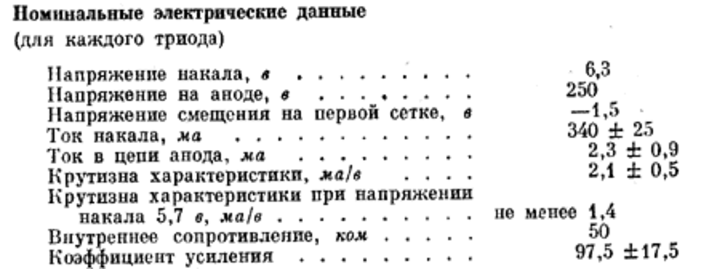
| Nominal electrical data, for each triode | |
|---|---|
| Heater voltage | 6.3 V |
| Plate voltage | 250 V |
| Bias voltage on the first grid | −1.5 V |
| Heater current | 340 ± 25 mA |
| Current in the plate circuit | 2.3 ± 0.9 mA |
| Transconductance (крутизна характеристики) | 2.1 ± 0.5 mA/V |
| Transconductance at 5.7 V heater voltage | ≥ 1.4 mA/V |
| Internal resistance | 50 kΩ |
| Amplification factor | 97.5 ± 17.5 |
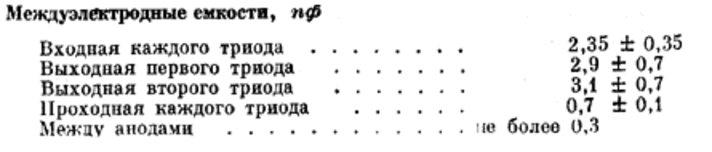
| Capacitance | pF |
|---|---|
| Input, each triode | 2.35 ± 0.35 |
| Output, first triode | 2.9 ± 0.7 |
| Output, second triode | 3.1 ± 0.7 |
| Transfer (проходная), each triode | 0.7 ± 0.1 |
| Between the plates | ≤ 0.3 |
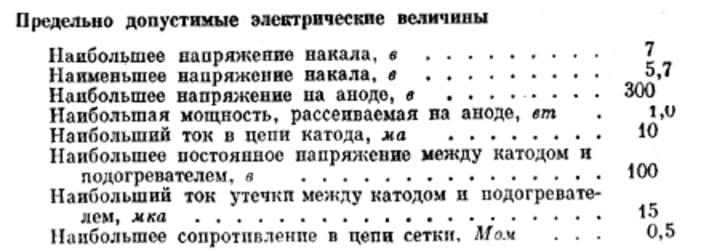
| Limiting permissible values | |
|---|---|
| Highest heater voltage | 7 V |
| Lowest heater voltage | 5.7 V |
| Highest plate voltage | 300 V |
| Highest power dissipated at the plate | 1.0 W |
| Highest current in the cathode circuit | 10 mA |
| Highest DC voltage between cathode and heater | 100 V |
| Highest leakage current between cathode and heater | 15 µA |
| Highest resistance in the grid circuit | 0.5 MΩ |
The page has two sets of curves.

The vertical axis is Ia, Ic in mA, numbered from 0.5 to 2.5. The horizontal axis is Ua in V, from 0 to 320. The solid curves are labelled by grid voltage: 1 V and 0.5 V (printed without a sign), Uc = 0, then −0.5, −1, −1.5, −2, −2.5, −3, −3.5, −4 and −4.5 V. The curves for 1 V, 0.5 V, 0 and −0.5 V start at the origin; from −1 V on, the more negative the grid voltage, the further right its curve starts. Two dashed curves at the lower left are labelled 1 V and 0.5 V. The figure does not mark which lines show plate current and which show grid current.
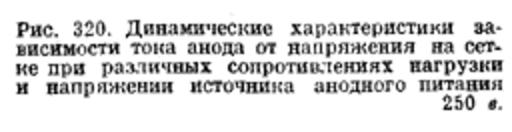
Fig. 320 shows dynamic characteristics: plate current against grid voltage, at different load resistances and a plate supply voltage of 250 V.
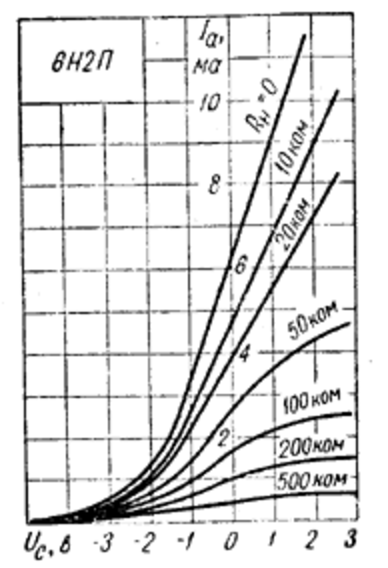
The vertical axis is Ia in mA, numbered from 2 to 10. The horizontal axis is Uc in V, numbered −3, −2, −1, 0, 1, 2, 3; the positive values are printed without a sign. The curves are labelled Rн = 0, 10, 20, 50, 100, 200 and 500 kΩ (ком). The larger the load, the flatter the curve.

The page says the 6N2P is an analogue of the 6N9S, that both tubes are interchangeable, and that the application circuits for the 6N2P and the 6N9S are the same.
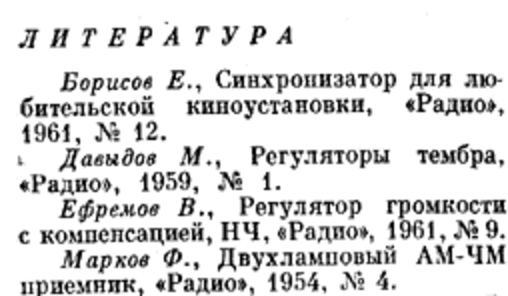

All six are in «Радио» (Radio):
Related products
Resources
Documentation
Browse our complete library of technical specifications and documentation.
Browse DatasheetsProducts
Explore our full inventory of vintage tubes, nixies, and capacitors.
View ProductsQuestions?
Need help finding the right part or datasheet? We're here to help.
Get in Touch