

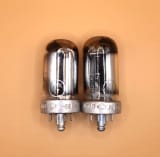

Svetlana / 4P1L
2x NOS 4P1L 4П1Л / 4L1S / 4LS1 / RL2 / 4P6 Matched Pair Svetlana Pentode Tested
Svetlana matched pair tested on L3-3, 50s-80s production, equiv. to 4L1S/4LS1/RL2/4P6
$15.997 in stock
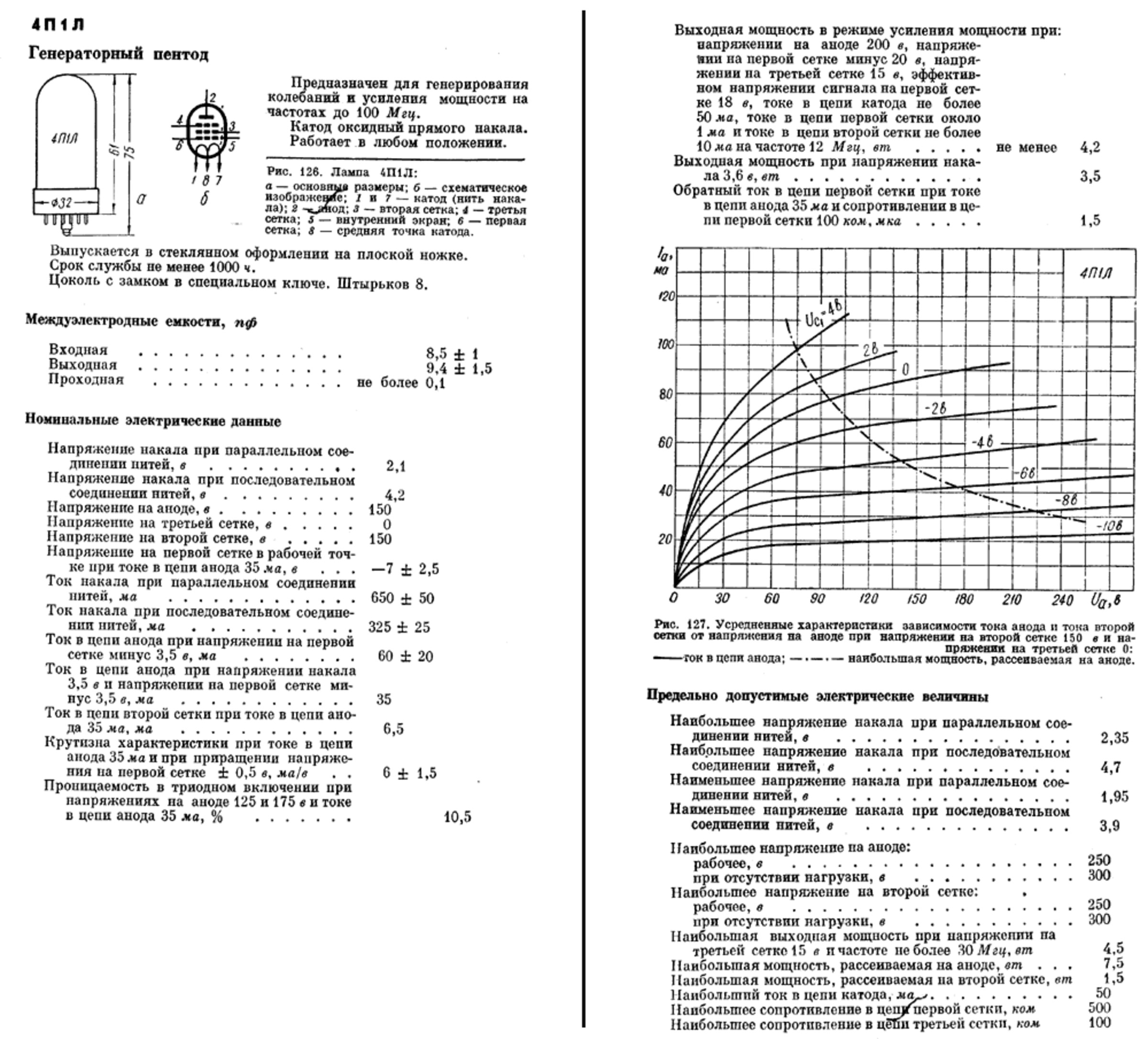
The 4P1L is a generator pentode (генераторный пентод).

It is intended for generating oscillations and for power amplification at frequencies up to 100 MHz (Мгц). It has an oxide cathode, directly heated (прямого накала), and works in any position.

It is made in a glass envelope on a flat stem (на плоской ножке). The service life is at least 1,000 hours (ч). The base has a lock in a special key (с замком в специальном ключе), and there are 8 pins (штырьков).
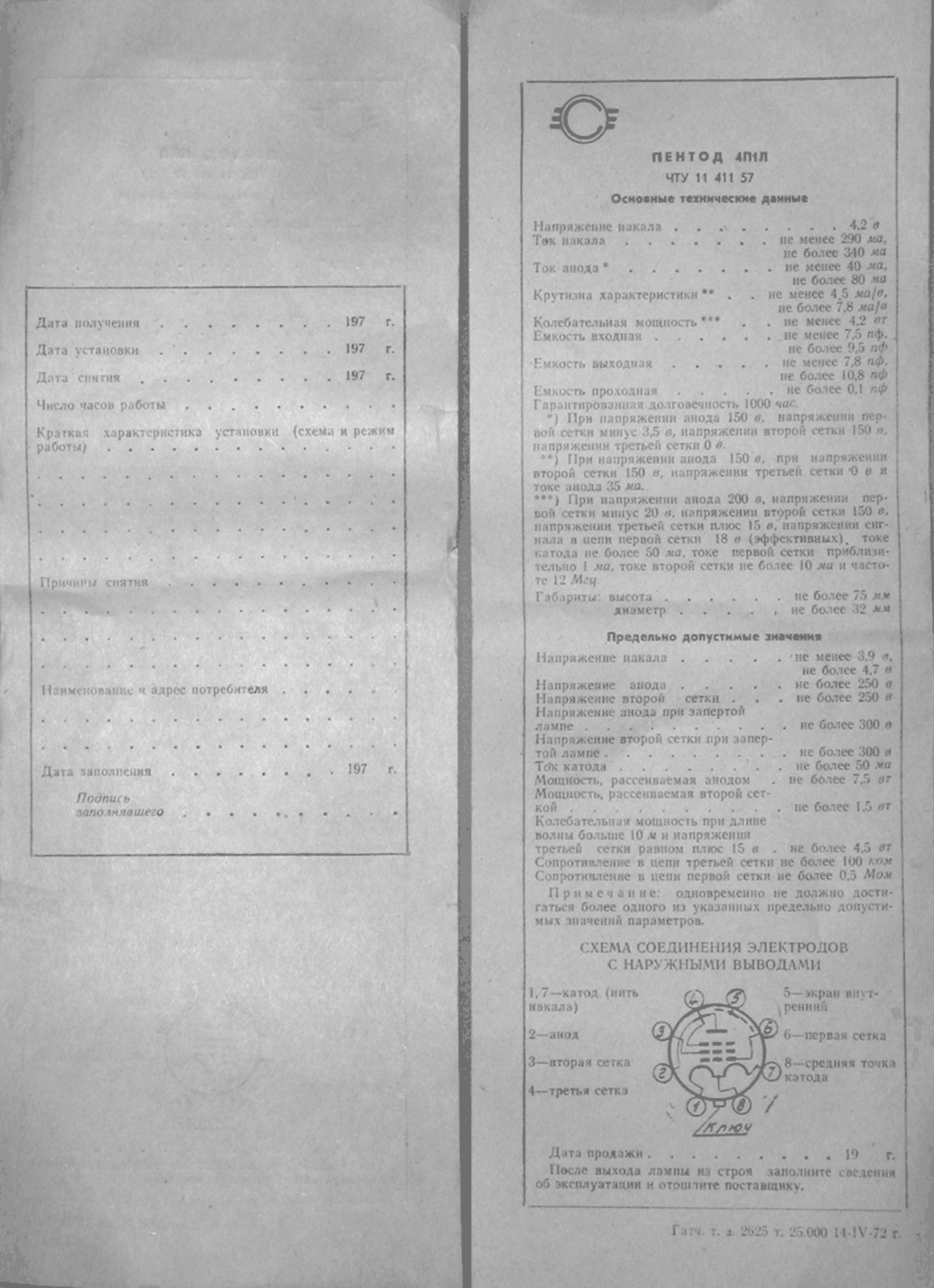
Page 1 is a handbook entry and page 2 a factory leaflet.
The leaflet is headed «Пентод 4П1Л» (pentode 4P1L), with ЧТУ 11 411 57 below the title and a round mark at the top left.

Lead 2 at the top goes to the plate, drawn as a bar. Three grids are drawn as dashed rows below it: lead 4 on the left goes to the row nearest the plate, lead 3 on the right to the middle row, and lead 6 on the left to the lowest row. Lead 5 on the right ends at a dot on a faint dashed line that runs down the inside of the envelope on the right. The filament is drawn as two loops at the bottom. Three lines with arrowheads go down from it: 1 from the left end, 8 from the middle and 7 from the right end.
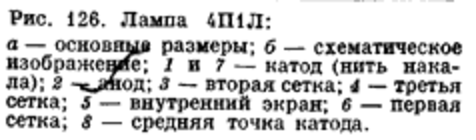
The caption names each lead:
| Lead | Electrode | In the handbook |
|---|---|---|
| 1 | Cathode (filament) | Катод (нить накала) |
| 2 | Plate | Анод |
| 3 | Second grid | Вторая сетка |
| 4 | Third grid | Третья сетка |
| 5 | Internal screen | Внутренний экран |
| 6 | First grid | Первая сетка |
| 7 | Cathode (filament) | Катод (нить накала) |
| 8 | Midpoint of the cathode | Средняя точка катода |
The caption gives leads 1 and 7 in one entry: «1 и 7 — катод (нить накала)». A curved stroke crosses three lines of the caption and covers the first letter of «анод» after the 2.
| Lead | Electrode | On the leaflet |
|---|---|---|
| 1 | Cathode (filament) | Катод (нить накала) |
| 2 | Plate | Анод |
| 3 | Second grid | Вторая сетка |
| 4 | Third grid | Третья сетка |
| 5 | Internal screen | Экран внутренний |
| 6 | First grid | Первая сетка |
| 7 | Cathode (filament) | Катод (нить накала) |
| 8 | Midpoint of the cathode | Средняя точка катода |
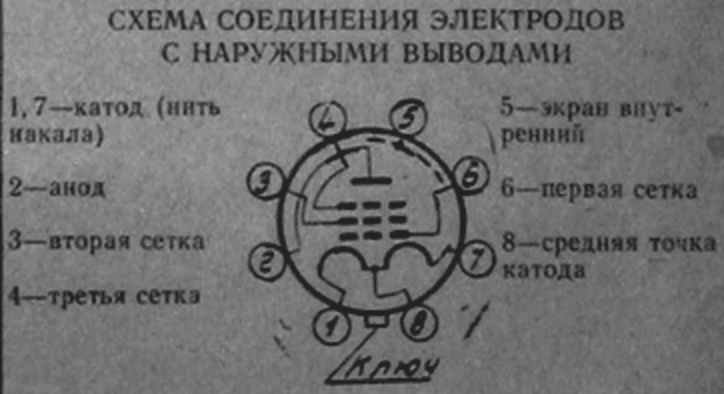
The leaflet also gives 1 and 7 in one entry, «1, 7 — катод (нить накала)». Both legends give the same electrode for every lead.
In the drawing, eight numbered circles sit around a larger circle: 4 and 5 at the top, 3 and 6 at the upper left and right, 2 and 7 at the lower left and right, and 1 and 8 at the bottom. Between 1 and 8, a small rectangle sits on the rim, and a line runs from it to the word «Ключ» (key) below.
Inside, lead 3 goes to the middle of three dashed grid rows and lead 6 to the lowest row. A short line from lead 4 crosses the plate’s line and joins an arc that ends at the top row. The plate, a bar at the top, has a line that runs along the left inside of the rim and ends at lead 2. A dashed arc runs inside the rim on the upper right, and lead 5 meets it. The filament is drawn as two loops: the left end goes to 1, the right end to 7, and a line from the middle runs to 8.
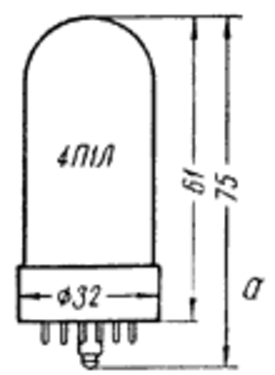
The outline prints a diameter of 32 (printed ф32) across the band at the bottom of the body, and two heights. 61 runs from the top of the bulb to the bottom of that band. 75 runs from the top of the bulb to the lower end of the post in the middle of the base. Short pins are drawn below the band, with the longer post among them. The type, 4П1Л, is lettered on the bulb. The drawing prints no unit.

| Interelectrode capacitance | pF |
|---|---|
| Input (входная) | 8.5 ± 1 |
| Output (выходная) | 9.4 ± 1.5 |
| Transfer (проходная) | ≤ 0.1 |
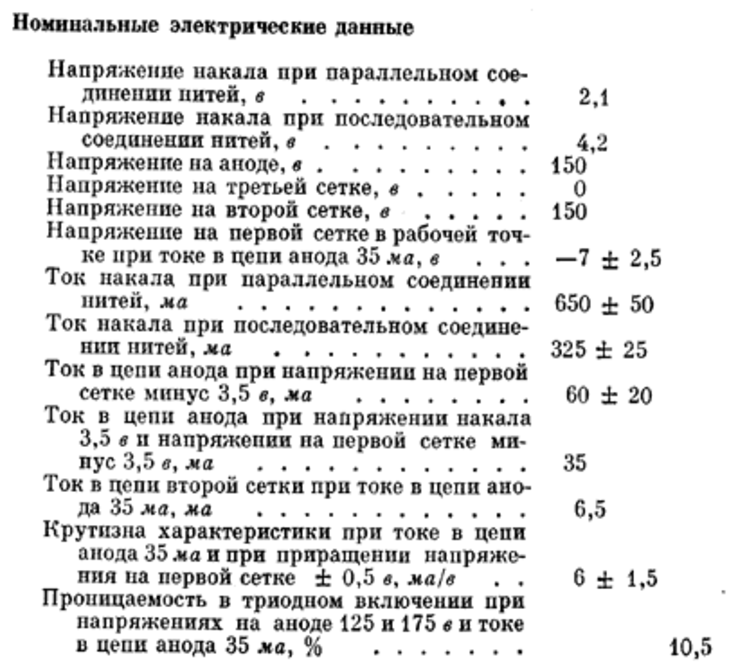
| Nominal electrical data | |
|---|---|
| Filament voltage (напряжение накала), filaments connected in parallel | 2.1 V |
| Filament voltage, filaments connected in series | 4.2 V |
| Plate voltage | 150 V |
| Voltage on the third grid | 0 V |
| Voltage on the second grid | 150 V |
| Voltage on the first grid at the operating point (в рабочей точке), at a plate-circuit current of 35 mA | −7 ± 2.5 V |
| Filament current, filaments in parallel | 650 ± 50 mA |
| Filament current, filaments in series | 325 ± 25 mA |
| Current in the plate circuit at minus 3.5 V on the first grid | 60 ± 20 mA |
| Current in the plate circuit at a filament voltage of 3.5 V and minus 3.5 V on the first grid | 35 mA |
| Current in the second-grid circuit at a plate-circuit current of 35 mA | 6.5 mA |
| Transconductance (крутизна характеристики) at a plate-circuit current of 35 mA and a change (приращение) of ± 0.5 V on the first grid | 6 ± 1.5 mA/V |
| Penetration (проницаемость) in triode connection (в триодном включении), at plate voltages of 125 and 175 V and a plate-circuit current of 35 mA | 10.5 % |

| Nominal electrical data, continued | |
|---|---|
| Output power in power-amplification mode (в режиме усиления мощности), at 200 V on the plate, minus 20 V on the first grid, 15 V on the third grid, an effective (эффективном) signal voltage of 18 V on the first grid, a cathode-circuit current of at most 50 mA, a first-grid-circuit current of about (около) 1 mA and a second-grid-circuit current of at most 10 mA, at a frequency of 12 MHz | ≥ 4.2 W |
| Output power at a filament voltage of 3.6 V | 3.5 W |
| Reverse current (обратный ток) in the first-grid circuit, at a plate-circuit current of 35 mA and 100 kΩ in the first-grid circuit | 1.5 µA |

| Limiting permissible values | |
|---|---|
| Highest filament voltage, filaments in parallel | 2.35 V |
| Highest filament voltage, filaments in series | 4.7 V |
| Lowest filament voltage, filaments in parallel | 1.95 V |
| Lowest filament voltage, filaments in series | 3.9 V |
| Highest plate voltage, working (рабочее) | 250 V |
| Highest plate voltage, with no load (при отсутствии нагрузки) | 300 V |
| Highest voltage on the second grid, working | 250 V |
| Highest voltage on the second grid, with no load | 300 V |
| Highest output power at 15 V on the third grid and a frequency of at most 30 MHz | 4.5 W |
| Highest power dissipated at the plate | 7.5 W |
| Highest power dissipated at the second grid | 1.5 W |
| Highest current in the cathode circuit | 50 mA |
| Highest resistance in the first-grid circuit | 500 kΩ |
| Highest resistance in the third-grid circuit | 100 kΩ |
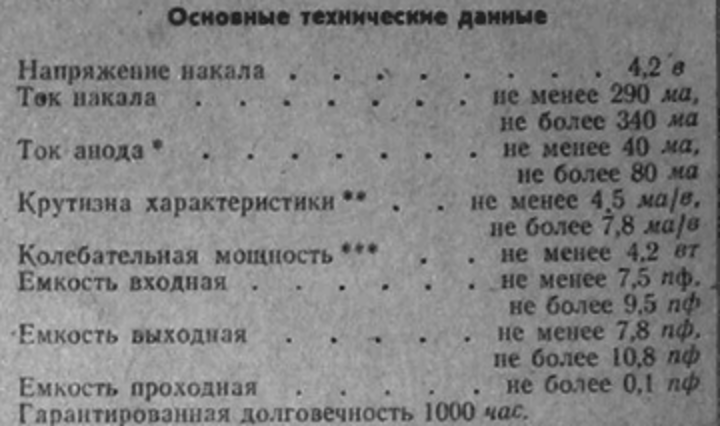
| Main technical data | |
|---|---|
| Filament voltage (напряжение накала) | 4.2 V |
| Filament current | ≥ 290 mA, ≤ 340 mA |
| Plate current (ток анода)* | ≥ 40 mA, ≤ 80 mA |
| Transconductance (крутизна характеристики)** | ≥ 4.5 mA/V, ≤ 7.8 mA/V |
| Oscillation power (колебательная мощность)*** | ≥ 4.2 W |
| Input capacitance | ≥ 7.5 pF, ≤ 9.5 pF |
| Output capacitance | ≥ 7.8 pF, ≤ 10.8 pF |
| Transfer capacitance (проходная) | ≤ 0.1 pF |
| Guaranteed durability (гарантированная долговечность) | 1,000 h (час.) |
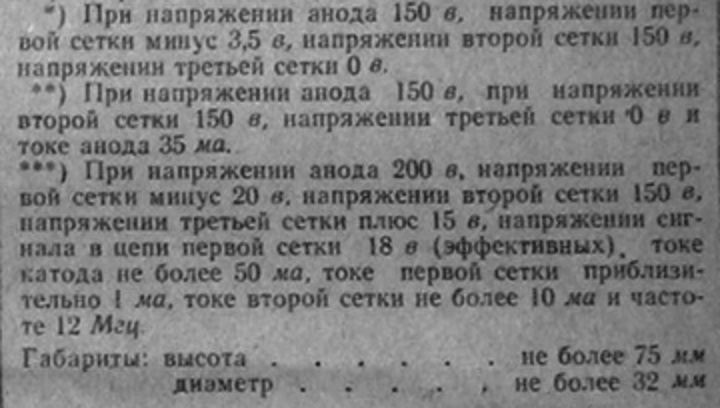
* At 150 V on the plate, minus 3.5 V on the first grid, 150 V on the second grid and 0 V on the third grid.
** At 150 V on the plate, 150 V on the second grid, 0 V on the third grid and a plate current of 35 mA.
*** At 200 V on the plate, minus 20 V on the first grid, 150 V on the second grid, plus 15 V on the third grid, a signal voltage of 18 V (effective, эффективных) in the first-grid circuit, a cathode current of at most 50 mA, a first-grid current of approximately (приблизительно) 1 mA, a second-grid current of at most 10 mA and a frequency of 12 MHz.
| Overall dimensions (габариты) | |
|---|---|
| Height (высота) | ≤ 75 mm |
| Diameter (диаметр) | ≤ 32 mm |
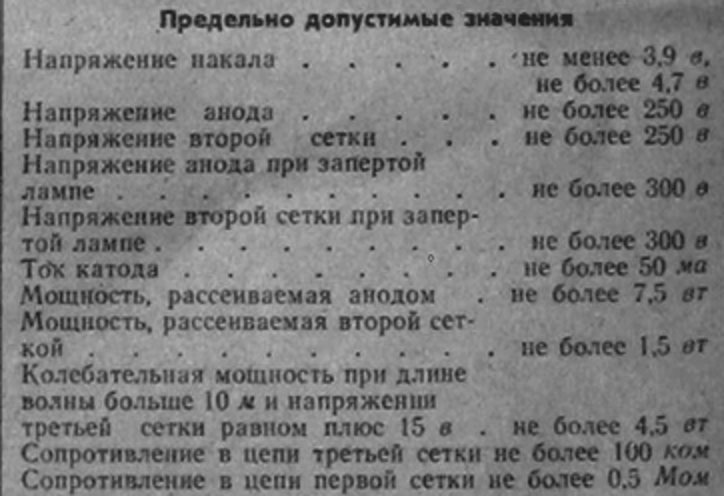
| Limiting permissible values | |
|---|---|
| Filament voltage | ≥ 3.9 V, ≤ 4.7 V |
| Plate voltage | ≤ 250 V |
| Second-grid voltage | ≤ 250 V |
| Plate voltage with the tube cut off (при запертой лампе) | ≤ 300 V |
| Second-grid voltage with the tube cut off | ≤ 300 V |
| Cathode current | ≤ 50 mA |
| Power dissipated by the plate | ≤ 7.5 W |
| Power dissipated by the second grid | ≤ 1.5 W |
| Oscillation power at a wavelength over 10 m (м) and plus 15 V on the third grid | ≤ 4.5 W |
| Resistance in the third-grid circuit | ≤ 100 kΩ |
| Resistance in the first-grid circuit | ≤ 0.5 MΩ |
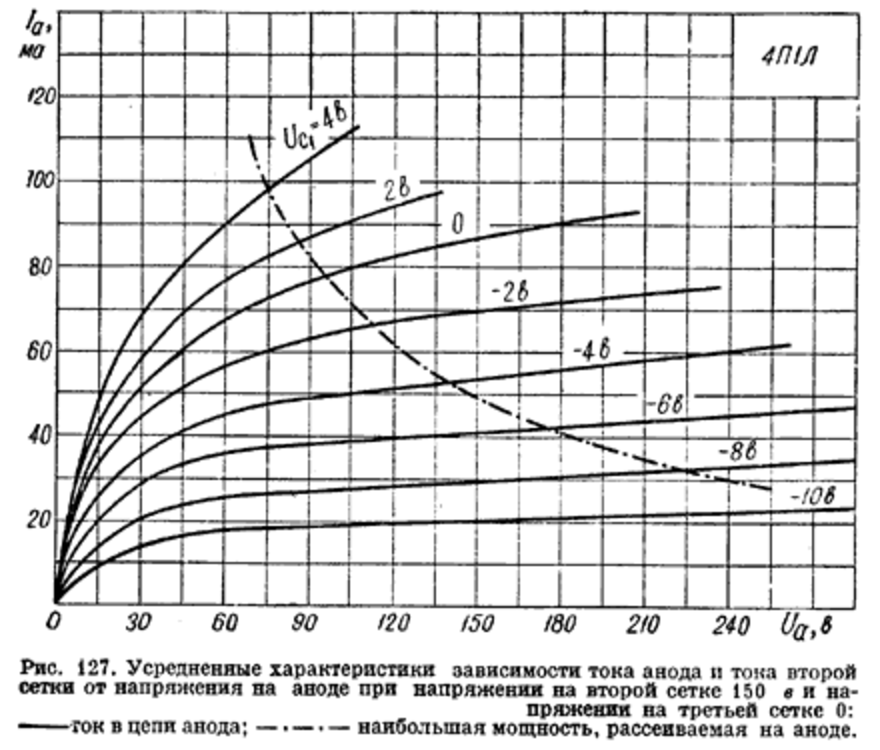
The vertical axis is Ia in mA (ма), numbered 20, 40, 60, 80, 100 and 120. The horizontal axis is Ua in V, numbered 0, 30, 60, 90, 120, 150, 180, 210 and 240. The type, 4П1Л, is lettered in a box in the top right corner. The key under the caption says the solid lines are the current in the plate circuit and the dash-dot line is the highest power dissipated at the plate.
The eight solid curves are labelled by first-grid voltage, from the top: Uc1 = 4 V, then 2 V, 0, −2, −4, −6, −8 and −10 V. All the solid curves start at the origin. Each rises steeply and then bends, climbing slowly to the right. Away from the origin they don’t cross: the more negative the grid voltage, the lower the curve. The 4 V, 2 V, 0, −2 V and −4 V curves stop short of the right edge, the higher ones further left; the −6 V, −8 V and −10 V curves run to the right edge.
The dash-dot line starts near the top of the graph, between 60 and 90 on the Ua scale and above 100 mA. It falls steeply at first and then more gently, crossing every solid curve from 4 V down to −8 V. It ends a little past 240, between the −8 V and −10 V curves.

Note (примечание): more than one of the listed limiting permissible parameter values must not be reached at the same time.
Below the pin drawing come a line for the date of sale (дата продажи), ending in «19 г.», and an instruction: after the tube fails (после выхода лампы из строя), fill in the operating details and send them to the supplier (поставщику). Below the frame, one line is printed: «Гатч. т. з. 2625 т. 25.000 14-IV-72 г.»
The left half of the leaflet is a blank form that starts with lines for the date received, installed and removed (each ending in «197 г.»), the number of hours of work, and a short description of the equipment, its circuit and operating mode (схема и режим работы).
Related products
Resources
Documentation
Browse our complete library of technical specifications and documentation.
Browse DatasheetsProducts
Explore our full inventory of vintage tubes, nixies, and capacitors.
View ProductsQuestions?
Need help finding the right part or datasheet? We're here to help.
Get in Touch